




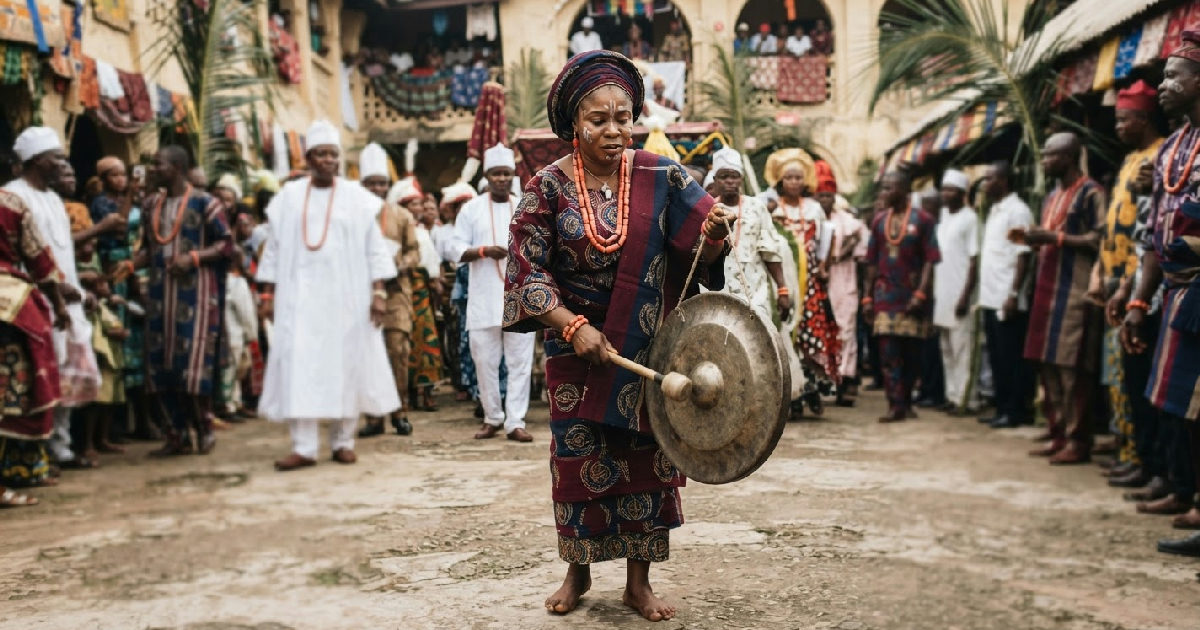
The first echo of the agogo gong cuts through the humid air of Owo, Ondo State, signalling the start of the Igogo Festival of Owo, a profound annual journey. This isn’t just a festival; it’s a living chronicle, a moment when the distant past of the Owo kingdom steps into the present.
At its heart is the enduring memory of Queen Oronsen, a figure whose spiritual power still shapes the rhythms of life and remembrance in this ancient Yoruba town.
The Igogo Festival of Owo’s mythic queen
For generations, the Igogo Festival of Owo has unfolded, transforming the town into a vibrant stage where history is performed, not merely recounted. It’s a vivid demonstration of how a community carries its heritage, not through dusty tomes, but through the sound of metal gongs, the symbolism of ceremonial dress, and the collective heartbeat of its people.
At the very core of Igogo lies the legend of Oronsen, a woman immortalised in Owo oral tradition as exceptionally beautiful and imbued with potent spiritual power. She became a cherished wife of Olowo Rerengejen, a ruler believed to have reigned over 600 years ago, bringing immense prosperity to the Owo Kingdom.
Her extraordinary nature, however, came with specific injunctions, particular acts that were strictly forbidden in her presence. These included seemingly mundane domestic actions such as throwing down firewood, splashing water, or crushing okra on a grinding stone. These prohibitions were fundamental to her mystical essence and status as an orisha.
But the story takes a turn, as jealousy reportedly festered among the other palace wives. They discovered Oronsen’s strict taboos and, in a calculated move, deliberately violated them while the king was away. This profound act of disrespect ultimately triggered a pivotal event in Owo’s foundational narrative.
Oronsen, feeling betrayed, fled the palace. Palace servants pursued her towards a location known as Ugbo Ulaja, desperate to bring her back. Yet, she vanished there, leaving behind only her head tie and clear instructions that she should be visited and appeased annually to ensure the kingdom’s protection.
Ugbo Ulaja and the sacred landscape
The memory of Oronsen’s departure continues to anchor many of Igogo’s most sacred ceremonies. Ugbo Ulaja remains a significant landmark in Owo’s remembered geography. The annual procession towards this site physically links the royal palace with the very landscape where Oronsen made her mystical exit.
This annual journey reinforces the idea that history isn’t just a narrative; it’s a tangible part of the environment, a path walked and re-experienced by each succeeding generation. It creates a living map of Owo’s founding myths and beliefs, making the past immediately present.
The echo of the agogo: silence of drums, rhythm of remembrance
The origins of the Igogo Festival intertwine closely with older yam season celebrations, a time of communal festivity. However, a profound shift occurred following Oronsen's disappearance, forever changing the festival's soundscape.
Olowo Rerengejen, consumed by grief and respect for his departed queen, prohibited the use of drums, which were typically central to such festivities. In their place, metal gongs, known as agogo, became the characteristic instruments for all ceremonies associated with Oronsen’s remembrance. This unique sound gives the festival its name, "Igogo."
This choice isn't merely a musical substitution; it imbues the festival with a distinct ritual language. The deliberate absence of conventional drumming during Igogo marks it as a sacred period, setting it apart from ordinary social celebrations and creating a unique auditory landscape for remembrance.
A 2012 study on Owo tourism highlighted the festival's traditional seventeen-day duration and the prominent use of these gongs, a feature that remains constant today. It also noted Igogo's deep association with the blessing and release of new yams, connecting spiritual remembrance directly to the agricultural cycle vital for the community's sustenance and prosperity.
This blending of spiritual and agricultural elements is a common thread in many traditional communal celebrations across Nigeria.
Yeye Olorisa: women as keepers of sacred power
Among the most compelling figures within the Igogo Festival are the Yeye Olorisa, powerful female religious figures whose ceremonial presence illuminates the enduring importance of women's sacred authority in Owo. Their roles underscore a unique aspect of Owo's cultural heritage, where women hold significant spiritual leadership.
Art historian Rowland Abiodun meticulously documented these priestesses during the Igogo Festival in the 1970s. His photographs and research provide crucial visual evidence of their participation, showing women whose elaborate appearance conveyed profound religious status and authority within the community.
The adornment of the Yeye Olorisa is carefully curated, featuring elaborate hairstyles, intricate beads, combs, and carefully draped cloth and feathers. These elements are not simply decorative; they are part of a broader Yoruba visual tradition where clothing and bodily presentation communicate office, spiritual power, and social standing, echoing ancient traditions of intricate textile artistry.
Their presence makes the Yeye Olorisa far more than mere participants; they embody a religious structure that makes female sacred power visible and central to Igogo. These women serve as a direct link to Oronsen's spiritual legacy, acting as conduits of ancient wisdom and communal strength for the Owo people.
Monarchs in feminine regalia: the Olowo’s homage
Another striking feature of the Igogo Festival is the unique appearance of the Olowo of Owo and his senior male chiefs. They adopt distinctly feminine regalia, a visual spectacle that sets Igogo apart from many other royal festivals.
Rowland Abiodun's observations from the 1970s describe the Olowo and ranking chiefs adorned with plaited hair, blouses, and large skirts. These elaborate hairstyles and ornaments, traditionally associated with feminine presentation, form a key part of the festival's ceremonial appearance.
This practice has continued into the modern era, with the reigning monarch, Oba Ajibade Gbadegesin Ogunoye III, who ascended the throne in 2019, participating in the same tradition. The Olowo may also wear a special sword, Udamaloore, and peacock feathers, Urere Okin, in his hair, adding to the grandeur.
This isn't merely theatrical cross-dressing. Within Igogo, the clothing forms part of a deep ceremonial acknowledgement of Oronsen and the female sacred authority associated with her memory. It transforms the body of the monarch into a living canvas of Owo's continuing ceremonial tradition, bridging past and present.
Igogo’s evolution: from ritual core to community celebration
While the Igogo Festival has long been described as a seventeen-day event, its contemporary programme has expanded significantly beyond this traditional ritual framework. This evolution reflects a dynamic cultural institution adapting to modern times.
For 2026, the official consolidated timetable commences with the first Upeli procession on August 30. Further Upeli processions are scheduled for September 3 and 7, leading into events like Utegi, Uyanna on September 11, and Ugbate Day on September 14.
Key celebrations involving the Ojomo Oluda of Ijebu Owo, Oba Kofoworola Oladoyinbo Aruliwo III, and quarter chiefs are listed for September 15. The principal celebration involving Oba Ajibade Gbadegesin Ogunoye III, the Olowo of Owo, and the Iloro chiefs, takes place on September 16.
The festival now incorporates a wider public programme that includes football matches, wrestling competitions, traditional games, hairdressing competitions, and even a Miss Oronshen pageant. Women's ceremonies, such as Igogo Olughore involving the Oloris' maidens, also feature on September 17, adding layers to the celebration.
Ogwalopo: A new public dimension
Ogwalopo exemplifies the festival’s expanding public dimension. This community gathering invites indigenes, families, visitors, and various associations to participate in vibrant cultural displays and pay homage to the Olowo. It takes place after the formal conclusion of the core Igogo ceremonies.
Unlike the restricted ritual soundscape of the main Igogo events where drums are forbidden, Ogwalopo embraces percussion and musical performances. This sequencing allows for broader public celebration to exist alongside the more sacred, restricted traditions associated with Oronsen and the central taboos of the ancient traditional practices.
Igogo has not remained static. Like many enduring cultural institutions, it adapts and integrates new elements while steadfastly retaining its recognisable ritual foundations. This ability to evolve ensures its continued relevance for each generation of Owo people, balancing reverence with contemporary engagement.
Ritual memory: how Owo preserves its past
The Igogo Festival demonstrates that communities don't simply preserve their history through written documents or archived records. Some histories endure through repeated movements across sacred spaces, others through songs, ceremonial clothing, revered titles, strict taboos, or objects carefully passed from one generation to the next.
The Igogo Festival of Owo masterfully combines several of these forms. The royal palace embodies continuity, while Ugbo Ulaja preserves the sacred geography of the Oronsen narrative. The distinctive sound of the agogo creates a unique ceremonial soundscape, and the Yeye Olorisa embody traditions of female religious authority.
The Olowo and his chiefs, through their adoption of specific clothing, hairstyles, and dance, publicly maintain the memory of Oronsen and the obligations associated with the festival. Their royal status doesn't exempt them; instead, kingship becomes a primary institution through which this memory is upheld.
Taken together, these elements make Igogo a powerful example of history carried through performance and communal remembrance. The festival allows contemporary participants a way of actively entering a historical narrative that remains central to the identity of the Owo kingdom, connecting them to a past that feels very much alive.
How much more do such traditions shape who Nigerians are today, often without us even realising it?
