




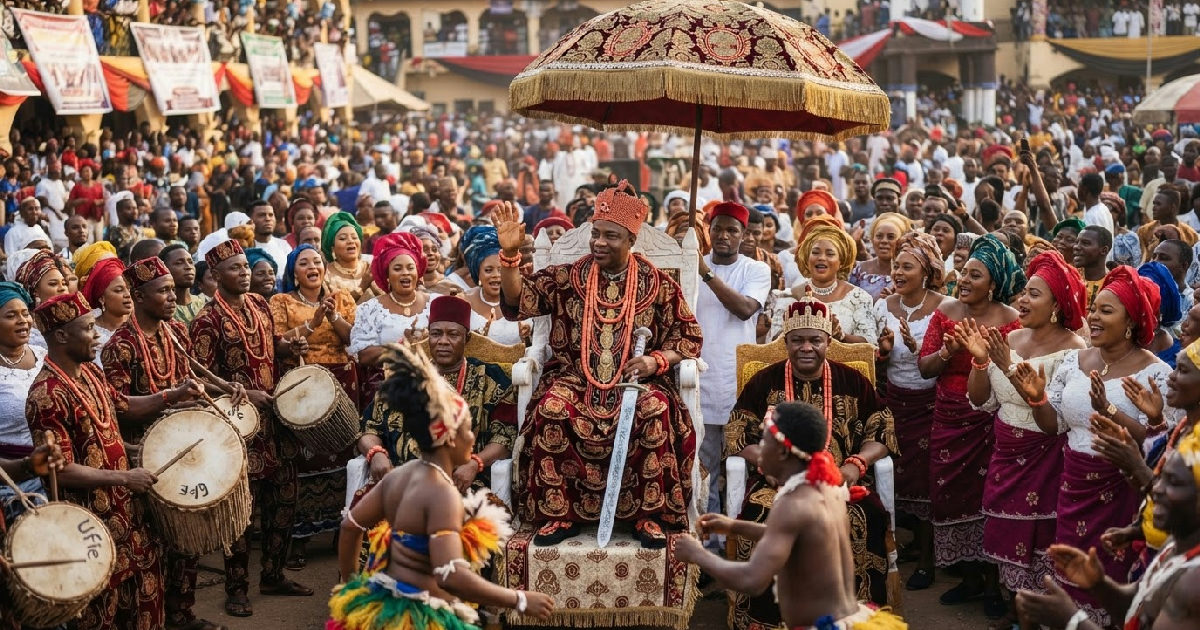
At the heart of Onitsha, a bustling city on the eastern bank of the River Niger in Anambra State, lies a tradition that pulses with centuries of history: the Ofala Festival.
This annual ceremony, steeped in ritual and vibrant public display, marks the ceremonial emergence of the Obi of Onitsha from a period of spiritual seclusion. It signifies a profound renewal of his sacred mandate and enduring connection with his people.
The Ofala Festival of Onitsha in the ceremonial year
For the ordinary resident, Ofala is more than just a colourful parade. It’s a tangible link to a royal institution that shapes communal life, spirituality, and identity, drawing on a deeply rooted system of kingship and mutual obligation between the monarch and the community.
The Ofala Festival isn’t a standalone event. It forms a crucial part of a wider ceremonial calendar in Onitsha, historically intertwined with the rhythms of agriculture, spiritual beliefs, and the societal order. This calendar reflects a community whose early economic life was fundamentally tied to farming and the changing seasons.
The traditional year includes six principal festivals: Aja Chi, Umatu, Owuwa Ji, Ofala, Osisi Ite, and Ifejioku. Among these, Ofala holds a distinct position because its focus rests squarely on the Obi. It’s the moment when the leader, having undergone significant ritual, publicly re-engages with his domain.
The current monarch and documentation efforts
Today, Nnaemeka Alfred Achebe, the 21st Obi of Onitsha, sits on the throne, having ascended it on 14 May 2002. His tenure has seen a concerted effort to safeguard Onitsha’s royal traditions. He’s worked to present them to a broader audience, both across Nigeria and internationally.
But the institution itself reaches back generations, predating the present monarch’s reign. Early insights into the ceremony were captured by Onuora Nzekwu in his article “Ofala Festival,” published in _Nigeria Magazine_ in 1959. This important mid-twentieth-century account offers a glimpse into the ceremony before the age of tourism campaigns or corporate sponsorships.
Later, academic works further documented Onitsha’s kingship. Anthropologist Richard N. Henderson’s 1972 book, _The King in Every Man_, and Sam B. A. Ifeka’s 1973 research, _Onicha (Onitsha) Kingship Institution_, provided extensive examinations. These scholarly efforts detail the royal household, coronation rites, and the intricate structure of traditional kingship, anchoring modern Ofala in a much deeper historical context.
The sacred pause of royal seclusion
Before the grand public spectacle of Ofala, there’s a period of profound importance for the Obi: ceremonial seclusion. This withdrawal isn’t just a quaint tradition; it’s central to the monarch’s role within the traditional institution.
The Obi isn’t merely a public figurehead awaiting a festival. His office carries significant spiritual and communal responsibilities, particularly concerning the welfare of the kingdom. The seclusion emphasizes these ritual obligations, placing the ruler in a state of deep reflection and spiritual communion.
The 2026 ceremonial calendar
The significance of this preparatory process is clear in the official 2026 Onicha Ado N’Idu Ceremonial Cycle. This detailed calendar outlines the various stages leading up to the public celebrations.
For instance, Mgbapu Afa Obodo and Inye Ukwu N’ Nlo Eze Onicha are scheduled for 7 October 2026. This is followed by Ogbalido on 10 October, and then Inyepu Ukwu N’ Nlo Eze Onicha, the Obi’s emergence, on 11 October. After these critical moments, the traditional Ofala observances commence, with Ofala Traditional Day on 12 October and Azu Ofala Traditional Day on 13 October.
The culmination for many spectators will be the major public ceremonies set for Friday, 16 October, and Saturday, 17 October 2026. These gatherings will take place at Ezechima Square in Onitsha. So, what visitors see at the square is the public face of a much longer, deeply ritualized process surrounding the monarch’s spiritual withdrawal and eventual return to his people.
Iru Ofala: the king before his people
The first significant public phase of the festival is known as Iru Ofala. During this event, all eyes turn to the Obi of Onitsha. Adorned in his full royal regalia, the monarch makes a spectacular appearance before his chiefs, subjects, and a host of guests and visitors.
According to established Onitsha tradition, the Obi parades the palace arena three times. Each appearance is accompanied by royal music, and it’s a moment when chiefs and community members offer their homage. The symbolism of this goes far beyond mere regal display.
Historically, the Obi held a unique position within Onitsha’s political and spiritual fabric. His public presence didn’t just affirm the monarchy’s central place in the kingdom. It also allowed subjects to reaffirm their own bond with the throne, solidifying a collective identity. The preceding period of seclusion, then, adds deeper ceremonial weight to this public emergence, linking his presence to sacred duties and responsibilities.
Azu Ofala: community takes the stage
The day following Iru Ofala is known as Azu Ofala, and it intentionally broadens the festival’s focus. On this day, age grade societies come to the forefront, showcasing another vital aspect of Onitsha communal life.
These groups, dressed in their distinct ceremonial attire, parade before the monarch, performing dances and offering homage. Age grades have always been important institutions in Onitsha society. They organize individuals of similar ages into recognized social groups, fulfilling communal, ceremonial, and organizational functions across generations.
During Azu Ofala, these societies transform the palace arena. They turn it into a vibrant public representation of the wider community’s structure and spirit. While Iru Ofala centers the spectacle on the Obi, Azu Ofala gives greater visibility to the organized segments of the community. Together, these two days dramatically portray the enduring relationship between the throne and its people.
The deep roots of Ofala
Understanding the Ofala Festival means tracing its origins back to the early history of Onitsha and the evolution of its royal institutions. Onitsha maintains several traditions concerning the ancestry of Ezechima, the foundational figure linked to Onitsha Ado N’Idu and other communities along the lower Niger River.
Accounts vary regarding Ezechima’s deeper ancestral connections. Some traditions suggest his lineage connects to migrations involving ancient Benin and Ile Ife. Others link it to the Nri civilization. These diverse accounts are all part of Onitsha’s rich inherited historical memory.
A 2026 scholarly study by Charles Ikechukwu Nnaji reinforces Ofala’s place as a historically instituted royal ritual. He associates it particularly with Onitsha, Umueri, and neighboring communities. Nnaji’s work examines how ceremonies bearing the Ofala name developed in other Igbo communities, all within a history of royal spirituality, political legitimacy, and communal order.
Onitsha today boasts one of the oldest, most prominent, and best-documented surviving Ofala traditions. While communities across Igboland developed varied political institutions and ceremonial traditions, creating unique local expressions of royal culture, Onitsha’s Ofala stands as a testament to its distinct history.
Nnewi’s distinct Ofala tradition
To truly appreciate the diversity within the Ofala tradition, one can look to Nnewi, another significant Igbo city. Nnewi maintains its own royal Ofala, associated with the Igwe of Nnewi, which local historical accounts trace back to the nineteenth century.
The current monarch, Igwe Kenneth Onyeneke Orizu III, was born on 30 October 1925 and ascended the Nnewi throne in 1963. He is the 20th Obi of Otolo and Igwe of Nnewi within the Nnofo royal line. His 2025 Ofala was particularly noteworthy.
Having reached the venerable age of 100 on 30 October 2025, Igwe Orizu III’s centenary was formally celebrated during the Ofala events of 28 and 29 December 2025, marking approximately 62 years of his reign.
The histories of both Nnewi and Onitsha highlight the varying interpretations and expressions of Ofala. Both communities feature ceremonies centered on royal authority, community engagement, and public homage. Yet, they maintain their own distinct calendars and local institutions, demonstrating the unique ways cultural traditions can evolve locally.
Ofala: tradition meets the modern stage
The modern Ofala Festival in Onitsha has expanded considerably beyond its core royal ceremonies. It now encompasses a much wider programme of events that appeal to diverse audiences. These additions include the Oreze International Art Exhibition, the Ofala Youth Carnival, lectures, and medical, health, and wellbeing outreach activities, showing how cultural practices adapt.
Corporate partnerships, extensive media coverage, and cultural tourism have also helped broaden the festival’s reach. For instance, the 2025 celebration adopted the theme “Njiko na Ntachi,” which translates to “Unity and Perseverance.” Its main ceremonial days were observed on 17 and 18 October 2025.
For 2026, organisers have announced the theme “igba mbo, iga n’iru,” presented in English as “Strive, and Advance,” with the broader formulation “From Resilience to Progress.” The principal public ceremonies for this year are slated for 16 and 17 October 2026 at Ezechima Square.
These contemporary elements, alongside exhibitions and outreach, have crafted a broader cultural programme that nonetheless remains rooted in the traditional ceremonial cycle, balancing ancient rites with modern engagement.
Recognized on national and global platforms
The growing public visibility of Ofala has not gone unnoticed. The festival has earned significant institutional recognition, both within Nigeria and on the international stage.
In November 2022, the Ofala Festival received a Federal Government Award of Excellence in Culture. This award acknowledged its significant contributions to the development and preservation of Nigeria’s cultural heritage. The presentation took place in Lagos during the first United Nations World Tourism Organisation Global Conference, which focused on linking tourism, culture, and the creative industries.
Moreover, the Ofala Festival of Onitsha is officially listed in Nigeria’s inventory of cultural resources, contributing to UNESCO’s intangible cultural heritage documentation efforts. Nigeria’s elements on UNESCO’s lists include other prominent traditions like the Ijele masquerade, the Argungu International Fishing and Cultural Festival, the Sango Festival in Oyo, and the Durbar in Kano.
This recognition solidifies Ofala’s standing as a major expression of Nigerian cultural identity, placing it among the cultural icons and practices that define the nation. It highlights how local customs can achieve global prominence while retaining their profound local meaning.
The enduring heart of Onitsha identity
The Ofala Festival persists and thrives today because it’s far more than an annual spectacle; it’s a living institution. In its Onitsha form, it intricately weaves together monarchy, spiritual beliefs, social organization, ancestral memory tied to agriculture, public allegiance, and distinctive cultural expressions through music and dress.
The Obi’s spectacular appearance is the powerful culmination of a ceremonial sequence that starts long before any spectator arrives.
Twentieth-century historical documents clearly show Ofala as a well-established Onitsha institution long before it became a major cultural and tourism event. Contemporary palace records continue to detail the structured sequence of royal seclusion, public emergence, the offering of homage, and communal participation that defines the festival.
But Ofala isn’t static; it has evolved with the society around it. Its public audience has expanded, and new cultural activities have blossomed around the traditional royal ceremonies. The variations seen in Nnewi and other communities further illustrate the rich diversity of traditions expressed under the single name of Ofala, each community nurturing its unique customs.
Perhaps what remains most striking is this institution’s ability to carry an ancient concept of kingship into the modern world. When the Obi emerges, performs royal dances, and accepts homage, the ceremony does more than just recall the past.
It publicly renews a vital relationship between a throne, a community, and a powerful cultural memory that continues to shape daily life in Onitsha. It begs the question: what other inherited traditions hold such enduring power in our rapidly changing world?
