



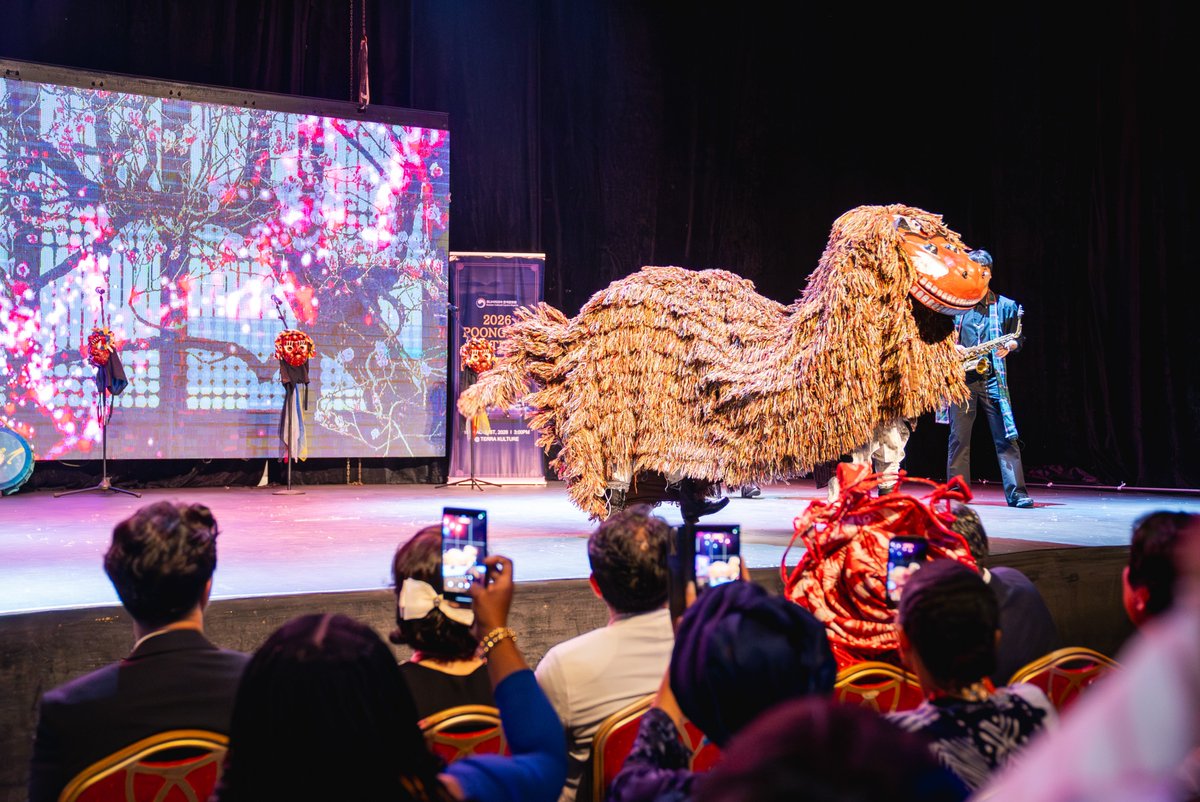
On August 15, 2026, the heart of Lagos throbbed with a unique rhythm as Nigeria and the Republic of Korea converged at Terra Kulture for the Poongryu Festival. Organized by the Korean Cultural Centre Nigeria (KCCN), this event was more than just a performance; it was a vibrant tapestry of shared humanity, weaving together traditional Korean arts with Nigeria’s own creative spirit.
The festival unfolded on a particularly significant day for Korea: Gwangbokjeol, its National Liberation Day. Ambassador Yo-an Jeong of the Republic of Korea to Nigeria underscored this dual significance, explaining how the uniquely Korean concept of Poongryu — an appreciation for music, nature, beauty, and fellowship — aligned perfectly with a day marking the “restoration of light” for his nation.
Korean spirit finds echoes in Poongryu
To truly understand the Poongryu Festival, one must first grasp the depth of its namesake. Poongryu, as Ambassador Yo-an Jeong described it, defies a simple English translation. It represents a profound Korean ethos, a way of life that elevates more than just aesthetic enjoyment.
At its core, Poongryu encompasses moral and spiritual values passed down across generations. It’s a philosophy rooted in principles like honoring parents, serving one’s country faithfully, and consistently choosing good over wrong. These precepts have shaped the Korean spirit, nurturing virtues of respect, responsibility, harmony, discipline, and dedicated service.
This deep-seated cultural foundation explains the global phenomenon of K-Culture. The K-Pop melodies, compelling Korean dramas, and critically acclaimed films enjoyed worldwide are not fleeting trends. They are modern expressions of a cultural soul, one deeply connected to Korea’s long and often challenging history. Their global resonance speaks to universal themes of human experience.
Gwangbokjeol’s historical resonance
The choice of August 15 for the festival was no accident. This date commemorates Gwangbokjeol, Korea’s National Liberation Day. It marks the day in 1945 when colonial rule ended, and Korea regained its freedom after 36 years under Japanese control.
From 1910 to 1945, Japanese policies actively sought to suppress Korean language, identity, and cultural traditions. Yet, against this backdrop of cultural oppression, Korean families and communities preserved their heritage. They safeguarded their language and traditions, ensuring their survival through difficult times.
The word “Gwangbok” itself means “the restoration of light,” a powerful metaphor for the recovery of national sovereignty. This resilience, born from a fight for cultural survival, mirrors struggles for identity found in many nations. It reveals how profoundly cultural traditions can sustain a people through adversity.
Where cultures meet: Nigerian embrace of K-Culture
The festival served as a vibrant stage for this cross-cultural dialogue. The six-member Choori Band, a traditional Korean music and dance troupe, traveled from Korea to perform. They are renowned for their ability to reimagine traditional Korean artistry for a contemporary audience.
Choori Band’s performances fused music, dance, storytelling, and humor, often involving audience participation. Their energetic renditions of pieces like ‘Pump It Up’ and ‘Rainbow Taryeon’ explored new possibilities for ancient forms. They demonstrated how traditional rhythms could connect with modern sounds, creating something fresh and engaging.
Local talent and global connections
Beyond the professional Korean troupe, the festival highlighted Nigeria’s enthusiastic engagement with K-Culture. The audience witnessed performances from local talents, including the third-place winners of the 2026 K-Pop Dance Festival Lagos.
The first-place winner of the 2026 K-Pop Singing Competition also delivered a powerful vocal performance. Ambassador Jeong noted that this Nigerian participation showcased how young Nigerians are not just embracing Korean culture, but actively making it their own, creatively interpreting and celebrating its various forms.
This creative adoption enriches both cultures. As the Ambassador put it, “Culture becomes richer when it is shared — and even richer when others make it their own.” It’s a dynamic exchange where new interpretations emerge, strengthening the global reach of cultural forms.
The deeper currents of cultural diplomacy
Such cultural exchanges go beyond mere entertainment; they are potent tools for diplomacy and understanding. The Poongryu Festival created a space where Korean history, values, and artistic traditions could engage in direct conversation with Nigerian experiences and creativity.
Chief Nike Okundaye, the acclaimed textile artist and gallery owner, attended the festival. She praised the Korean Cultural Centre Nigeria for its efforts, describing the event as a clear reflection of the deepening partnership between Nigeria and Korea. Her presence underscored the significance of the exchange within Nigeria’s own cultural landscape.
Ambassador Jeong further articulated this vision, stating, “Freedom gives a nation its dignity; culture gives a nation its soul. When cultures meet in freedom and mutual respect, friendship between nations grows stronger.” This sentiment speaks to a fundamental truth about human connection across borders.
For ordinary Nigerians, particularly the youth interested in Korean popular culture, the festival was a tangible connection to a global phenomenon. It offered an opportunity to witness, participate in, and feel a part of a wider cultural conversation.
Beyond the festival: A shared future in cultural exchange
The Korean Cultural Centre Nigeria (KCCN) played a pivotal role in bringing this vision to life. Established in Abuja in May 2010 by the Republic of Korea’s Ministry of Culture, Sports and Tourism, KCCN stands as the first Korean Cultural Centre in Africa.
With KCCN Director Jeon Ju-ho at its helm, the centre’s mission extends beyond single events. It aims to foster enduring friendship, strengthen bilateral relations, and deepen understanding between Korea and Nigeria through a continuous stream of cultural and educational programmes. This long-term commitment transforms fleeting moments into lasting bridges between peoples.
The success of the Poongryu Festival in Lagos highlights a growing trend of cultural interest and exchange. It shows how the lived experience of culture, from traditional music to modern K-Pop, can serve as a powerful medium for international understanding.
These shared experiences build connections that transcend politics and economics, weaving nations together one performance, one shared laugh, one dance at a time. The echoes of Poongryu in Lagos suggest a future rich with such mutual discovery.
The interplay of diverse cultural expressions, such as those seen at Terra Kulture, creates a dynamic environment for learning and appreciation. It allows Nigerians to experience global narratives while also presenting their own unique perspectives to the world. Events like these provide concrete examples of how nations can connect on a human level, moving beyond headlines and towards genuine empathy.
Looking ahead, the KCCN’s ongoing initiatives promise to keep this cultural dialogue vibrant. Their work supports the idea that understanding another culture isn’t just about learning facts; it’s about feeling its soul and seeing its reflection in your own.
This continuous engagement enriches the lives of countless individuals and strengthens the bonds between two geographically distant, yet culturally connected, nations.
It’s a testament to the idea that shared art and heritage can build a powerful foundation for international cooperation and mutual respect, much like the way personal stories shape our understanding of wider societal issues.
