




The depth of gbagyi culture is reflected in the legacy of Ladi Kwali, an internationally renowned potter featured on the N20 note. On its back is the image of a woman, Ladi Kwali, her hands shaping a water jar. She is one of the country’s most celebrated artists, a potter of international renown.
But few who touch her image know she was Gbagyi, and fewer still know the depth of Gbagyi culture.
Kwali’s simultaneous fame and anonymity is a perfect metaphor for her people. The Gbagyi are the indigenous inhabitants of the land on which Nigeria built its capital, Abuja. They are, in a literal sense, at the very heart of the nation. Yet their culture, their language, and their history remain largely unknown to the country they host.
Understanding Gbagyi culture at the centre of Nigeria
For centuries, the Gbagyi people lived across the rolling savanna of Nigeria’s north-central region. They are known as a peace-loving and accommodating people, historically recognized for their agriculture, weaving, and a unique matrilineal tradition of pottery. Their art told their stories, with geometric and animal motifs inscribed on clay, a silent record of their worldview.
Compared to Nigeria’s three most populous ethnicities—the Hausa, the Yoruba, and the Igbo—the Gbagyi were historically quiet on the national stage. Their place was reflected in their own proverb: Before the ripening of fruit, what were the birds eating? It’s a celebration of resilience and quiet adaptability, of surviving before the harvest comes.
That quiet existence was shattered in 1976. The military government of Murtala Mohammed and Olusegun Obasanjo, seeking a neutral ground after the bitter Biafran War, promulgated Decree No. 6. It designated this “no man’s land” as the site for a new Federal Capital Territory. The move was meant to symbolize unity. But the land was not empty. It was Gbagyi land.
From the early 1980s, the Gbagyi and other smaller ethnic groups were displaced. Their ancestral lands, farms, and even sacred sites, like the community shrine on which Aso Rock was built, were taken. The compensation was notoriously inadequate. A project designed to heal the nation’s ethnic divisions inflicted a deep wound on the people at its new centre.
The proverb and the storyteller
It is this history of resilience, displacement, and cultural loss that Nigerian-American author Afabwaje Kurian found herself confronting. In 1990, at age seven, her family moved to the United States. She grew up in a predominantly Black neighbourhood in Maryland, an experience that gave her a deep understanding of African American history and the fight for civil rights.
Years later, after a decade working in public health, she began writing what she thought would be a novel about an American immigrant experience. But the story pulled her in a different direction.
“I felt as if the protagonist I started with began to be interested in where he had come from and who he was,” she said. To find that character’s story, she first had to find her own.
This detour “opened a new portal of historical inquiry,” taking her back to 1970s Nigeria and her own Gbagyi heritage. The result is her 2024 debut novel, Before the Mango Ripens, its title taken directly from the old Gbagyi proverb. The book, a finalist for the Aspen Words Literary Prize, became a vessel for exploring an identity she had left behind as a child.
A conversation across generations
The novel’s transformation was sparked by a single conversation. On a visit to Nigeria in 2015, Kurian sat down with her maternal grandfather, a retired pastor. For four hours, with her father and uncle present, three generations of one Gbagyi family listened as the eldest spoke. It was a moment of profound revelation.
“He was able to speak to the traditions that we lost as Gbagyi people… what we lost because of the advent of Christianity,” Kurian recalled. “My father and uncle realized that there was a history that they also didn’t know as well. It was informing all of us.” That four-hour conversation changed everything, turning an American story into a deeply Nigerian one.
Rebuilding a world from fragments
Writing the novel became an act of cultural archaeology. For ten years, Kurian pieced together the world of 1970s Nigeria. In Nigeria, she interviewed relatives and read Joseph Shekwo’s Gbagyi Folktales and Myths. In America, she sought out missionaries who had served in Nigeria during that era, trying to understand the world from both sides.
Her research took her to the archives of evangelist Billy Graham and into the letters of missionary nurses. She found memoirs from a Dutch missionary couple who spent 30 years in Nigeria. This dedication to research was crucial, especially when grappling with the complexities of writing from the diaspora.
It’s a challenge many Nigerian American writers face: how to capture a place and time you didn’t fully experience. For Kurian, whose own second novel is influenced by The Ghost of Buchi Emecheta, the work of literary ancestors provides a guide.
The challenge of writing from a distance
Kurian is candid about the difficulties. “If you’re writing about a decade that you didn’t grow up in, there’s a lot of research you’re doing,” she explained. Fidelity to dialogue and vocabulary was a major concern. She relied on her father, who grew up in that period, to review the manuscript and ensure its authenticity.
The result is a story told not from an emigrant’s perspective, but attempted from a native vantage point.
It was through this process that she uncovered the nuances of her heritage. She hadn’t set out to write a lament for lost traditions. But after talking to her grandfather, she “sensed the depth of loss and anger.”
Yet she also wanted to show a more complicated picture—a people who authentically accepted Christianity while rejecting certain Western customs. The tension between indigenous belief and foreign faith, a dynamic visible in conversations around Why Isese Day’s Return, lies at the heart of her novel.
A culture carried on the shoulder
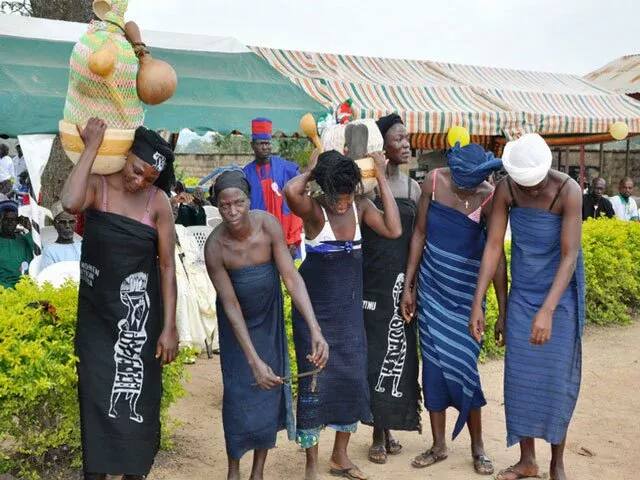
Gbagyi culture is rich with unique traditions. Perhaps the most visually distinctive is the practice of women carrying loads on their shoulders, not their heads. This stems from a belief that the head is the “King of the entire body” and should not be burdened with ordinary things. It’s a physical expression of a deeply held respect for the seat of identity and thought.
Their traditional religion includes a belief in a supreme God, Shekwoyi, alongside devotion to other deities and ancestral spirits. Even as many Gbagyi have embraced Christianity or Islam, these older animistic beliefs are often interwoven, creating a syncretic spiritual life that preserves tradition within new frameworks. This ability to adapt while retaining core identity is a hallmark of Gbagyi history.
From their patrilineal kinship system, where authority rests with the eldest male, to their famous craftsmanship in pottery, woodcarving, and tie-and-dye cloth known as Ajeside, the Gbagyi possess a distinct cultural fingerprint. These are the details that are often lost in Nigeria’s broader narrative, but which writers like Kurian are helping to bring into focus, contributing to the fight for Nigeria’s memory.
The emigrant as family historian
One of the great ironies of Kurian’s journey is what happened after the book was published. Cousins reached out to tell her that the novel contained so much Gbagyi cosmology and family history that they, who had grown up in Nigeria, had never known.
The emigrant, through her deliberate act of research and imagination, had learned more about their shared culture than the relatives who never left.
“I became an unofficial family historian,” she said. Her story speaks to the complex reality of the diaspora, of existing in a “liminal space or third culture,” as she calls it. It’s the feeling of being neither fully American nor, in the eyes of some, fully Nigerian. And yet, it is often from this space that the clearest view of home emerges.
Afabwaje Kurian’s work is more than just a novel. It is a map. It shows a way back for a generation of Nigerians in the diaspora who feel a powerful connection to a home they barely know.
Her journey of growing her Gbagyi roots shows that history is not just something that is lost; it is also something that can be found, rebuilt, and shared, even from an ocean away.
