




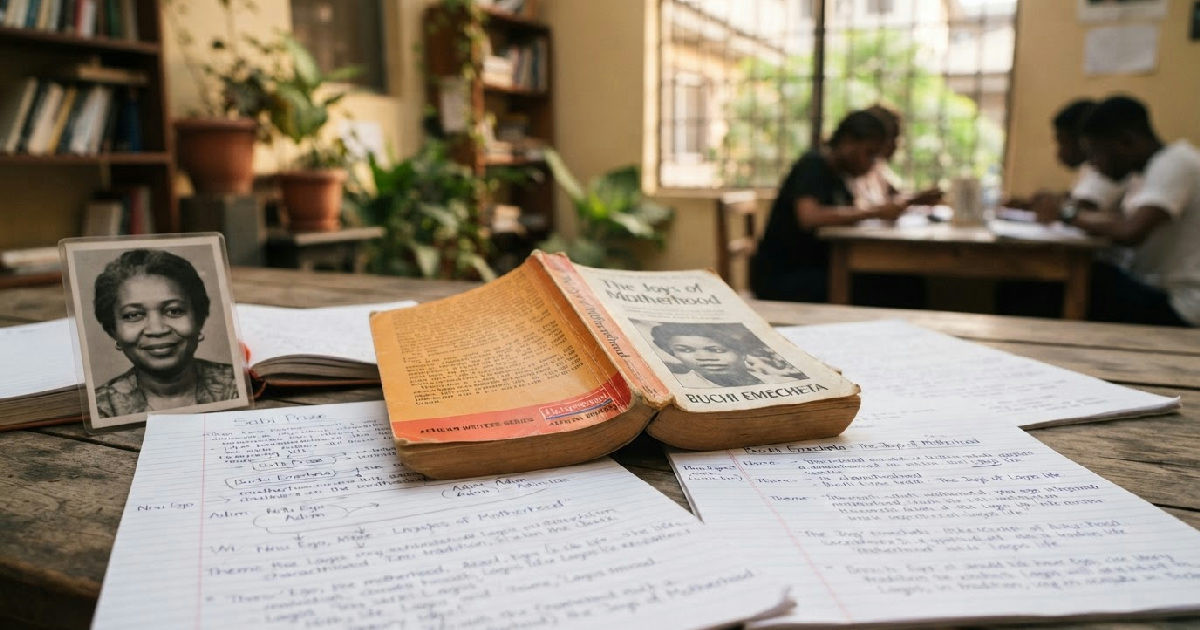
In a small, crowded room in colonial Lagos, a young woman named Nnu-Ego arrives to meet her new husband in the classic 1979 novel by Buchi Emecheta. She has journeyed for four days, carrying the hopes of her village and the heavy weight of tradition. But the city offers no gentle welcome.
Her husband, Nnaife, is a stranger shaped by a relentless new world. Their union is not one of intimacy, but a transaction of survival.
The legacy of Buchi Emecheta
This scene, drawn from Chapter Four of Buchi Emecheta’s 1979 novel The Joys of Motherhood, is almost half a century old. Yet it is speaking with startling urgency to a new generation of Nigerians, thanks to a literary prize that has dared them to listen.
The Sabi Prize for Critical Reading and Writing has turned to Emecheta’s ghost to ask a question: what does her world tell us about our own?
Buchi Emecheta was a writer born of necessity. Born in Lagos in 1944, she moved to the UK in 1962, where she endured a famously difficult marriage while raising five children alone. She wrote in the quiet hours of the morning, often in her kitchen, carving out a literary space for the stories of Nigerian women that had, until then, remained largely untold and unwritten.
Her novels were not gentle allegories. They were raw, unflinching portraits of women navigating the crushing pressures of patriarchy, poverty, and the disorienting encounter with colonialism. Emecheta’s work explored the friction between tradition and a modernity that often seemed to promise freedom while delivering new forms of bondage.
She gave voice to characters like Nnu-Ego, for whom the “joys of motherhood” were inseparable from its sorrows and sacrifices.
For decades, her work has been a staple of Nigerian literature, a foundational text for understanding the female experience in the country’s turbulent 20th century. Her contribution to the nation’s story is as vital as that of other famous families like the Ransome-Kuti family.
But The Sabi Prize has revealed that Emecheta is not just a historical figure. She is a living presence, her words a mirror for the anxieties of today.
A new generation opens the book
From a pool of 220 entries across Nigeria, the Sabi Prize asked its finalists to analyze that single, dense chapter from The Joys of Motherhood. The challenge was to examine its themes of colonialism, cultural conflict, and the brutal demands of survival. The results, judged by acclaimed writers Adachioma Ezeano and Esther Ifesinachi Okonkwo, were a revelation.
The top three winners were all young women: Juanita Douglas-Jombo, Pearl Okereke, and Sekinat Agbeleshola. Each student peeled back the layers of Emecheta’s colonial Lagos to find startlingly relevant truths. They weren’t just reading a book; they were dissecting the DNA of the society they had inherited.
And in their essays, Emecheta’s characters walked again, not as historical artifacts, but as urgent emblems of a continuing struggle.
The prize money itself makes a powerful statement. With a total pot of ₦2,950,000, including a ₦1,000,000 grand prize for the winner, the initiative places a profound financial value on the act of critical thinking. It’s a deliberate investment in a future generation of readers and thinkers.
Survival over autonomy in Juanita Douglas-Jombo’s analysis
First-place winner Juanita Douglas-Jombo, a student at Lycée Français Louis Pasteur de Lagos, reads the chapter as a story of “cultural dislocation.” She sees a world where survival forces people to trade their autonomy for a foothold in a hostile system.
Her essay, “Survival Over Autonomy: Colonial Pressures in Emecheta’s Nigeria,” argues that the colonial project wasn’t just about economic extraction; it was about the subtle dismantling of a people’s soul.
Douglas-Jombo focuses on the hypocrisy of the colonial couple, Dr. and Mrs. Meers, who enforce Christian values on their Nigerian staff that they themselves do not practice.
She writes that the indigenous people were “an assembly of vessels to be imbibed with religious values that the White man couldn’t be bothered to follow himself.” The result is a society where identity becomes a performance for the coloniser.
This is a complex exploration of what it means to have an authentically African identity under such external pressures.
For Douglas-Jombo, Nnu-Ego’s slow assimilation into the city’s “mundane lifestyle” is the ultimate tragedy. She becomes “another piece on the board, enthralled by the shillings in her pocket.” Culture, tradition, and selfhood all crumble under the immense weight of economic necessity. Survival, she concludes, becomes the only value left to celebrate.
The city as a callous mistress in Pearl Okereke’s vision
For second-place winner Pearl Okereke, a student at The Hillside School in Abuja, Lagos itself becomes a central character. In her essay, “The Lagos Life: Labour and Loss,” she animates the city as a “ruthless mistress to whom all who enter must bow.” It’s a place that “advertises itself as a land flowing with milk and honey” but whose reality is a suffocating trap.
Okereke powerfully latches onto a line from the novel: “They stopped being men long ago. Now they are machines.” She argues this metaphor explains the deep degradation of African men under colonial labour systems. Traditional values like strength of character and authority are replaced by productivity. Humanity is measured by usefulness, draining men of spirit and emotion until only a “machine” remains.
Nnaife, Nnu-Ego’s husband, is the primary victim of this process. His job as a washer-man for a white family leaves no room for personal fulfillment. “Exhaustion trumps affection. Routine replaces intimacy,” Okereke writes. In this parasitic ecosystem, she concludes, “no human can survive. Only machines.” Her analysis elevates the story from a domestic drama to a critique of an entire economic and social structure.
The unmaking of a man in Sekinat Agbeleshola’s portrait
Sekinat Agbeleshola, the third-place winner from City of Knowledge Academy in Ijebu-Ode, offers a nuanced portrait of Nnaife. In “Pressed and Empty,” she moves beyond Nnu-Ego’s disappointment to see Nnaife as an unwitting victim. He is not just an inadequate husband but a man dismantled by the “dehumanizing structures of colonial Lagos.”
Agbeleshola argues that the city rewires masculinity itself. Where village life valued pride and independence, Lagos rewards emotionless efficiency. “Nnaife exposes how Lagos rewards efficiency over empathy, and illustrates his loss of emotional instinct,” she writes. Even his Sunday, his only time off, is co-opted by his employers, who require him to attend church. Spirituality becomes another form of labour.
If Nnaife is the machine, Agbeleshola contends, Nnu-Ego is forced to become his fuel. Intimacy is a luxury they cannot afford. Agbeleshola’s essay is a powerful look at how a system designed for exploitation erodes not just identity but the very possibility of human connection, turning relationships into transactions and men into static, unfeeling figures.
The minds behind a necessary resistance
The Sabi Prize was founded by Dawn Chinagorom-Abiakalam and Chukwuka Odigbo. Their initiative is not just a literary competition; it is a direct response to a crisis. They saw a nation where less than 10% of the national budget is allocated to education and where up to 18.3 million children are out of school, one of the highest figures in the world.
In this context, creating a prize that rewards close reading and critical thought is a radical act. When Otosirieze, the editor of Open Country Mag which published the winning essays, learned of the founders’ proposal, he saw it as a “necessary act of resistance.” The prize insists on curiosity in a system that often seems apathetic to learning.
By choosing a text like The Joys of Motherhood, the founders did more than just assign a book. They connected a generation of young Nigerians to the literary giants on whose shoulders they stand, much like how modern actors bring classic characters to life. They affirmed that the questions Emecheta asked in 1979 are still the questions Nigeria must answer today.
What Emecheta’s endurance tells us about Nigeria
Why does a novel about a woman’s struggle in colonial Lagos still speak so loudly in 2026? The essays of Juanita Douglas-Jombo, Pearl Okereke, and Sekinat Agbeleshola provide the answer. Emecheta’s themes—economic desperation, urban alienation, the collision of tradition with a harsh modernity, and the redefinition of gender roles—have not faded into history. They are the daily headlines of Nigerian life.
The character of Nnaife, the man reduced to a machine by his labour, is recognizable to anyone stuck in the Lagos traffic of today, chasing a wage that barely covers survival. Nnu-Ego’s struggle to reconcile her identity with the city’s demands mirrors the cultural dislocation felt by millions who move from village to metropolis.
The brutal economics of the city, where children are seen as “another mouth to feed,” remains a painful reality.
It is perhaps most telling that the prize’s top three winners are young women, dissecting a novel titled The Joys of Motherhood with such clear-eyed analysis of its pain. They are Emecheta’s literary daughters, continuing her work of holding Nigerian society up to a mirror.
Their essays prove that while systems may fail, the resilient intelligence of Nigeria’s youth, when given the tools and the space to think, remains one of the nation’s greatest resources. The ghost of Buchi Emecheta is still teaching, and a new generation is finally taking notes.
