




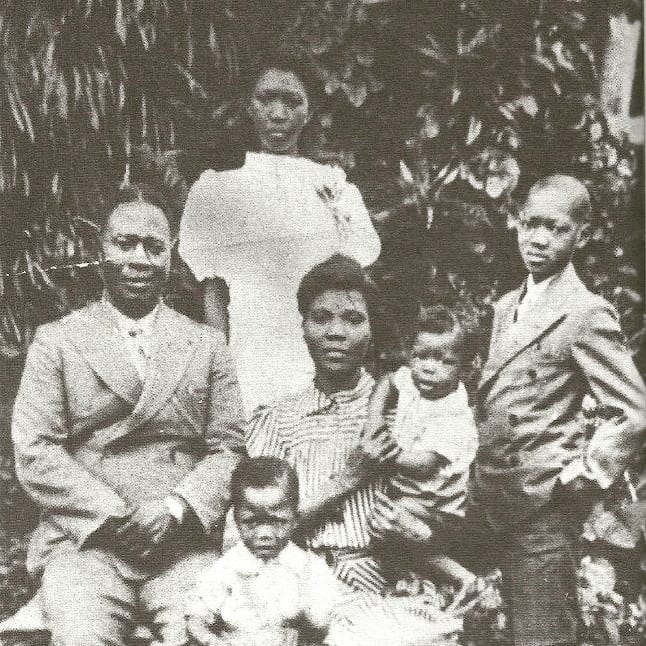
In 1922, a Nigerian clergyman stood in a London recording studio, a world away from his home in Abeokuta. Reverend Canon Josiah Jesse Ransome-Kuti, born in 1855, was there to capture his hymns on 10-inch gramophone discs for Zonophone Records, establishing the musical and activist legacy of the Ransome-Kuti family.
As his rich baritone filled the room, singing in Yoruba to a piano accompaniment, he was doing more than making Nigeria’s first-ever musical recordings. He was setting a precedent that would echo for over a century.
The patriarch of the Ransome-Kuti family
That act of cultural preservation and innovation became the blueprint for a dynasty. The Ransome-Kuti family would go on to shape the very soul of Nigeria, producing educators, doctors, activists, and musicians who held the nation to account. Their story is not just one of individual achievements, but of a relentless, generational pursuit of a more just and expressive Nigeria.
Josiah Ransome-Kuti was a man of the church, serving in institutions like St. Peter’s Cathedral in Ake, Abeokuta. But his vision extended beyond the pulpit. His decision to record traditional Yoruba hymns was a quiet rebellion against the colonial-era church music that dominated worship. He wanted, in his own words, to make sacred songs “available to all Yoruba-speaking people.”
This wasn’t just about music; it was a political statement about the value of indigenous culture in a colonial world. It’s a direct line from Josiah’s hymns, like the Egba anthem Lori Oke ati Petele, to the modern fusion of local languages in Nigerian gospel music.
His pioneering work, released in 1925, was happening around the same time early experiments in Nigerian cinema’s colonial roots were being explored, showing a nascent cultural awakening.
He also challenged the church’s rigid social structures, baptising children of parents who weren’t married in the church and defending the rights of women. This combination of artistic innovation and social conscience became the family’s inheritance. It was a legacy his children would carry into the heart of the fight for a new Nigeria.
A generation of nation-builders
Two of Reverend Josiah’s children, Israel and Funmilayo, became central figures in building the institutions and movements that would define the post-colonial era. They took their father’s spirit of service and applied it to education and political liberation, operating at the highest levels of national life.
This transition from religious leadership to civil advocacy marked a pivotal moment in Nigeria’s pre-independence history. By translating Christian ethics into secular activism, this sibling dynamic laid the intellectual and organizational foundations for future resistance against both British colonial administrative policies and domestic tyranny.
Their joint efforts created a dual legacy where formal education and grassroots mobilization operated in tandem. This powerful combination of social infrastructure and political resistance would not only challenge local authorities in Abeokuta but would also establish the template for civic engagement that subsequent generations of Nigerians would inherit and refine.
The educator and the unionist
Reverend Israel Oludotun Ransome-Kuti, an Anglican priest like his father, dedicated his life to education. As a principal at major schools like Abeokuta Grammar School, he was a respected figure. But his most enduring contribution came in 1931 when he became the first president of the newly formed Nigerian Union of Teachers (NUT).
By uniting educators across the country, he helped professionalise teaching and gave the profession a powerful, unified voice. It was foundational work, creating a platform for teachers to demand better conditions and influence colonial policy. His efforts, alongside colleagues like Alvan Ikoku, laid the groundwork for a national education system.
The lioness of lisabi
Israel’s wife, Olufunmilayo Ransome-Kuti, became one of the most formidable activists in Nigerian history. Often remembered simplistically as the first woman in Nigeria to drive a car, her real impact was far more profound. She was a tireless organiser and a thorn in the side of the colonial administration.
As co-founder of the Abeokuta Women’s Union (AWU) in 1946, she mobilised thousands of women against unfair colonial policies. She led mass protests—the famous “Great Weep”—against unjust taxes and price controls, even forcing the Alake of Egba into temporary exile. She was an effective organiser who trained women how to handle tear gas and drafted meticulous documents detailing their grievances.
Her fight for women’s suffrage and political representation took her to London as part of a 1947 delegation and to constitutional conferences at home. Funmilayo Ransome-Kuti ensured that the needs of women were on the national agenda as Nigeria moved toward independence.
Her life ended tragically in 1978, from injuries sustained during a military raid on her son Fela’s compound, a martyr to the very state brutality she had fought against for decades.
The conscience of the republic
Funmilayo and Israel’s children inherited a legacy that was both a privilege and a burden. Three of their sons—Olikoye, Beko, and Fela—along with their cousin, the Nobel laureate Professor Wole Soyinka, would become the unwavering conscience of an independent Nigeria, each choosing a different battlefield.
Whether confronting military regimes through revolutionary music, demanding human rights through civil disobedience, or reforming public health from within governmental institutions, these individuals demonstrated how a single family could engage multiple facets of statehood. Their actions collectively challenged the post-independence state to live up to its democratic promises.
By dividing their efforts across the cultural, medical, and political spheres, they ensured that the struggle for a better Nigeria was waged on all fronts. This multi-dimensional approach to advocacy meant that their impact was felt throughout society, cementing their collective reputation as relentless critics of systemic corruption and defenders of the common citizen.
Fela: The black president’s rebellion
Fela Anikulapo-Kuti took the family’s musical and activist DNA and weaponised it. He fused jazz, funk, and traditional Yoruba rhythms into Afrobeat, creating a sound that was both intoxicating and politically explosive. From his communal compound, the Kalakuta Republic, and his stage at the Afrika Shrine, Fela waged a relentless war on military dictatorship, corruption, and neo-colonialism.
His songs were sprawling manifestos that named names and detailed the failures of the state, turning him into a global icon of resistance. Fela’s life was a performance of defiance, which brought him immense fame but also immense suffering, including countless arrests, beatings, and the 1978 death of his mother.
His powerful voice echoed the frustrations of many, much like how the commentary of Ernest Okonkwo shaped football lore for a generation of sports fans. Fela became a symbol of the artist as activist, a role he played until his death in 1997.
The doctor-activists: Olikoye and Beko
While Fela fought from the outside, his brothers chose different paths. Professor Olikoye Ransome-Kuti, a paediatrician, worked from within the system. As Minister of Health under General Ibrahim Babangida’s regime from 1985, he led one of the most effective public health campaigns in the nation’s history.
He championed Nigeria’s first comprehensive primary healthcare policy, drove mass immunisation programs, and was one of the first public officials to openly address the HIV/AIDS epidemic with relentless awareness campaigns. His work earned him international acclaim and a reputation as perhaps Nigeria’s most effective cabinet minister.
When Fela died of AIDS-related complications, it was Olikoye who bravely announced the cause, turning a family tragedy into a national teaching moment.
Their younger brother, Dr. Bekolari ‘Beko’ Ransome-Kuti, was also a medical doctor but operated as a frontline human rights activist. He founded the Campaign for Democracy and was a leader in the pro-democracy movement that fought against military rule, especially after the annulment of the June 12 election.
Beko’s activism, often alongside legal giants like Gani Fawehinmi, led to multiple imprisonments, but he never wavered in his demand for constitutional governance. His struggles highlighted the deep-seated problems within Nigeria, including the decline of state-run enterprises like the Nigerian National Shipping Line.
How the Ransome-Kuti legacy endures today
The family’s torch has not been extinguished. Today, a fourth generation continues to navigate the complex legacy of their name, adapting it for a new era. Fela’s children have ensured that Afrobeat remains a vibrant and politically charged force in Nigerian culture.
His eldest son, Femi Kuti, a multiple Grammy nominee, has carried the musical mantle for decades with his band, Positive Force. His music continues to critique Nigeria’s political class while pushing Afrobeat in new directions.
Femi’s sister, Yeni Kuti, chose dance and stewardship, co-managing the New Afrika Shrine and founding Felabration, the annual festival that celebrates their father’s life and work, turning his legacy into a global institution.
Seun Kuti, the youngest son, inherited Fela’s original band, Egypt 80, at the age of 14 and has become perhaps the most politically outspoken of his siblings. His music is uncompromisingly revolutionary, and he is a constant, often controversial, voice in national debates.
The line continues with Femi’s son, Made Kuti, a multi-instrumentalist who performs with his father and as a solo artist. His music blends intricate jazz compositions with the foundational principles of Afrobeat, asking critical questions of a new generation.
The Ransome-Kuti story is a chronicle of Nigeria itself—its hopes, its betrayals, its enduring struggle for justice. It began with a clergyman’s desire to preserve his culture and evolved into a dynasty of dissidents and builders. Their lives pose a lingering question for every Nigerian: what does it mean to serve your nation, and what price are you willing to pay?
Who was the patriarch of the Ransome-Kuti family?
The patriarch was Reverend Canon Josiah Jesse Ransome-Kuti, born in 1855, who made Nigeria’s first-ever musical recordings in 1922 and championed indigenous culture and women’s rights.
What is Olufunmilayo Ransome-Kuti remembered for?
She is legendary for leading the Abeokuta Women’s Union in historic protests against colonial tax policies, campaigning for women’s suffrage, and helping shape early national constitutional debates.
How did the three brothers—Fela, Olikoye, and Beko—affect Nigeria?
They attacked systemic state issues from different angles: Fela through radical Afrobeat music and activism; Olikoye through pioneering primary healthcare reforms; and Beko through frontline pro-democracy advocacy.
Is the Ransome-Kuti legacy still active today?
Yes, Fela’s descendants—including Femi, Yeni, Seun, and Made Kuti—actively carry on the musical, artistic, and political tradition through Afrobeat performance and civic commentary.
