




For decades, to fly within Nigeria was to fly with the government. The national carrier, Nigeria Airways, held a near-total monopoly on the skies until Okada Air emerged to challenge the system. It was a system many Nigerians knew through long delays, cancelled flights, and a sense that there was simply no other choice for air travel.
Then, in 1983, a new name appeared on the departure boards. Founded by Chief Gabriel Osawaru Igbinedion, the Esama of Benin, Okada Air began operations from Benin City. It wasn’t just a new airline; it was the beginning of a challenge to the entire structure of Nigerian commercial aviation.
The rise of Okada Air in a state-dominated sky
Before the early 1980s, scheduled passenger aviation in Nigeria was synonymous with Nigeria Airways. The federal government played the central role in transportation, owning the infrastructure and the dominant carrier. This structure was a common inheritance for critical post-colonial industries.
This state-owned model, however, created significant operational bottlenecks and an expansive, often inefficient, system. Passengers frequently had little recourse when flights were disrupted, leading to a vast, underserved market for reliable domestic travel.
Entering this sector was not for the faint of heart. Aircraft acquisition demanded substantial capital, often in scarce foreign exchange, and maintenance frequently required expensive overseas facilities. Operators also needed trained pilots, engineers, and complex regulatory approval for scheduled passenger services.
It was against this background that a few pioneering entrepreneurs saw an opportunity. They didn’t just want to run small charter flights; they aimed to build a parallel system of private air travel that would compete directly with the incumbent state carrier.
The birth of a private sector aviation system
Chief Gabriel Osawaru Igbinedion was already a formidable businessman with established interests in several sectors before turning his sights to aviation. The decision to launch an airline was a calculated, high-stakes risk, moving into one of the most technically demanding and capital-intensive industries in the nation.
Okada Air was established in 1983, with its first flights taking off in the second half of that year. Its home base in Benin City, the capital of the former Bendel State, was a strategic move, positioning the company as an important commercial centre in southern Nigeria.
This launch signalled the start of a seismic shift in Nigerian transportation. While other carriers like Kabo Air and Intercontinental Airlines had begun operations in 1981, the early 1980s marked the explosion of Nigerian-owned airlines entering scheduled passenger services. The struggle for state-owned enterprise to deliver efficient services often left a vacuum that private entrepreneurs were keen to fill.
The technical challenge of building a fleet
Operating an airline in the Nigeria of the 1980s was a monumental logistical feat. Nigeria’s economic difficulties meant that foreign currency, essential for buying planes and spare parts, was a constant struggle. Heavy maintenance often had to be conducted overseas, requiring further foreign exchange.
An airline, Igbinedion knew, was a complex ecosystem requiring more than just aircraft. It demanded a steady supply of technical personnel, including pilots and engineers, ground handlers, and administrative staff. It also required maintenance hangars, airport facility agreements, reliable fuel supplies, and complex government approvals for each route.
Okada Air’s initial fleet included the HS125 aircraft, a Caravelle, and the BAC One-Eleven. The British-made BAC One-Eleven jet, well-suited for domestic routes, became the aircraft type most closely associated with the airline during its peak years.
Building a network from Benin City
From its Benin City base, the airline methodically built a network connecting Nigeria’s major commercial corridors. Routes linking Lagos, Benin City, Enugu, and Port Harcourt placed Okada Air in direct competition with the national carrier on its busiest and most profitable connections.
The company’s expansion was rapid and visible. Its growth quickly developed the airline into one of the largest operators in this new generation of indigenous carriers, providing passengers with vital alternatives to the state-owned system.
Scaling up to rewrite the aviation map
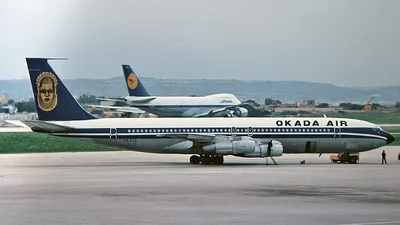
The growth of Okada Air was nothing short of explosive. Throughout the 1980s and into the early 1990s, the airline relentlessly expanded its fleet and its ambitions. Its acquisitions included a diverse range of aircraft, such as the Boeing 727, Boeing 707, Douglas DC 8, and even the massive Boeing 747.
By 1993, researcher Tom Forrest recorded the Okada Air fleet at a staggering 32 aircraft. To put that scale into context, its closest private competitor, Kabo Air, was recorded with 16 planes in the same period. This demonstrated an unprecedented level of private investment and organisational capacity in the nation’s history.
The impact on the domestic system was profound and immediate. By 1989, private airlines were carrying approximately 75 percent of all domestic air passengers in Nigeria. Okada and Kabo Air accounted for the lion’s share of that private traffic.
In less than a decade, the monopoly of Nigeria Airways had been decisively broken, permanently changing the structure of Nigerian air transport. This transformation proved that indigenous Nigerian entrepreneurs could finance and manage businesses in a highly technical and capital intensive industry, much like other forces that reshaped Nigeria’s aviation systems.
Ambitions beyond Nigeria’s borders
Chief Igbinedion’s vision did not stop at Nigeria’s coastline. The airline expanded into cargo services, acquiring a Boeing 707 cargo aircraft and Douglas DC-8 planes to handle international logistics. This was a clear attempt to challenge the foreign carriers that dominated the air freight sector.
By 1988, Okada Air had achieved the status of a Scheduled Domestic Carrier and was actively pursuing approval for scheduled international passenger operations. The scale of the company’s ambition was reflected in its fleet, which included aircraft capable of operating far beyond the country’s borders.
One aircraft, the Boeing 707-365C registered 5N-AOO, became a particularly memorable visual symbol of the company’s aspirations. Although it only served with the airline for a short period in 1988, photographs of it in Okada’s distinctive colours remain an important part of the period’s visual history.
The cost and eventual decline of a pioneering system
The very forces that enabled Okada Air’s rise also contained the seeds of its downfall. The operating environment in Nigeria became increasingly difficult throughout the 1990s. Chronic foreign exchange shortages, the constant high cost of maintenance, and regulatory pressures began to affect numerous carriers.
Okada Air was also not immune to the inherent dangers of the aviation industry. On 7 September 1989, a BAC One-Eleven suffered major structural damage after a hard landing at Port Harcourt Airport, though thankfully there were no fatalities.
A more tragic incident occurred on 26 June 1991. A BAC One-Eleven flying from Lagos toward Kano attempted a forced landing near Sokoto after its fuel supply became critically low due to weather disruptions. The crash destroyed the aircraft and resulted in the deaths of four people, becoming one of the most serious incidents in the airline’s history.
These challenges—economic, operational, and safety-related—began to take their toll on the company. The aviation sector, with its high dependence on global standards and foreign exchange, proved uniquely vulnerable to the economic pressures of the time.
By the end of the 1990s and into the early 2000s, the dominant force of Okada Air had begun to fade. The airline gradually ceased to function as the major scheduled carrier it once was, its decline forming part of a broader period of change in Nigerian aviation as a generation of private enterprise struggled to survive the decade.
The enduring legacy of competition
Okada Air had ceased to function as a major carrier by the turn of the millennium, but the system it created endures. The airline’s most important legacy was not its peak fleet size of 32 aircraft, but the proof of concept it established for Nigeria.
Okada Air demonstrated that Nigerian private capital could successfully finance, build, and manage critical transportation infrastructure on a massive scale. This offered a choice and competition in a sector once reserved entirely for the state.
The airline’s story remains a powerful chapter in the history of Nigerian enterprise and the liberalisation of its economy. It displayed the ambition, organisational capacity, and high risk appetite of a generation of entrepreneurs who sought to build something better than the structures they inherited.
The memory of the distinctive Okada livery, the records of its extensive operations, and the accounts of its former employees all preserve the story of this transformative period. It permanently changed the structure of Nigerian domestic aviation.
The rise, expansion, and eventual fall of Okada Air is far more than just the story of one company. It is a vital case study in the immense possibilities and profound challenges inherent in building new, dynamic systems that could serve the needs of a modern Nigeria. What does this pioneering system tell us about the resilience of Nigerian enterprise today?
