




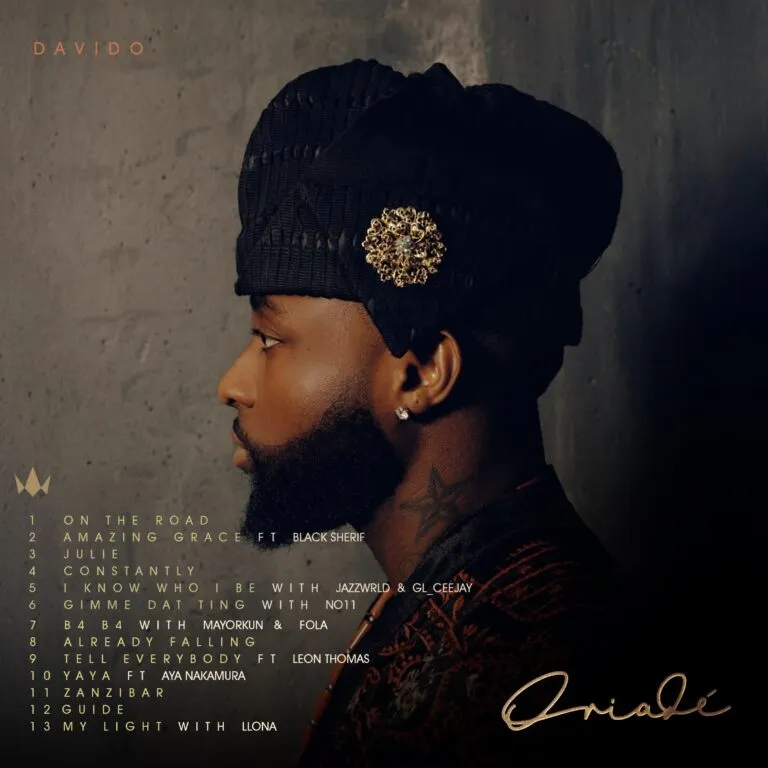
Over fifteen years ago, a young man named David Adedeji Adeleke decided to trust a feeling he couldn’t fully explain. On July 31, 2026, with the release of his sixth studio album, ORÍADÉ, that feeling has been vindicated, crowning the journey of the man behind a generation of Nigerian music that reshaped the sound of a continent.
The album arrived not with a bang, but with a throne. Its cinematic trailer showed Davido in traditional Yoruba attire, a woman’s voice chanting praise as he sat, regal and composed. The message was clear. This wasn’t just another album; it was an arrival. It was the story of a man finally at peace with his own destiny.
The man behind the crown
The album’s title, ORÍADÉ, is a fusion of two Yoruba words: “Orí,” meaning head, spirit, or destiny, and “Adé,” meaning crown. The crown of destiny. It’s a title that speaks volumes about the man who chose it.
From his explosive entry onto the scene, Davido has been a study in contrasts—the son of affluence who craved street credibility, the hitmaker who struggled for album-length respect.
“Over fifteen years ago, I made a decision to trust something I couldn’t fully explain,” he told Billboard recently. “I just knew music was my destiny.” This mission has been the engine of his career, a relentless drive to prove that his place wasn’t bought, but earned.
He has navigated a world that constantly questioned his motives, a journey that mirrors a broader conversation about what it means to be authentically African and successful.
His early persona, “Omo Baba Olowo,” was both a boast and a shield. It acknowledged his privilege while daring anyone to claim it was all he had. But with ORÍADÉ, the posture has changed.
The defiance has softened into a quiet confidence, the sound of a man who no longer needs to shout to be heard. The crown, it seems, is no longer a goal to be chased, but a reality to be worn.
A fifteen-year conversation with his audience
To understand Davido in 2026, you must understand the path he has walked, album by album. His discography is a public conversation, a series of statements and responses between the artist and his audience.
It began in 2012 with Ọmọ Baba Olowo: The Genesis, a project packed with what are now classic hits, but one that felt more like a collection of great songs than a coherent album.
He was still finding his voice. The years that followed were marked by massive singles but a long wait for a sophomore project. When A Good Time finally arrived in 2019, it felt like a deliberate statement piece. But its follow-up, 2020’s A Better Time, was met with criticism.
Fans and critics felt it was bloated with features, a perceived attempt to cater to an American market.
He listened. After bearing the weight of immense personal loss, he returned with 2023’s Timeless, a more balanced and cohesive record that earned him a Grammy nomination. It was followed by 2025’s 5ive, an album seen by some as a placeholder. This history of reception makes ORÍADÉ all the more significant.
It’s the work of an artist who has weathered storms, taken feedback, and emerged with a clearer sense of self.
Inside Oríadé: The sound of a settled king
Davido himself described this album as something he didn’t need to make. “There was really no need to drop an album,” he explained, noting he was just “sitting on so much beautiful music.” This sense of ease permeates the 13-track project. It’s less about proving a point and more about sharing a feeling—gratitude, growth, and love.
The album’s cover art shows him holding an ornate golden crown, a physical manifestation of the title. The lead track, “On The Road,” is a soulful summary of his journey, touching on the price of fame and the challenges of a life lived in the public eye. It sets the tone for a mature, reflective body of work that prioritises emotion over bravado.
Themes of love, particularly for his wife, are central. But it’s also an album about legacy. He reflects on learning from mistakes and the desire to be remembered as someone who shared his blessings, a sentiment heavily influenced by the support of his family through periods of grief. This is Davido the man, husband, and son, not just Davido the superstar.
The collaborator-in-chief
While past albums were critiqued for excessive features, ORÍADÉ uses its seven collaborations with precision. Davido continues to display a sharp ear for A&R, using his platform to elevate others. The album features a diverse cast, from American R&B artist Leon Thomas to French singer Aya Nakamura and Ghanaian star Black Sherif.
He also makes space for the next generation of Nigerian talent, tapping artists like NO 11 and FOLA. The feature with rising artist Llona on “My Light,” a track about the difficulties of touring, was reportedly timed perfectly to coincide with Llona’s own album release. It’s a move that shows Davido’s evolution from competitor to kingmaker, secure enough in his own position to lift others.
Echoes of the past, glimpses of the future
The album isn’t a complete departure from the “Davido-isms” fans know. Critics have pointed out moments where he seems to be chasing past glories, as on the track “Julie,” which sonically recalls an older sound. On “Constantly,” penned by the producer Pheelz, some feel Davido’s own voice gets lost in the collaboration.
But there are also moments of brilliant reinvention. On “Already Falling,” he masterfully interpolates Elvis Presley’s 1961 classic “Can’t Help Falling in Love,” transforming it into something new with the help of Peruzzi’s background vocals. It’s a nod to his global influences and his ambition.
He has openly expressed an interest in movies, drawing parallels to musical artists like Ice Cube and Ice T who successfully crossed over, suggesting his creative journey is far from over.
What Davido’s journey tells us about Nigeria
David Adeleke’s fifteen-year reign is more than a music story; it’s a Nigerian story. He represents a unique archetype: the privileged son who worked tirelessly for public validation, forever balancing the “Omo Baba Olowo” tag with an undeniable connection to the street. His career is a testament to the idea that in Nigeria, ambition and hustle are currencies that transcend class.
His journey has also mirrored the explosion of Afrobeats on the world stage. Long before it was a global phenomenon, Davido was pushing the sound internationally. His 2026 Coachella debut and his contribution to the FIFA World Cup soundtrack are milestones not just for him, but for the entire movement he helped build.
He has also embraced the responsibility that comes with his platform. At a World Cup countdown concert in Los Angeles, he wore a custom jacket bearing the names of abducted students and teachers from Oyo State, a quiet but powerful act of solidarity. It shows the evolution of the Nigerian superstar from entertainer to a figure with a voice on national issues.
The endless debate over his albums versus his singles raises a fundamental question about Nigerian celebrity. Do we demand cohesive, artistic masterpieces, or a relentless stream of cultural moments that define our lives? Davido has provided both, and in doing so, has become a mirror for our own expectations.
ORÍADÉ feels like his answer: the crown has been won, the destiny fulfilled. What matters now is the man who wears it.
