



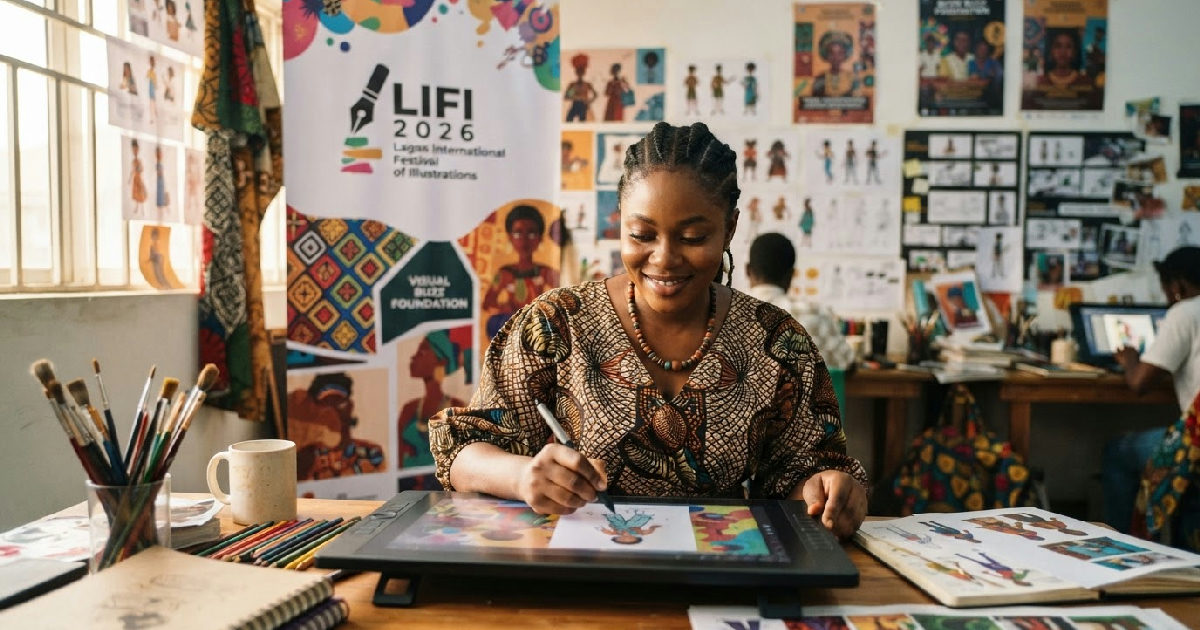
In a small studio in Surulere, a young artist sketches on a tablet, her lines forming a world that is recognisably Lagos but filled with a magic all her own. For years, her imagination, and that of countless others like her, existed in notebooks and on hard drives, a creative current with no clear channel to the sea. Today, that is changing, and the change is being drawn, painted, and rendered into existence.
This is the world that the Lagos International Festival of Illustrations (LIFI) was built for. Now returning for its second edition, the festival is more than an event; it’s the physical manifestation of a cultural shift. It’s a space where the solitary act of creation becomes a public, and global, conversation about what it means to tell a Nigerian story through images.
The Lagos International Festival of Illustrations redefines visual culture
For decades, the visual landscape for many young Nigerians was defined by imports. Children’s books often featured fair-skinned characters in snowy landscapes, and cartoons were beamed in from American or Japanese studios. While Nigeria has a rich history of visual art, a dedicated, modern industry for illustration—the kind that populates book covers, graphic novels, and animation—has been slower to form.
This created a gap: a generation of storytellers was rising, but the visual language to accompany their words often felt borrowed. The Book Buzz Foundation, founded by Ms. Lola Shoneyin, identified this not as a lack of talent, but a lack of infrastructure. The foundation saw a need to train, connect, and elevate a scattered community of artists into a cohesive industry capable of defining its own aesthetic.
The challenge was to build a bridge between raw Nigerian talent and global publishing standards. This need to define a modern visual identity connects to the long history of Nigerian art seeking local definition, long before Nigerian cinema’s colonial roots were being debated. LIFI is the contemporary extension of that impulse: to own the narrative, not just in word, but in image.
The core mission of the Lagos International Festival of Illustrations is to ignite creativity and build skills. It specifically addresses the need to train a new generation of Nigerian illustrators. This is particularly vital for children’s books, ensuring young readers see themselves in the stories they consume.
A global conversation on a Lagos stage
From September 17-19, 2026, Lagos will once again become a global nexus for the art of illustration. The Book Buzz Foundation is bringing together a formidable gathering: 45 of Nigeria’s most promising illustrators will work alongside nine internationally acclaimed artists. This year, the guest list speaks to a deliberate and widening dialogue.
In partnership with the Embassy of Italy, the festival welcomes a trio of Italian illustrators: Elenia Beretta, Giulia Orecchia, and Cynthia Alonso. They are joined by a Polish contingent featuring Joanna Rusinek, Zosia Dzierżawska, and Zosia Frankowska. Representing Latin America are Gina Rosas Moncada, Caio Zero, and Geraldine de Leon, some of whom are returning after the inaugural event, a testament to the connections forged.
The festival deliberately mixes these global perspectives with the vibrant energy of the local scene. It’s an act of creative diplomacy, a structured space for artists to exchange techniques, styles, and philosophies. What happens when a Polish artist, raised on a legacy of minimalist poster design, collaborates with a Nigerian artist whose work is steeped in visual tradition? The answer is a new kind of visual language, born in Lagos but fluent in global ideas.
The three Latin American representatives—Gina Rosas Moncada, Caio Zero, and Geraldine de Leon—were also participants in the well-attended 2025 edition. Their return underscores the value of the collaboration and the lasting commercial connections that LIFI aims to foster. The festival actively seeks to position Lagos as a global hub for excellence in illustrations.
Building skills for the future of Nigerian storytelling
The power of LIFI lies in its structure, which is designed to build an industry, not just host a cultural event. While exhibitions will showcase finished work, the heart of the festival beats in its hands-on workshops, live drawing demonstrations, and intensive portfolio clinics. These sessions are where the real work happens, demystifying the path from a passionate artist to a paid professional.
Emerging Nigerian illustrators will have the chance to get direct, unfiltered feedback from established veterans. This mentorship is critical in an industry where career paths are not always clearly marked. The festival is a space where cultural ambition meets curated community, creating connections that lead to collaborations and commercial opportunities long after the three-day event concludes.
This practical focus is central to the mission of the Book Buzz Foundation. The foundation is dedicated to promoting literacy by developing reading spaces for children and organizing cultural festivals. The festival is a key pillar in its ambitious strategy to publish 100 Nigerian children’s books by the end of 2027.
To achieve that ambitious goal, Nigeria needs a small army of skilled illustrators who can create worlds that captivate young readers. LIFI is the training ground for that army, ensuring the stories being written are matched by world-class visual storytelling that elevates Nigerian culture.
The power of seeing ourselves on the page
At its core, the drive behind LIFI is about representation. For a child in Nigeria to pick up a book and see a character who looks like them, living in a house that resembles their own, eating food they recognise—this is not a small thing. It is an act of validation. It tells them their world is worthy of story, worthy of art.
The inaugural festival in 2025, held at OUIDA House in Lagos, laid the foundation. It brought together artists from Spain and Slovenia alongside their Nigerian counterparts, proving there was a hunger for this kind of international exchange. The 2026 edition is an escalation, a doubling-down on the belief that Nigerian visual culture has a vital contribution to make on the world stage, a continuation of Nigeria’s cultural journey.
By creating a consistent, high-quality annual event, the Book Buzz Foundation is building institutional memory. It is creating a reliable calendar moment that artists can plan for, aspire to, and build around. It’s how a scene becomes a self-sustaining ecosystem, positioning Lagos not just as a consumer of global culture, but as a global hub for excellence in illustration. The 2025 edition also hosted 9 international and 45 Nigerian illustrators, setting a successful precedent for the upcoming event.
The future of Nigerian storytelling, in full colour
The rise of a professional illustration scene is the next chapter in Nigeria’s global cultural ascendancy. In the last two decades, Nollywood has revolutionised continental cinema, and Afrobeats has become the world’s dominant sound. Nigerian writers, from Chinua Achebe to a new generation of literary stars, have long commanded international respect. Illustration and animation are the next logical frontiers.
Events like LIFI are the crucibles where that future is being forged. They provide the skills, the network, and the confidence for local artists to compete anywhere in the world. More importantly, they help artists create authentic, compelling work for their own communities. It is a long-term investment in the nation’s imaginative capital, fostered by the hard work of the Book Buzz Foundation.
As these 54 artists gather in Lagos from September 17 to 19, they will trade techniques on shading and colour theory. They will discuss contracts and intellectual property. But beneath it all, they will be engaged in a much deeper project. They are deciding what Nigeria looks like, one line at a time. The question their work poses is not just about art, but about identity: in the 21st century, how will Nigeria choose to see itself?
