




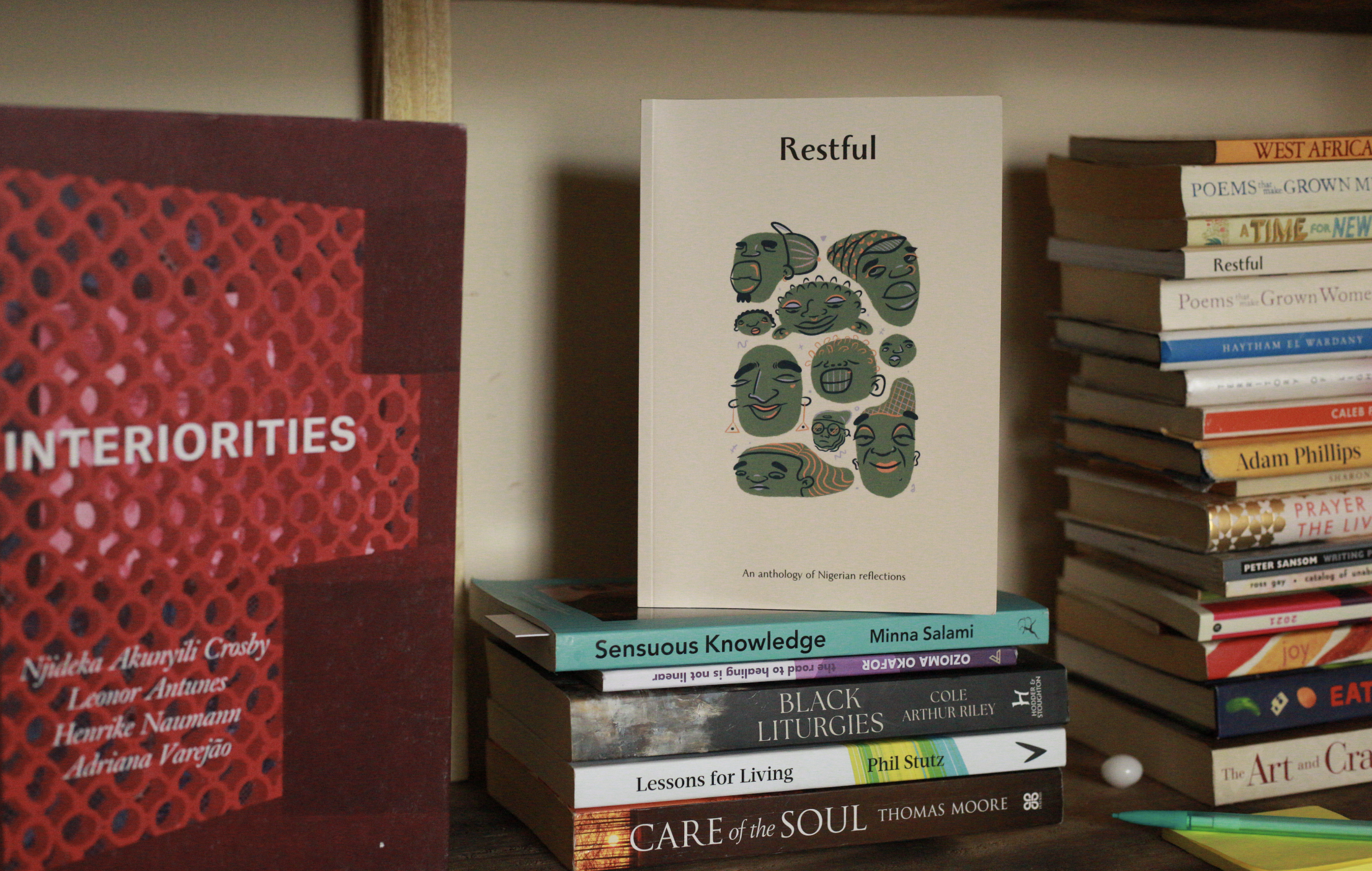
In her latest work, Immaculata publishes new details about her 2017 journey to piece her life back together after intense personal struggle.
The book gathers deeply intimate essays, poems, interviews, and photography from a cast of Nigerian writers and artists who explore what it means to find repose and healing in a nation that often demands constant vigilance and hustle. Highlighted within the collection is Stella Inabo’s widely shared piece, “The Passport Photo of Stephen Aduku,” a tender reflection on the legacy of a late father.
Tracing the Curator’s Evolution from Newsletter to Anthology
Abba’s project didn’t start with a publisher’s contract or a formal call for submissions. It began as an organic, evolving platform for processing the difficult question: how do you rest when the environment around you is hostile to the idea?
This quest for stillness first took shape as a simple newsletter, a digital space where she could explore these themes without pressure. It progressed to a curatorial Instagram page, where she built a community around the aesthetic and philosophy of slowing down, before transitioning to a radio show on Oroko Radio.
By 2025, the weight of these accumulated years of exploration and community-building demanded a physical form. The resulting anthology is not just a collection of works; it is the physical manifestation of Abba’s eight-year personal and professional evolution.
Abba described the book in her introduction as “a piece of her heart,” offering an explicit invitation to readers to “sit with oneself.” The central philosophy is a quiet assertion that “beauty and sweetness are still allowed, even now, even here,” regardless of the external pressures of Nigerian life.
This approach transforms the act of publication into a therapeutic act, both for the curator and the readership.
The necessity of rest in a demanding society
The very title, Restful, challenges the prevailing cultural narrative of relentless productivity often celebrated in Nigerian society. Abba centers the conversation on the necessity of pausing in a country that “rarely affords its people the luxury” of stopping.
It’s an examination of survival mechanics, where slowing down is not seen as surrender but as a strategy for resilience. When the news cycle is dominated by political and economic turmoil, finding spaces for personal tranquility becomes a subversive act of self-preservation. This project aligns with a growing movement among younger Nigerians seeking spaces for reflection and cultural ambition outside the traditional grind.
The Emotional Core: Grief, Identity, and the Weary Heart
The power of the anthology lies in its contributors’ willingness to share raw, often painful, human experiences that underpin the need for rest. These are not academic reflections, but deeply felt stories of physical and emotional exhaustion.
Stella Inabo’s “The Passport Photo of Stephen Aduku” has resonated most widely with readers. It serves as a devastatingly tender letter to her late father, Wing Commander Stephen Inabo, focusing on the pain of lost potential and the shifting nature of identity.
Inabo reflects on her father’s career in the Nigerian Airforce, noting his disappointment after being relegated to a desk job due to airsickness—a condition she realizes she shares. She grapples with the question of whether his professional setbacks, which eventually led to his retirement, hastened his death.
This personal grief becomes a mirror for broader national anxieties about unfulfilled dreams and the way career identity can consume a person. Inabo writes, “My job is also my identity now. If I am not Stella Inabo, content writer at Float, then who am I?”
Loss, Chronic Illness, and Disappointment
Other contributions dive into similar areas of vulnerability. Hauwa Saleh Abubakar’s piece, Color Me Chronic, confronts the specific kind of grief tied to “chronic illness and diminished capacity.” It is a necessary acknowledgment of bodies that cannot meet society’s demand for endless motion.
Daniel Adeyemo’s “Freewill” cuts deep into the reality of expectations that are rarely met, closing with a powerful couplet about disappointment. Meanwhile, Ozoz Sokoh shares her experience of “losing her voice entirely” during a quarter-life crisis, an episode that necessitated a physical move far from home to regain her footing.
These writers articulate the collective weariness that stems not just from poverty or insecurity, but from the daily attrition of living in a system prone to systemic failure. The anthology positions these personal setbacks as reflections of the nation’s struggle to care for its people.
Sites of Care: Food, Hair, and Intergenerational Healing
Beyond abstract discussions of grief, Restful grounds the concept of care in physical, everyday acts passed down through families. Abba’s curatorial choice here emphasizes that rest is often administered through small, loving gestures.
Gbope Onigbanjo writes about the comfort found in noodles prepared by a mother who was nursing her back from chronic stress. This simple, domestic act becomes a meditation on unconditional maternal support, illustrating how the mundane can hold immense therapeutic power.
Oyindamola Depo-Oyedokun’s “Who Natural Hair Help?” focuses on the ritual of hair care, illustrated with photography by Adetutu Adediran. Her work traces the lineage of self-care, detailing how a mother’s effort to relieve her daughter’s pain became a formalized model for an entire generation of Nigerian women.
This section subtly reframes self-care from a privileged indulgence into an essential cultural legacy. It shows how Nigerian women, in particular, have codified methods of restorative practice using the resources of the home and local economy.
The power of lived experience in a time of crisis
The shift from high literary reflection to the grounded reality of food and hair demonstrates Abba’s commitment to accessibility. Her goal isn’t to prescribe a luxury retreat but to show that rest is found in small, achievable actions.
It emphasizes that the best examples of care and relief often originate locally, within the structures of family and community. This grounding connects the emotional labor detailed in the collection to the tangible economic and social life of Nigeria, recognizing, for instance, the immense value placed on the local economy of caregiving.
Conversations with Unlikely Witnesses to History
The final section of Restful consists of three critical conversations, highlighting Abba’s ability to draw profound insight from varied voices. These interviews are perhaps the sharpest illustration of her role as a researcher and artist.
Abba conducts an interview herself with photographer Rachel Seidu, ensuring the visual artists who capture rest are also heard. More surprisingly, Oluwakemi Agbato sits down with Olayiwola Ojo, a retired designer of Nigeria’s banknotes.
The decision to interview a man whose professional life was dedicated to designing the symbols of Nigeria’s economic identity—the ultimate source of much modern weariness—is a brilliant curatorial stroke. Ojo represents the institutional side of the country’s pressures, offering a different kind of witness to history.
The collection closes with a three-way dialogue between Abba, the poet Wana Udobang, and the documentarian Etinosa Yvonne. Their conversation focuses on the idea of healing as a personal responsibility, a burden that “no one else can carry for you.”
Immaculata Abba’s enduring message of self-possession
The deliberate structure of the anthology—moving from personal reflection to physical acts of care, and finally to institutional and philosophical discussions—shows Abba’s skill as an architect of ideas. She guides the reader through increasing levels of complexity while always returning to the individual’s internal life.
Abba, who is also a writer and researcher, established the foundation of this anthology with a sense of personal imperative. By naming her own emotional collapse as the genesis of the project, she lends enormous credibility to the final product.
The anthology, published by Studio Styles and supported by a grant from the Goethe-Institut Nigeria’s Support and Connect initiative, is a testament to the power of self-initiated projects. The cover illustration by Amina Gimba reinforces the collaborative, artistic spirit of the endeavor.
The enduring message woven through Restful is that the search for peace begins within. Immaculata Abba’s journey from a quiet personal promise to a published collection for the masses provides a clear, vital pathway for Nigerians seeking to understand their own histories of pain, resilience, and hope.
She has not just created a book; she has offered a survival manual for the spirit, asking readers what they will allow themselves to possess when so much else feels lost.
