




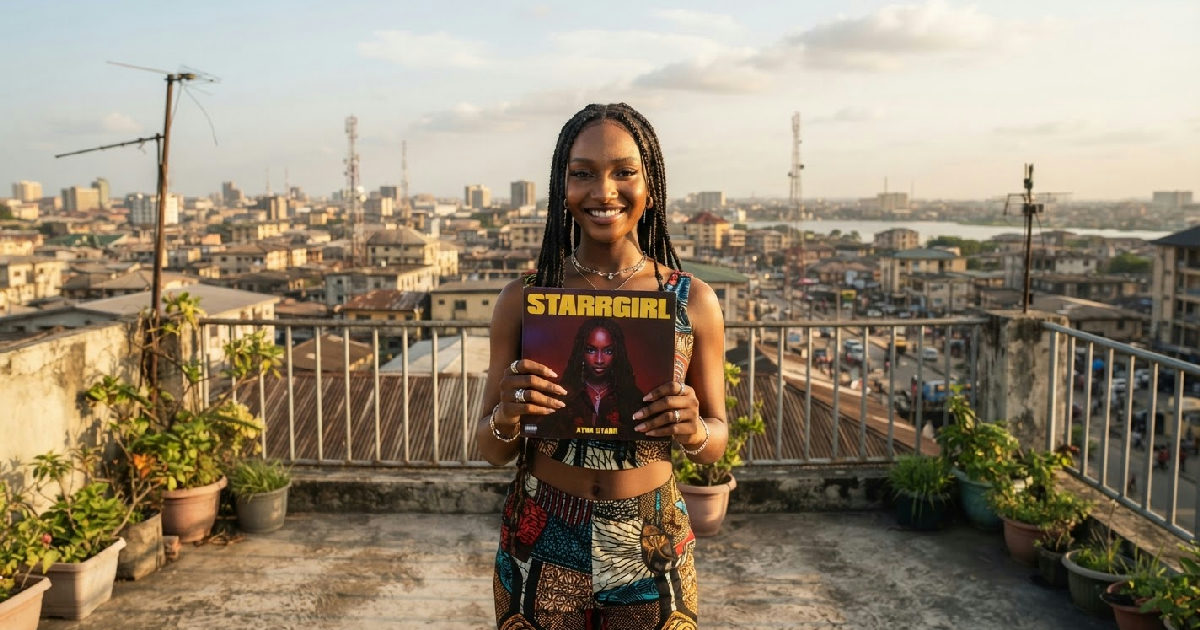
The Ayra Starr Starrgirl album, released in August 2026, reflects the Afrobeats artist’s newfound independence and self-discovery. Ayra Starr, the 24-year-old Afrobeats artist, had spent months living alone, far from the pressures of Lagos and the watchful eyes that come with early superstardom. This new independence, a catalyst for deeper self-discovery, pulses through her latest offering, the Ayra Starr Starrgirl album.
Released this August, the album isn’t just a collection of sixteen tracks; it’s a bold declaration, a definitive statement from an artist who has traded the narrative of youthful “becoming” for the certainty of “being.”
From teen angst to self-assured artistry on the Ayra Starr Starrgirl album
It’s a record that asks nothing of its listeners except to keep pace, assuming they already know the woman behind the mic. The title itself, Starrgirl, is the first signal.
It consciously abandons the age-centric titles of her previous works, 19 & Dangerous and The Year I Turned 21, signifying a profound internal shift that shapes every beat and lyric. This isn’t about a moment in time; it’s about an identity that feels fully formed.
Ayra Starr’s journey has been one of public growth, each album a chapter in a rapidly unfolding life. Her 2021 eponymous EP first introduced a vibrant, raw talent. Then came 19 & Dangerous, capturing the fierce spirit of a fast-talking teenager navigating newfound fame.
The Year I Turned 21 offered a more reflective, ballad-heavy sound, hinting at a willingness to explore vulnerability. But in Starrgirl, that exploration has blossomed into full-blown confidence.
As Ayra Starr herself explained in a recent Variety interview, “Starrgirl isn’t an alter ego so much as the part of her that’s already whole — a version of herself defined by ‘I am’ instead of ‘I have to be.’”
This shift wasn’t just an artistic decision; it was deeply personal. Growing up as an African girl in the public eye often comes with an unspoken expectation to constantly present a polished, complete version of oneself.
Relocating to New York, living alone for the first time, and experiencing life outside the public gaze — waking up late, going to parties — allowed her to peel back those layers of pressure. This newfound freedom resonates throughout the album, evident in how unhurried her vocals sound, even on the most intricate productions.
A cosmopolitan sound for global ambitions
The sonic architecture of Starrgirl pushes boundaries, demonstrating Ayra Starr’s ambition to blend tradition with a wider, more cosmopolitan sound. Terry Apala’s praise vocals open the album, an immediate anchor to her roots before she launches into a brash, unhurried performance. The album weaves through a rich tapestry of genres: Afrobeats, Soul, R&B, Pop, Dancehall, House, and Bouyon.
Tracks like Amazing, featuring kwn, delve into intimate R&B territory, showcasing some of her most confident vocal work. Here, she reportedly trusted the recording process, not knowing where it would lead, a testament to her embrace of spontaneity. Meanwhile, Pressure, with Leon Thomas, offers a glossier Afrobeats pulse, a seamless blend of his polished style and her raw instincts.
Pushing boundaries with unique production
The album truly shines in its structural daring. Tornado, built by Shizzi and Skillies, stands as a clear statement of self-assurance, its dense wordplay rewarding repeated listens. One of the album’s boldest moves comes with Midnight in New York.
This track dives into house and techno, not as an Afrobeats artist merely experimenting, but with a full, genuine immersion. Ayra Starr’s voice and story feel truly embedded within the sound, not simply superimposed.
Her co-production credit on Midnight in New York alongside LONDON and Matt James highlights her active role in shaping the music’s architecture. Then there’s Ms. Paper, a track built on a Bouyon rhythm, a sound rarely heard in Nigerian pop.
Its inclusion, complete with Theodora’s French verse, exemplifies an artist who has genuinely inhabited unfamiliar sounds rather than just sampling them for novelty. It’s a testament to redefining artistic expression through diverse influences.
Collaborations and cultural conversations
Starrgirl masterfully navigates a landscape of collaborations, revealing fascinating insights into cultural and sonic exchanges. The Nigerian features, particularly Wizkid on Gimme Dat and Rema on Who’s Dat Girl, feel less like guest appearances and more like natural conversations between artists who share a common musical upbringing.
The chemistry with Rema, on a track described as five years in the making, is especially palpable, an exchange between equals.
These local collaborations possess an inherent ease that even significant international star power can’t quite replicate. While international guests add dimension, ZAYN on Heaven Baby stands out as a clear exception. His falsetto intertwining with Ayra Starr’s creates one of the album’s most emotionally resonant moments, needing no translation to connect with listeners.
Similarly, Theodora’s contribution to Ms. Paper works because the Bouyon rhythm provides a shared musical language, bypassing potential linguistic barriers.
The album also serves as Ayra Starr’s subtle but firm rebuttal to persistent rivalry narratives often peddled by fans and blogs. Instead of directly addressing these comparisons, she lets the music speak for itself. The undeniable confidence and artistic depth of Starrgirl make a more powerful statement than any verbal retort ever could, shifting the conversation to her undeniable talent.
The intentional crafting of a complete work
In an era often dominated by single-driven albums, Starrgirl distinguishes itself as a meticulously crafted body of work. All the pre-released tracks — Gimme Dat, Tornado, Hot Body, Who’s Dat Girl, Where Do We Go — earn their place within the album’s larger narrative.
Yet, some of the most compelling moments come from songs the public hadn’t heard before: Amazing, Ms. Paper, Midnight in New York, and Dance.
This careful sequencing and the emergence of new favorites from a project already boasting successful singles demonstrates a deliberate artistic vision. It’s a strategy that builds anticipation and rewards deeper listening, moving from a brash opener to sensual mid-tempos, genre experiments, and a devotional closer without ever causing sonic whiplash. The album allows for a deeper cultural impact, offering a cohesive experience.
Much of this cohesion can be attributed to Johnny Drille, who mixed and mastered the bulk of the tracklist. His creative relationship with Ayra Starr stretches back to the beginning of her career, and his fingerprints are evident in the unified feel of the record, even as it boldly hops between genres.
This consistent touch ensures that the album, despite its diverse sounds, maintains a singular artistic voice.
Embracing womanhood and global ambition
Starrgirl represents an undeniable step forward from The Year I Turned 21. That earlier album was a raw, diaristic account of a young woman grappling with wins, losses, and the complexities of control over her own life and body. It was about the process of becoming, filled with questions and the occasional rawness of youth.
This new album doesn’t discard that emotional intelligence; rather, it matures it. It moves past narrating the process of growing up and instead confidently embodies the outcome of that growth. Where her previous work asked questions, Starrgirl provides answers, primarily by refusing to re-ask them.
She now aims for “global hegemony,” shedding any internal conflict that might have linked her distinctly Nigerian branding to perceived limitations on global stardom. This artistic maturity reflects a wider trend among Nigerian artists who are finding ways to celebrate their heritage while shaping new narratives on the global stage.
Ultimately, Starrgirl solidifies everything that first drew listeners to Ayra Starr: her sharp wit, intricate wordplay, confident bravado, and a refusal to be confined to a single aesthetic. These qualities have been honed and arranged into an album that no longer needs to announce its arrival or justify its existence.
It simply is, a powerful statement from a young artist who has truly found her footing.
