



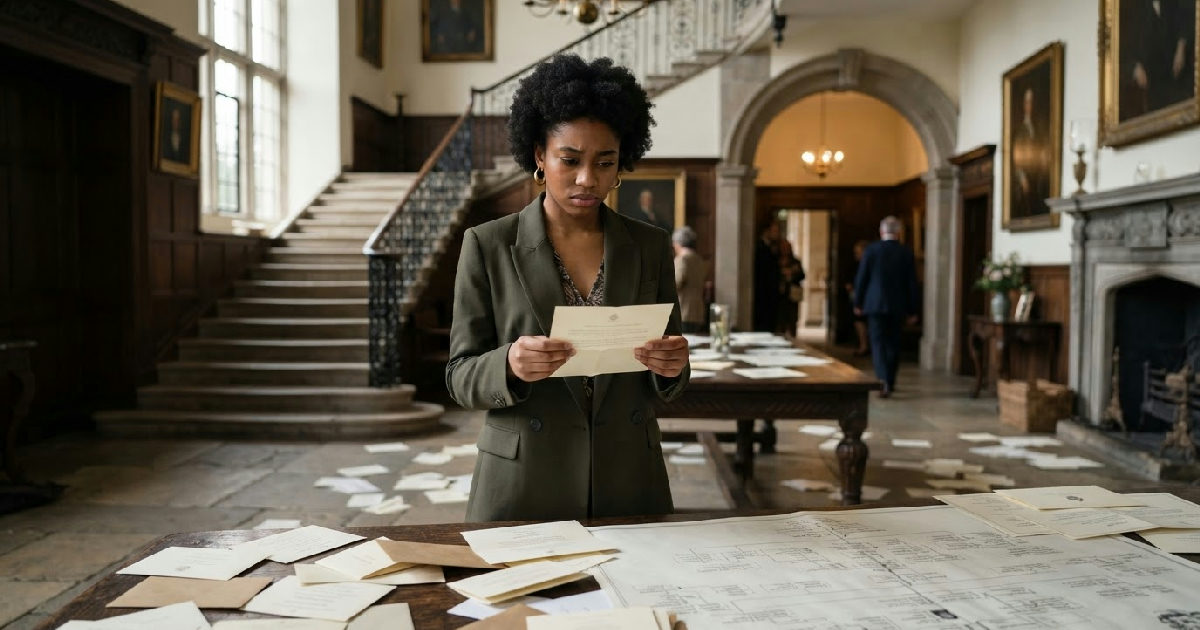
Derin, a British-Nigerian student, stood on the cusp of Cambridge University, her future bright before her. An unexpected invitation to Professor Alexander Darnley’s summer ball at the historic Kenfield estate plunged her into a past steeped in secrets.
What began as a celebration turned into a cutthroat inheritance competition, revealing a family history far darker than she could have imagined in Aleema Omotoni Winners & Liars.
This is the world of Aleema Omotoni’s latest Young Adult (YA) novel, Winners & Liars, published by HarperCollins in June 2026. The book isn’t just a thrilling mystery; it’s a profound exploration of who gets to control the narrative of the past. It asks probing questions about what histories we inherit and what truths we are compelled to uncover for ourselves.
A Victorian Inheritance Game in Aleema Omotoni Winners & Liars
The story kicks off when Derin and her highly ambitious university preparatory group, the Kenfield Set, gather at the sprawling Kenfield estate. They had expected a joyful summer ball hosted by Professor Darnley and his novelist wife, Cornelia, but tragedy strikes, leaving them instead at a will reading.
In a stunning twist, the Darnleys’ aristocratic children find themselves disinherited. The students are offered a chance to compete for the family’s multimillion-pound fortune and the estate itself.
This unique contest is styled as a Victorian, literary-inspired game, echoing Cornelia Darnley’s bestselling historical novel about Black Victorian elites. There is no official list of participants for this fictional inheritance competition.
Participants don period costumes and navigate complex parlour games and secret passageways hidden within the historic home. For Derin, a win represents more than just wealth; it’s a pathway to secure her working-class family’s future. The stakes couldn’t be higher, driving her personal ambition.
But this competition quickly unravels into a dangerous web. Scheming relatives, a blossoming romance, and a mysterious note all point to a deeply buried family secret. Derin soon discovers that the history behind the inheritance is tragically “soaked in lies and blood.”
The Hidden Narratives of Kenfield Estate
The mystery in Winners & Liars operates on two critical levels. Derin must not only discern who among the competitors she can truly trust. She also confronts the deliberate distortions chosen by those who came before her, especially concerning the estate’s true legacy.
Omotoni herself aptly describes Winners & Liars as “Knives Out meets Dead Poets Society.” This comparison highlights the novel’s layered complexity. It blends the intricate puzzle-solving and suspense of a classic whodunit.
It also brings the intellectual and emotional depth of young people challenging established norms and discovering their voices. This pursuit of authentic expression, much like Iheoma Uzomba’s interdisciplinary poetry, shapes fresh perspectives.
Aleema Omotoni Explores Identity and Belonging
Aleema Omotoni is an award-winning British-Nigerian author recognized for her thoughtful narratives. Her work consistently centers Black teenagers as they navigate complex coming-of-age experiences, relationships, and often, worlds both contemporary and fantastical.
Her debut novel, Everyone’s Thinking It, won the 2024 NAACP Image Award for Outstanding Literary Work—Youth/Teens. It explored themes like bullying, classism, and identity within an elite boarding school. Winners & Liars continues this, delving deeper into questions of ambition and belonging.
YA literature serves as a crucial space for young readers to engage with complex societal issues. Omotoni leverages this platform to tackle difficult questions about historical truth and personal responsibility. Her books resonate strongly with readers seeking authentic representation and challenging narratives.
Beyond the Page: Understanding Historical Erasure
The novel’s focus on the “whitewashing of history” is particularly resonant. It critiques how dominant narratives often omit or misrepresent the experiences of marginalized groups, especially Black individuals. This applies particularly to Victorian Britain, where primogeniture obscured women’s and people of color’s contributions.
Omotoni’s work forces readers to consider how these historical omissions impact contemporary identity and belonging. Her ability to weave these weighty themes into an accessible mystery ensures younger audiences engage with critical cultural heritage. The exploration of cultural narratives, such as how African visual art shapes identity, helps illuminate these broader discussions.
Crafting a World from History Degrees
Omotoni openly acknowledges drawing on her history degrees when crafting Winners & Liars. This academic background is evident in the novel’s meticulous detail, from Victorian-inspired competition mechanics to the nuanced portrayal of historical distortion. She didn’t just want to tell a story, but to make history itself a character.
Her expertise elevates the narrative beyond a simple whodunit. It transforms the inheritance game into a sophisticated commentary on historical interpretation and its enduring consequences. The novel acts as a literary bridge, connecting past injustices with present-day identities and struggles for recognition.
Remarkably, Omotoni reportedly wrote the novel in just one month. This swift creation process for such a layered story speaks volumes about her vision and command of craft. It highlights a rare combination of speed and depth, delivering a timely and impactful work.
The British-Nigerian Literary Wave
Aleema Omotoni stands as a significant voice within a growing cohort of British-Nigerian authors. These writers are increasingly shaping contemporary literature with their explorations of identity, cultural heritage, and the complexities of the diaspora experience.
Authors like Oyinkan Braithwaite and Nikki May have paved the way. Omotoni’s contribution enriches this literary space by focusing on the unique challenges of Black British teenagers. Her perspective offers a fresh lens on dual heritage.
The critical acclaim for Winners & Liars, including starred reviews from *Kirkus Reviews* and *School Library Journal*, further solidifies Omotoni’s position. These accolades signal the novel’s “exceptional merit” and its potential for “staying power,” influencing young readers and wider literary conversations. Omotoni’s storytelling, much like Zaynab Alkali’s literary impact, introduces new perspectives to a diverse audience.
Ultimately, Winners & Liars is more than a YA mystery; it’s an invitation. It invites readers to look closely at the stories they’ve been told, to question their origins, and to understand the power embedded in who controls them. What will you choose to inherit, and what will you choose to unearth?
