




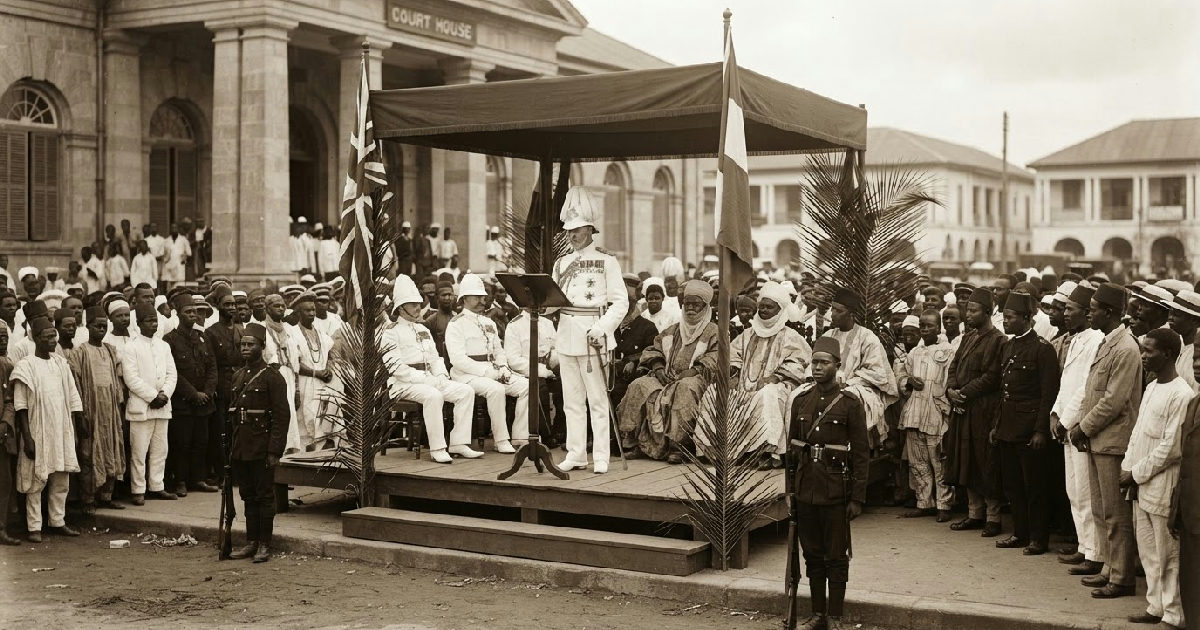
On 1 January 1914, a ceremony at the old Court House in Tinubu Square, Lagos, marked a pivotal administrative shift for Britain’s West African territories. It was the formal proclamation of the 1914 Nigeria Amalgamation, bringing together the Northern and Southern Protectorates.
Yet, in popular memory, the story often centres on a specific colonial building in Lokoja, a narrative that simplifies a far more intricate historical process.
Lokoja’s enduring role in the 1914 Nigeria Amalgamation
This complex reorganisation wasn’t a single event in one location. Instead, it was a multi-stage affair involving decisions made in Britain, symbolic acts in Lagos, and further ceremonies in Zungeru. To understand how colonial Nigeria truly came into being, we must look beyond the enduring myth of the “Lokoja House” and examine the specific actors and sites that shaped this transformative moment.
Long before the 1914 Nigeria Amalgamation, Lokoja had already established itself as a critical hub for British imperial ambitions. Its strategic location near the confluence of the Niger and Benue rivers made it indispensable for European commerce, military movements, and communication into the interior. The Royal Niger Company, a powerful British chartered company, operated extensively from Lokoja in the late nineteenth century.
A decisive moment for Lokoja came on 1 January 1900. On that day, the Royal Niger Company’s chartered administration formally ended. The British government then assumed direct responsibility for the territories it had overseen. In a solemn ceremony at Lokoja, the company’s flag was lowered, and the Union Flag was raised, signifying a new era of direct British rule in Northern Nigeria.
Frederick Lugard, then Britain’s High Commissioner for Northern Nigeria, formally proclaimed this new administration. This ceremony solidified Lokoja’s place in the establishment of the Protectorate of Northern Nigeria. It’s a moment often confused with the later 1914 amalgamation, blurring important distinctions in the historical record.
Despite its initial prominence, Lokoja’s administrative centrality waned. By September 1902, the headquarters of Northern Nigeria had shifted to Zungeru. While some important departments remained in Lokoja, its status as the principal administrative centre had passed.
The persistent narrative of the “Lokoja Amalgamation House”
Even today, the popular image of a single Lokoja House hosting the 1914 Nigeria Amalgamation persists. For instance, the National Library of Nigeria’s 2023 digital repository includes a record titled “The Picture of the House That Hosted the Amalgamation of Nigeria.” Its description identifies a Lokoja building with this monumental event.
Lokoja certainly boasts a collection of colonial-era structures connected to Sir Frederick Lugard and early British administration. Among these are Lugard’s Senior Staff Quarters and a room sometimes called Lugard’s Conference Room. Mount Patti also features a rest house historically associated with Lugard. These sites serve as tangible links to the period of colonial consolidation.
But these historical associations, while crucial for understanding Lokoja’s deep past, do not mean the 1914 amalgamation itself was physically enacted there. The actual constitutional reorganisation was a much broader process. It involved legal instruments drawn up in Britain and public ceremonies conducted in multiple Nigerian locations, not just one.
Sir Frederick Lugard’s blueprint for unification
Sir Frederick Lugard, a central figure in extending British authority across Northern Nigeria, returned to the region in 1912. He had previously served as Governor of Hong Kong. His new mandate was ambitious: to oversee Northern and Southern Nigeria and devise a workable plan for their administrative unification.
On 9 May 1913, Sir Frederick Lugard submitted his detailed proposals for amalgamation to the Colonial Office. He envisioned a central authority led by a Governor-General. Crucially, his plan also retained substantial regional administrative structures. This meant that existing institutions, laws, and arrangements in Northern and Southern Nigeria wouldn’t immediately become identical.
The goal was to create a unified governmental command while allowing for locally tailored governance. It’s worth noting that during this period, Lugard was known as Sir Frederick Lugard. He was only elevated to the peerage as Baron Lugard of Abinger much later, in 1928, a detail often overlooked in casual historical references.
Britain’s constitutional framework for the amalgamation
The true genesis of the 1914 Nigeria Amalgamation lies in the constitutional instruments formally authorised in Britain. One of the most significant was the Nigeria Protectorate Order in Council, 1913. This pivotal order was made at Windsor Castle on 22 November 1913.
It was designed to come into operation on 1 January 1914. This order formally transformed the separate Protectorates of Northern and Southern Nigeria into the Protectorate of Nigeria. There was a subtle yet important constitutional distinction in this arrangement.
The Colony of Nigeria was not simply absorbed into this new Protectorate. Instead, separate Letters Patent, dated 29 November 1913, dealt with its status. Under these new arrangements, the Colony and the Protectorate together formed what became commonly known as Nigeria, all placed under the authority of a Governor-General.
This means the familiar image of Lugard personally signing a single document in a single Nigerian building doesn’t fully capture the complex constitutional process. British Colonial Office planning, Lugard’s detailed proposals, and royal authority all converged to form this reorganisation. This framework laid the groundwork for Nigeria’s future governance.
The public ceremonies: Lagos and Zungeru take centre stage
When the new constitutional arrangements took effect on 1 January 1914, Nigeria witnessed several public ceremonies marking the change. The most widely documented was held at the old Court House in Tinubu Square, Lagos. This building is also referred to in historical accounts as the Supreme Court Building.
Sir Alan Burns, who would later serve as Governor of Nigeria, provided an important eyewitness account of this occasion. Having arrived in Southern Nigeria in 1912, Burns was personally present in Lagos when the amalgamation was proclaimed. His recollections confirm the Tinubu Square location as central to the public ceremonial history.
Historian Emeka Keazor notes that the Lagos ceremony took place at approximately 9 a.m., with Sir Frederick Lugard presiding before an invited gathering. In his Amalgamation Day speech, Lugard announced the approval and immediate implementation of his proposals. This speech formally placed Nigeria under a Governor-General.
The former Northern Nigeria became the Northern Provinces, and the Protectorate of Southern Nigeria became the Southern Provinces. The Colony retained its distinct constitutional identity within this broader governmental structure. But Lagos wasn’t the only site for these inaugural events.
Following the Lagos ceremony, Lugard travelled north. A further amalgamation ceremony was held in Zungeru on 3 January 1914. Zungeru’s involvement was historically significant because it had served as Northern Nigeria’s principal headquarters since 1902. It remained an important administrative centre at the time of the amalgamation.
The Zungeru event also formed a crucial part of the public inauguration of the new governmental arrangement. The chronology is clear: constitutional decisions were made in Britain in November 1913, coming into effect on 1 January 1914. This was followed by a major proclamation ceremony in Lagos, then another in Zungeru two days later.
Beyond amalgamation: the enduring administrative divide
The term “amalgamation” itself can be misleading. It often suggests a voluntary merger of two completely independent Nigerian states. But this was not the reality. Northern and Southern Nigeria were, in fact, territories under British colonial rule. The 1914 Nigeria Amalgamation was purely an imperial constitutional and administrative reorganisation carried out by Britain.
It was not a treaty negotiated and signed by elected representatives of the Nigerian peoples. Nor did it immediately create a completely uniform political system across the entire territory. Lugard’s Amalgamation Day speech had explicitly stated that regional administrative distinctions would persist.
Indeed, separate local structures, laws, and administrative practices continued to operate. Central departments and authority became increasingly coordinated under the Governor-General, but significant differences between the North and South remained. These administrative distinctions would continue to be politically relevant long after 1914, shaping many aspects of Nigeria’s future.
Another common misconception claims the 1914 amalgamation was a contract set to expire after exactly 100 years. This popular story circulated widely around 2014. However, the constitutional documents contained no such termination date.
Nigeria’s centenary celebrations in 2014 simply marked 100 years since the amalgamation took effect. They did not signify the end of a century-long agreement. The amalgamation was a colonial governmental reorganisation, not a lease or treaty between two independent Nigerian entities.
Lokoja’s lasting importance in Nigeria’s formation
Distinguishing the events of 1900 from those of 1914 does not diminish Lokoja’s significance in Nigerian history. On the contrary, it enriches our understanding of the town’s multifaceted past. Lokoja was profoundly connected with the transition from chartered company rule to direct British colonial government.
The ceremony of 1 January 1900, where the Royal Niger Company flag was replaced by the Union Flag, remains a major moment in the creation of the Northern Nigerian colonial administration.
The town’s strategic location at the Niger and Benue confluence also made it crucial for British transportation, military movements, commerce, and communications throughout the Niger territories. These strategic considerations often intertwined with the development of military structures in colonial Nigeria.
Many of its colonial buildings still stand today, serving as powerful physical reminders of the period when British authority was consolidated in the region. Lokoja, therefore, holds a prominent place within the long and complex history that ultimately led to the 1914 Nigeria Amalgamation. Its story intertwines with constitutional developments in Britain and the public ceremonies held in both Lagos and Zungeru.
Understanding these distinct yet interconnected moments offers a far deeper picture of the political and administrative processes that shaped colonial Nigeria. It prompts us to consider how these historical layers continue to influence the nation’s identity today, even as popular narratives often simplify the past.
