




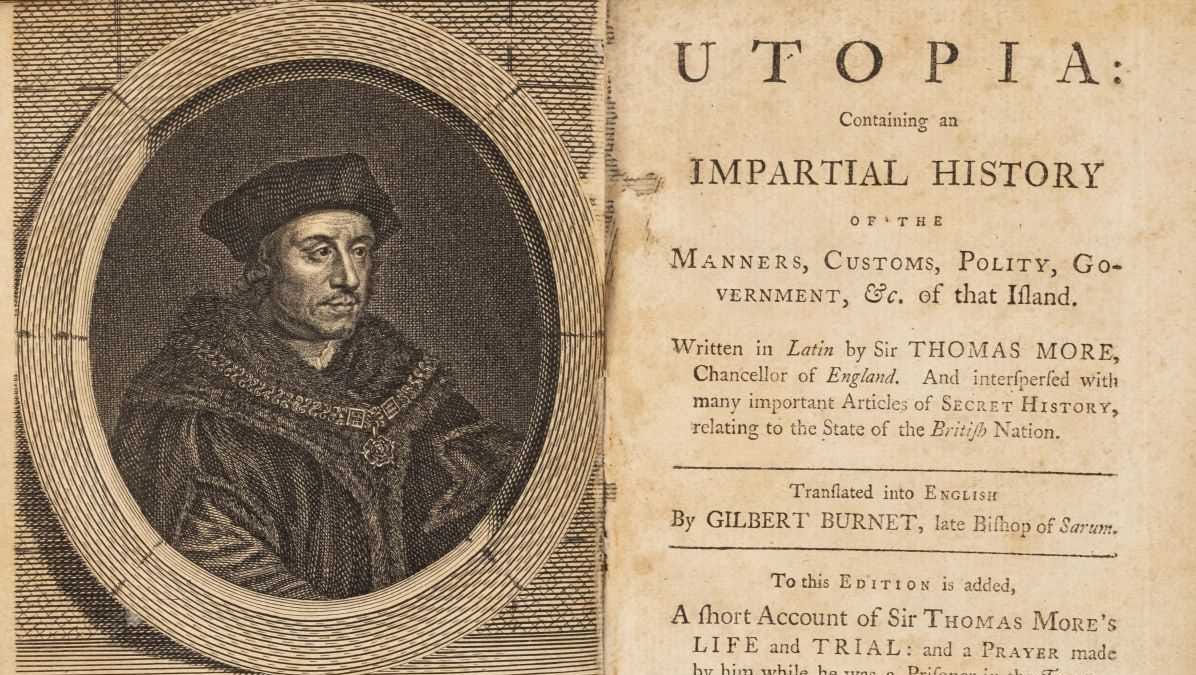
Sir Thomas More’s seminal 1516 work, Utopia, was not a fanciful dream of an unattainable paradise. Instead, this detailed treatise offered a sharp, practical blueprint for societal organization, challenging its enduring reputation as a mere literary metaphor. More presented it as a serious critique of 16th-century Europe, aiming to guide those seeking a more egalitarian and life-sustaining society.
This re-evaluation shifts our understanding of what More intended when he penned his influential text. It reveals a political philosopher proposing concrete policy recommendations, rather than just an imaginative storyteller. For Nigeria, this historical perspective resonates with its own long-standing quests for ordered communities and collective well-being.
Thomas More’s Utopia: societal critique
More, an English lawyer and statesman, published Utopia in Latin, framing it as a debate between himself and the fictional traveler Raphael Hythloday. Hythloday’s account of the island society served as a thinly veiled criticism of England’s societal ills, including corruption and abuse of power. The book was a direct challenge to the status quo of his era.
The text was a pointed commentary on contemporary European problems. More used the fictional island to highlight issues like social inequality, economic exploitation, and political corruption prevalent in 16th-century society. His work became a foundational text for political philosophy.
Hythloday’s name itself, meaning “dispenser of nonsense” or “knowing in trifles,” injected an ironic layer into his seemingly perfect description. This subtle humour underscored More’s complex intentions. He was not presenting a flawless ideal, but a structured alternative for consideration.
More himself served as Lord Chancellor under King Henry VIII. His later execution in 1535 for refusing to accept the King as head of the Church of England cemented his image as a man of profound conviction. This personal history reinforced the serious intent behind his seemingly fictional work.
Utopia’s practical organizational principles
The island of Utopia, purportedly off the Atlantic coast of Latin America, featured 54 towns of identical size. Its capital was named Amaurot, a Greek term meaning “dark and gloomy place.” These names, like the river Anyder, or “river without water,” hinted at the fictionality and critical intent behind the detailed descriptions.
Utopian society prioritized communal ownership of property over private wealth. This system aimed to eliminate poverty and ensure everyone’s needs were met. All inhabitants participated in productive labour, particularly agricultural work, fostering a sense of shared responsibility.
Governance was structured through elected officials, whose primary role was the organization of labour and resources. This direct approach to resource management highlighted More’s focus on practical solutions. Religious toleration was practiced, a truly radical concept for 16th-century Europe, where religious strife was common.
However, More’s “perfect” society also included enslaved people, both criminals and foreigners, in each household. This stark detail complicated any simple notion of paradise, underscoring the work’s function as a critique rather than a literal ideal. It invited readers to question the compromises inherent in societal design.
The enduring pun: no-place and good-place
More himself coined the term “utopia” in 1516. It derived from Greek words: “οὐ” (ou), meaning “not,” and “τόπος” (topos), meaning “place.” Thus, it literally translates to “no-place” or “nowhere,” emphasizing its fictional nature and perhaps its unattainability.
Yet, the genius of More’s coinage lay in its deliberate pun. It sounded remarkably similar to “eutopia” (εὖ, eu), meaning “good place” or “well-born.” More even addressed this duality in an addendum, stating, “Wherfore not Utopie, but rather rightely my name is Eutopie, a place of felicitie.” This playful ambiguity was central to its message.
This linguistic precision was not a mere literary flourish. It suggested that while a perfect society might be a “no-place” in reality, the pursuit of a “good place” remained a vital intellectual exercise. More invited his readers to engage with these complex ideas about ideal governance and social structures.
Evolving interpretations and modern misconceptions
Over centuries, the term “utopia” evolved into a capacious concept, shaping philosophical debates on epistemology and truth. Its modern usage often carries a derogatory connotation, implying naiveté or even veiled dystopian tendencies. This stands in contrast to More’s original nuanced intent.
Scholars like Karma Lochrie suggest that utopian thought existed even before More’s 1516 publication. However, More’s Utopia undeniably inaugurated a distinct genre of literature. It became the benchmark for exploring imagined ideal societies, though often misinterpreted as purely fanciful.
Understanding More’s work as a policy proposal, rather than just a metaphor, reveals its depth as social commentary. It forces a re-evaluation of how societies approach systemic issues. For Nigerians seeking societal transformation, this re-contextualization offers valuable historical insight.
Echoes in Nigerian communal ideals
While centuries and continents apart, the underlying impulse behind More’s detailed societal blueprint finds resonance in historical Nigerian communities. Many pre-colonial Nigerian societies developed intricate systems of communal living, governance, and resource sharing. These structures often prioritized collective well-being and stability.
Such historical models, whether in the Yoruba city-states or Igbo communal systems, sought to organize human activity for mutual benefit. They reflected a practical pursuit of a “good place” through established rules and shared responsibilities, much like More’s more abstract proposal. Nigeria’s rich cultural heritage, as seen in the Esie stone figures, often celebrated collective identity.
These indigenous systems often focused on mechanisms for collective decision-making and resource allocation. They were not abstract theories but lived realities, demonstrating practical attempts to create orderly and equitable societies. This pragmatic approach to social engineering echoes More’s own intentions.
Lessons for contemporary Nigerian society
The enduring relevance of More’s Utopia lies in its original intent: a framework for thinking about societal organization, not just a distant dream. It underscores humanity’s persistent drive to structure societies for greater equity and functionality. This historical precedent offers a powerful lens through which to view Nigeria’s own ongoing efforts to build and refine its social and political structures.
Understanding Utopia as a policy document rather than a metaphor reveals the depth of More’s critique and his vision for tangible change. It reminds us that the pursuit of a better society, while often challenging, is fundamentally about practical organization and collective action. Historical shifts in governance, like those seen in ancient succession patterns, illustrate this continuous evolution.
The ongoing search for improved governance and a more equitable society in Nigeria reflects this universal human aspiration. More’s work, from a distant 16th century, provides a reminder that thoughtful social critique and the articulation of alternatives remain crucial. It highlights the importance of envisioning practical changes for collective prosperity and stability.
