



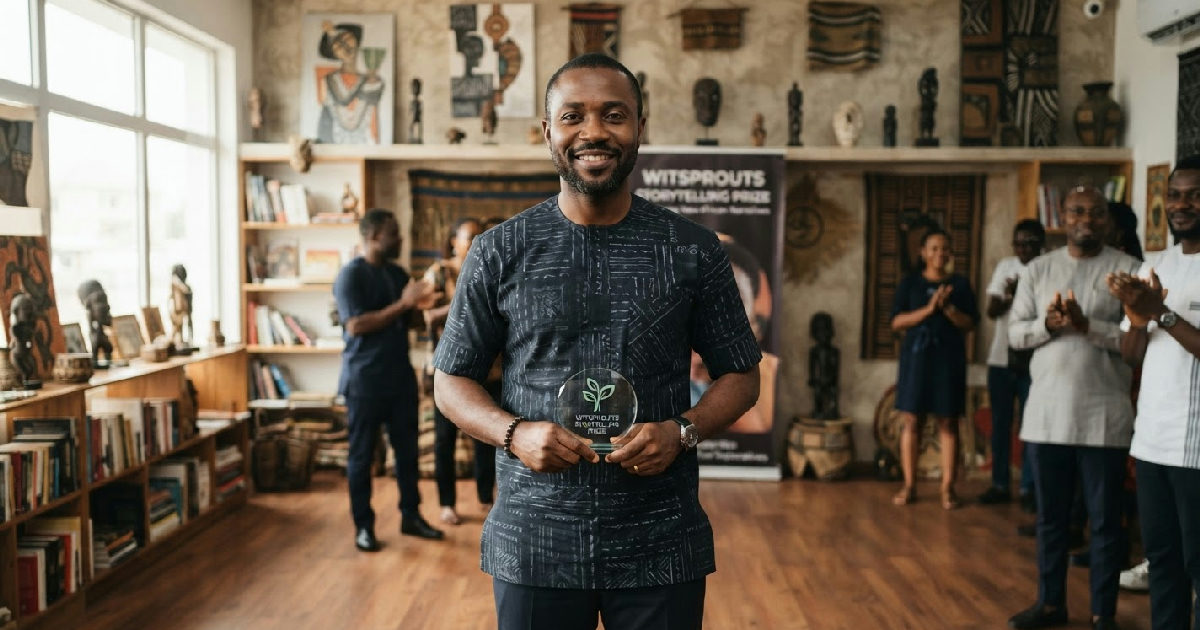
Tope Akintayo is a Nigerian-American actor and comedian who has gained recognition for his work in television and film.
This conviction fuels The Witsprouts Project, the cultural organisation Akintayo founded in January 2018. It finds its latest expression in the second edition of the Witsprouts Storytelling Prize, announced on August 26, 2026. This year, the prize puts a substantial ₦500,000 on the table for a young creative who can best capture the spirit of African narrative in a modern form.
Tope Akintayo’s Cultural Curation
To truly grasp the significance of the prize, you must first understand the man behind it. Tope Akintayo is more than just a name; he’s a Cultural Manager, Anthologist, and Publisher. These roles aren’t merely job titles, but interconnected facets of a singular mission to revive and meticulously catalogue African performance arts.
Akintayo operates from a foundational belief: creativity needs a robust platform to thrive, and far too many vital contemporary voices in Nigeria remain unheard. When he established The Witsprouts Project, also known as Witsprouts Global, he was responding to a clear gap within the cultural landscape. He aimed to foster deeper engagement with African arts.
While Nigeria boasts a globally recognised literary scene, the foundational art of oral performance often felt neglected, seemingly left behind by digital progress. The project was conceived as a crucial bridge, connecting this ancient art form to the cutting-edge tools of the 21st century. It seeks to blend ancestral wisdom with modern creative expression.
This mission to blend the old with the new echoes broader patterns in Nigeria’s cultural history. Innovators have often sought new expressions for traditional ideas, adapting them to changing eras and technologies. Akintayo’s work stands firmly in this tradition, applied now to the evolving landscape of narrative and performance in the digital age.
A successful first chapter in 2025
The first Witsprouts Storytelling Prize in 2025 served as a powerful proof of concept for Akintayo’s vision. Launched in April 2025, it carried the resonant theme of “Rebooting Legends and Memories.” The call was specific: Nigerian artists were invited to craft original 5–10 minute theatrical video performances.
These submissions were tasked with reimagining traditional African oral storytelling for modern digital platforms. It was a direct and ambitious challenge, asking creatives to effectively translate the intimacy of a firelight circle to the expansive reach of a smartphone screen. The deadline for these innovative submissions was May 31, 2025.
The response unequivocally affirmed Akintayo’s central thesis. A rigorous selection process, expertly led by acclaimed writer and filmmaker Jude Idada alongside playwright Akanbi Taofeek, narrowed a competitive field. They identified three powerful finalists whose work truly exemplified the prize’s objectives.
These finalists included Debbie Ajom for “His Last Safe House,” Keesh Rowland for “Tomorrow Didn’t Die,” and Rachel Ajisafe for her compelling “Haunting Song of Promises.” Each presented a distinct and compelling vision for how ancient stories could deeply resonate in the contemporary moment, bridging past and present narratives.
In October 2025, Rachel Ajisafe was named the overall winner. Her celebrated oral performances, “Haunting Song of Promises” and “The King Who Became Lightning,” earned her the inaugural ₦500,000 prize. For Akintayo, her victory represented more than just an outcome; it was a profound affirmation of the prize’s core purpose and a significant step forward for the project.
“Rachel Ajisafe’s win is a testament to the timeless power of African storytelling in today’s digital world,” Akintayo declared at the time. He powerfully framed her achievement as establishing “the bridge between ancestral wisdom and the creativity of the new generation,” a central tenet of The Witsprouts Project.
The success of this inaugural prize was made possible with the support of several key partners. These included Witsprouts Arts and Culture Empowerment Initiative, Moveee Media, StoryRat, and Orange Poetry Africa. Further backing came from Rambling Thoughts Bookclub and the Hill-Top Creative Arts Foundation, showcasing a collaborative spirit.
Expanding the vision for a new generation of griots
If the first prize was a focused and successful experiment, the second edition represents a confident and expansive leap. For the 2026 edition, with nominations officially opening on August 26 and running until September 30, Akintayo and Witsprouts have notably broadened their criteria. The specific format of theatrical video is now gone.
Crucially, the thematic constraint of “Rebooting Legends and Memories” has also been removed. This significant shift demonstrates a desire to embrace a wider spectrum of contemporary African storytelling. The prize now celebrates storytellers across all forms of oral and multimedia expression, reflecting a dynamic and evolving creative landscape.
This includes emerging talents such as podcasters, spoken word poets, and animators, alongside those pioneering audio dramas and innovative video content. The geographical scope has also widened considerably, now welcoming nominees from anywhere in Africa and its global diaspora. It’s a clear signal of intent to meet creators where they are.
Akintayo articulated his belief, describing storytelling as “one of the most powerful tools available, and one that continues to evolve.” He sees the modern podcaster and animator not as deviations, but as direct descendants of the traditional griot, carrying the same vital cultural DNA into new eras. The prize, he explained, serves as a crucial mechanism to ensure these voices are “encouraged, celebrated, and supported.”
This effort to build new platforms for culture outside of established channels reflects broader historical trends in Nigeria, where the establishment of educational institutions has often shaped the intellectual landscape. Akintayo’s project, in its own way, creates an informal, digital commons for the nation’s creative spirit to flourish, fostering new avenues for expression.
The currency of culture in modern Nigeria
In a literary landscape frequently dominated by heavyweight awards, such as the prestigious US$100,000 Nigeria Prize for Literature, a ₦500,000 award might appear modest at first glance. However, its true value cannot be measured in cash alone. It is an investment in a specific, often underfunded, sector of the creative economy.
The ₦500,000 prize, which is approximately $359 USD as of August 2026, aims to provide significant support. While a November 2025 discussion on Nairametrics questioned if ₦500,000 monthly income still qualifies one as middle class in Lagos, for emerging artists, this prize money provides invaluable recognition and a tangible boost.
Akintayo’s prize acts as a targeted injection of capital and confidence directly into the hands of performance artists and digital creators. It contrasts with other notable awards like the Quramo Writers’ Prize, offering ₦1 million and a publishing contract, or The Wole Soyinka Prize for Literature in Africa, a biennial award.
The prize champions process as much as the final product. By being open to nominations from anyone—be it friends, dedicated fans, or the artists themselves—it inherently democratizes access. This approach ensures it’s not solely about identifying the most polished output, but rather about nurturing raw, emerging talent whose work truly deserves a wider audience.
Akintayo’s work is part of a larger, quiet movement of cultural preservation taking place across Nigeria. It aligns with efforts to safeguard traditional Nigerian crafts and cultural heritage, ensuring their continuity in a rapidly changing world. Both are acts of refusal—a refusal to let invaluable parts of a shared heritage dissolve into memory.
Ultimately, the Witsprouts Storytelling Prize poses a critical question to the future of Nigerian culture: what can a story truly be in the 21st century, and more importantly, who gets to tell it?
By committing his resources and vision, Tope Akintayo isn’t merely funding artists; he’s making a profound bet on the enduring power and adaptability of the Nigerian voice, no matter what form it ultimately takes.
