




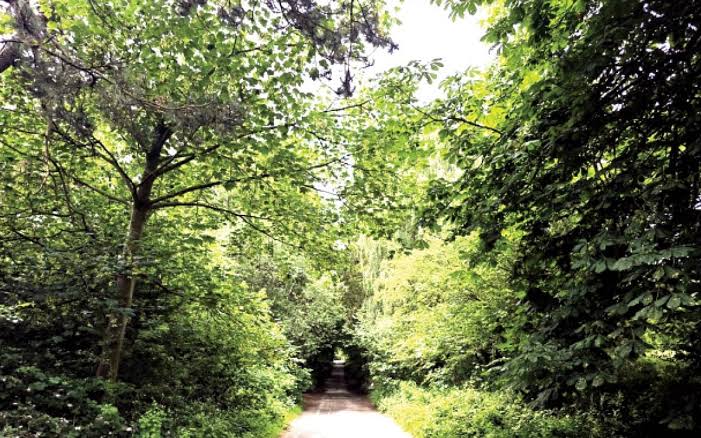
Joyce Aranuwa’s acclaimed “Nature’s Abundance” series uses powerful visual metaphors like a bridge stretching into uncertain distance to urge viewers to reflect on human experience. A road disappears into shadow.
These are the powerful visual metaphors Joyce Aranuwa employs in her acclaimed “Nature’s Abundance” series, urging viewers to reflect on the inherent dualities of human experience. Her photographs, currently featured in a UK exhibition, connect the quiet shifts in natural environments with the enduring uncertainties people navigate daily.
Through her lens, Aranuwa challenges the notion of landscapes as static backdrops. She presents them instead as living records, where the cycles of growth and decay, permanence and impermanence, exist in a delicate, continuous dance. It’s a perspective that resonates deeply with the rhythms of life as lived by ordinary Nigerians, who often find themselves balancing contrasting forces of hope and challenge.
Joyce Aranuwa’s lens on life’s fundamental dualities
Aranuwa’s “Nature’s Abundance” series deliberately focuses on the subtle, often overlooked changes within nature. This approach illuminates the tensions between survival and loss, renewal and decline—themes that mirror the constant negotiations in human lives. For her, the environment is not just a subject but a canvas reflecting our inner worlds.
Two striking works from this series, “Threshold” and “Into Silence,” currently form part of “States of Exposure,” a Cista Arts group exhibition running in the UK until the end of July 2026. This exhibition features the work of 22 contemporary artists from around the world, collectively exploring the nuances of transition, resilience, and the fragile balance inherent in both natural landscapes and individual journeys.
“Threshold” and “Into Silence”: navigating life’s transitions
“Threshold” invites contemplation on the very act of moving from one state to another. The bridge depicted isn’t a final destination, but rather a potent symbol of transition, suspended between the act of leaving and the promise of arriving.
The image powerfully evokes moments of personal limbo, prompting reflection on what we shed, what remains, and what it truly means to step into an unknown future.
Continuing this exploration of life’s journey, “Into Silence” presents an image of a road that gently fades into shadow. Here, Aranuwa resists offering a clear destination.
Instead, the photograph becomes a meditation on the uncertainty that accompanies forward movement, delving into themes of trust, vulnerability, and the sheer determination required to persist when the path ahead isn’t clear. The piece doesn’t provide ready answers, but rather encourages viewers to embrace the unfolding nature of their own paths.
African visual art often delves into such profound introspections.
From Lagos fashion to Arctic tundras: Aranuwa’s diverse path
Joyce Aranuwa’s personal trajectory is as varied and thought-provoking as her artwork. Before her rise as a photographer, she initially pursued studies in Economics, a field seemingly far removed from the arts. This early academic grounding likely contributes to the structural depth and analytical rigour evident in her artistic explorations of complex themes.
Her path then led her to the vibrant world of Nigerian fashion. In 2013, Aranuwa earned a diploma from the Zaris Fashion & Style Academy in Nigeria. This Lagos-based institution, founded by Tessy Jibodu, is well-regarded for empowering emerging designers and fostering entrepreneurship within the Nigerian fashion industry. This experience broadened her creative perspective and honed her eye for visual storytelling.
But her connection to the environment runs even deeper. Aranuwa previously worked in conservation and marine biology, experiences that profoundly exposed her to the realities of environmental degradation and change. This hands-on understanding of natural ecosystems undeniably informs her artistic focus on the planet’s protection and the delicate balance of existence.
She also undertook demanding expeditions, including a solo journey across the Arctic’s vast, open tundra. These experiences forged an intimate connection with the natural world, allowing her to witness its raw power and subtle transformations firsthand. This fusion of scientific observation, fashion aesthetics, and personal adventure shapes the unique perspective she brings to her photographic practice.
Nigerian heritage and global landscapes in her art
Aranuwa’s “Nature’s Abundance” series deliberately eschews specific geographical anchors. The plants and scenes in “Threshold” and “Into Silence” could suggest both tropical and temperate environments, leaving their exact locations open to interpretation. This intentional ambiguity adds a rich layer of complexity, reflecting Aranuwa’s own identity as a UK-based photographer whose artistic vision is profoundly shaped by her African experiences of landscape and environment.
Her broader body of work consistently intertwines environmental photography with powerful concepts of heritage, womanhood, and the contemporary human experience of place. She masterfully employs both documentary and staged imagery to explore how memories are preserved, how identities are forged, and how historical narratives continue to influence the present moment. This approach transforms landscape into a repository of lived human history and cultural continuity.
Beyond the exhibited works: exploring interdependence
The concepts explored in “Nature’s Abundance” extend beyond the exhibition’s featured pieces. The series often portrays themes like the delicate balance between dependence and resilience, sometimes through natural elements seeking support or light. This visual approach speaks volumes about the intricate connections within ecosystems and human lives.
Such imagery prompts fundamental questions about what we borrow, what we share, and the often-complex requirements for survival. It suggests that endurance, both in nature and in human society, frequently arises from connections that can feel both limiting and profoundly supportive. This dynamic interplay is a constant feature of communal life, especially in societies where mutual support networks are essential.
Cista Arts and the global stage for African artistic voices
Aranuwa’s inclusion in the “States of Exposure” exhibition highlights a broader, significant trend: the increasing recognition and prominence of African art and artists on the global stage. Cista Arts, the UK-based organization behind the exhibition, plays a crucial role in this cultural exchange. Founded in 2018 by Dr. Fatemeh Takht-Keshian, Cista Arts serves as an interdisciplinary and transcultural platform, bridging geographical and cultural divides.
The organization’s mission is to connect artists, researchers, and audiences, supporting contemporary practices that engage with critical themes like identity, memory, place, society, and global concerns. With over 50 solo and group exhibitions since its inception, Cista Arts provides a vital showcase for diverse voices.
The “States of Exposure” exhibition itself features the work of 22 contemporary artists from around the world, making it a truly international platform.
London, in particular, has emerged as a key hub for African art, hosting events like the annual Contemporary African Art Fair. This growing interest is fueled by Africa’s rich cultural heritage and its diverse artistic styles.
Artists like Aranuwa, with her dual UK and African influences, embody this cultural exchange, demonstrating how such diverse backgrounds contribute to a vibrant global artistic conversation. Her perspective enriches the understanding of enduring traditions in a modern context.
Reflecting on nature’s quiet lessons
Joyce Aranuwa’s “Nature’s Abundance” series offers more than just aesthetically pleasing images; it provides a profound framework for understanding the human condition through the natural world. Her photographs serve as quiet reminders that life, much like the landscapes she captures, is a continuous process of change, challenge, and quiet resilience.
By treating environmental settings as “living records,” Aranuwa encourages us to look closer, to see the growth within decay and the potential for renewal in decline.
Her work prompts a deeper engagement with our surroundings, both natural and personal, and asks us to consider how much of our own journey is mirrored in the subtle patterns of the world around us. What lessons might we draw from nature’s enduring ability to adapt and persist through constant transformation?
