



On January 31, 1916, Sir Frederick Lugard, Governor-General of Nigeria, officially opened the railway bridge spanning the Niger River at Jebba.
But the story of the Lagos-Kano Railway isn’t one of a single grand unveiling. Instead, it’s a complex narrative of separate colonial ambitions, engineering challenges, and administrative mergers. This foundational infrastructure project would redefine trade, migration, and even the political landscape of the emerging nation, leaving a profound legacy that endures today.
The Jebba Bridge completed: early colonial railway construction
The roots of Nigeria’s expansive railway system stretch back to the late 19th century, driven by British imperial interests. Construction began from Lagos in 1898, pushing inland to Ibadan by 1901. This initial segment formed the backbone of the Lagos Government Railway, gradually extending towards a crucial northern connection.
Simultaneously, a distinct railway project unfolded in Northern Nigeria, starting from the Niger river port of Baro. This Baro-Kano Railway was specifically designed to tap into the commercial and agricultural potential of the region, targeting areas rich in cotton production and the Plateau tinfields. British officials saw Kano as a key economic hub.
By 1911, the Baro-Kano line had largely reached its destination. While regular traffic operations were not immediately announced, contemporary engineering reports from 1912 confirmed the line was operational. This dual development set the stage for an eventual, albeit complex, unification.
Bridging the divide: the Niger at Jebba
The two independently developed railway systems eventually converged in the Minna area, a crucial junction that symbolically, if not yet physically, connected north and south. Engineering accounts confirm the Lagos Railway section north of the Niger joined the Baro-Kano system at Minna by early 1912. For the first time, an operational transport network linked the coast with the far north, though physical continuity remained elusive.
This operational connection prompted administrative consolidation. On October 3, 1912, the Lagos Government Railway and the Baro-Kano Railway officially merged, forming the Nigerian Railways. This date stands as a significant landmark, uniting two disparate colonial railway administrations into a single entity, even as the tracks themselves still faced a formidable natural barrier.
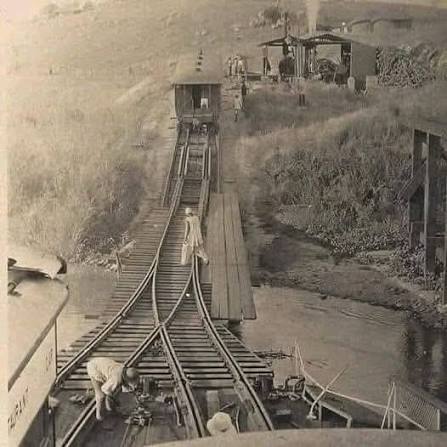
That barrier was the mighty River Niger at Jebba. Until a permanent bridge could be constructed, passengers and goods faced an extraordinary interruption. Trains from Lagos would arrive at Jebba, where entire railway carriages were meticulously transferred onto a ferry steamer for the crossing. Once on the other bank, the journey northwards could resume.
This system of crossings, though cumbersome, allowed a functional through-journey years before the physical infrastructure was continuous. It highlights the ingenuity of engineers and the pressing demand for connectivity. The interim solution proved that the vision of linking Lagos and Kano was viable, even if the final piece of the puzzle remained.
The puzzle was finally completed on January 31, 1916, when Sir Frederick Lugard inaugurated the Jebba railway bridge. This event eliminated the ferry interruption, creating an unbroken rail connection between the coast and the northern interior. Archival records from the Cambridge University Library confirm this bridge truly connected Lagos and Kano, spanning 705 miles.
Economic engine: transforming trade and labour
Britain’s primary motivation for building the railway was economic, coupled with administrative control. The aim was to facilitate cheaper and faster movement of raw materials from the interior to coastal ports for export. Conversely, imported goods could then be distributed more easily throughout the hinterlands, solidifying colonial trade dominance.
Early planners held high hopes for northern cotton, with parliamentary discussions in 1912 specifically mentioning the British Cotton Growing Association’s ginnery at Zaria. The railway was expected to stimulate vast cotton production for British industries. But while cotton saw some growth, another commodity emerged as a dominant force: groundnuts.
Historical economic research shows the railway’s arrival around Kano dramatically expanded groundnut exports. Indigenous farmers and merchants quickly adapted, turning groundnuts into a defining export commodity of colonial Northern Nigeria. The Plateau tinfields also influenced railway expansion, with branches connecting mining areas to the wider network. This infrastructure, built for imperial objectives, rapidly acquired uses that extended far beyond its builders’ initial intentions.
The railway’s construction also created an industrial workforce, albeit one formed under complex conditions. Forced labour and coercive recruitment were features of colonial Nigeria, especially for public works. While some workers were paid daily wages or piece rates, scholarship shows a blend of forced and voluntary labour existed within the system. This nuance is crucial for understanding the human cost of infrastructure development.
Over time, this railway employment fostered a substantial African industrial workforce. It included artisans, mechanics, technicians, and clerks, laying the groundwork for organised labour. These workers eventually became an influential part of Nigeria’s organised labour movement, advocating for better wages and working conditions. Infrastructure projects often bring unforeseen social consequences, and the railway was no different.
Figures like Michael Imoudu, a prominent leader of the Railway Workers’ Union, emerged from this environment. Railway workers participated in broader anti-colonial struggles, demonstrating an irony: a system designed to strengthen colonial administration eventually provided the very networks and workplaces through which Africans could organise against it. The story of the railway, then, is as much about human agency as it is about colonial power.
Echoes of history: the modern standard gauge project
More than a century after the Jebba bridge solidified the colonial route, the broad transport axis between Lagos and Kano remains central to Nigeria’s development. The modern Lagos-Kano Standard Gauge Railway (SGR) project, however, is a fundamentally different undertaking, designed to replace the historic 1,067-millimetre Cape gauge with a modern standard.
This 1,343-kilometre line aims to connect Lagos to Kano, near the border with Niger.
The contemporary project officially began in 2006 when the Nigerian government awarded a contract worth US$8.3 billion to China Civil Engineering Construction Company (CCECC). Funding was ambitious, intended to come from petroleum sales and a US$500 million concessionary loan from the Chinese government. A US$250 million mobilization fee was paid in 2007 to kickstart the initiative, marking the first major milestone of the modern era.
A decade later, in July 2016, the first segment of this new vision came to fruition. The Abuja-Kaduna segment, a 186-kilometre stretch, was officially opened for passenger trains. Construction, which began in February 2011, culminated in an operational line that cost US$876 million, with US$500 million sourced from China Exim Bank loans. This segment quickly proved its value, serving 3,700 daily riders by 2019.
The second major modern milestone occurred on June 10, 2021, with the commissioning of the Lagos-Ibadan segment. This 157-kilometre stretch marked West Africa’s first double-track standard gauge line, a significant infrastructural achievement. A US$1.53 billion contract for this section was awarded to CCECC in 2012, largely funded by a US$1.267 billion preferential buyer’s credit from China Exim Bank, with Nigeria contributing approximately US$314.5 million.
Today, work continues on the remaining sections. As of July 2026, the Federal Ministry of Information and National Orientation reported that the Kaduna, Zaria, and Kano section is approximately 80 to 85 percent complete. Permanent Secretary of the Federal Ministry of Transportation, Funsho Adebiyi, has targeted December 2026 for its commissioning.
While other sections, including the wider Kano to Maradi development, have varying schedules, progress is tangible.
A century of connection: enduring questions
The parallel journeys of the colonial and modern Lagos-Kano railways offer compelling insight into Nigeria’s enduring challenges. Both projects, separated by a century, grapple with the same fundamental question: how best to move large volumes of people and freight between the coastal economic powerhouses and the vast interior. This quest for connectivity has shaped, and continues to shape, the nation’s economic and social fabric.
The historical railway, born of colonial ambition, quickly became a tool for Nigerian agency. It facilitated commerce, enabled migration across previously difficult boundaries, and inadvertently fostered the growth of organised labour that challenged the very system that built it. Communities sprang up around stations, creating new social and economic landscapes.
The contemporary standard gauge project, though using advanced technology and different funding models, carries the weight of this past. It aims to address modern Nigeria’s needs for efficient transport, regional integration, and economic diversification. The ambition remains high, much like it did for the colonial engineers who faced the challenge of the Niger River.
As Nigeria pushes towards completing its modern Lagos-Kano line, the story of its predecessor serves as a powerful reminder. Major transformations are rarely singular events; they are processes, shaped by many decisions, built by countless hands, and ultimately defined by the people who use them. The railway, then and now, isn’t just steel and sleepers; it’s a living artery of Nigeria’s continuing evolution.
