




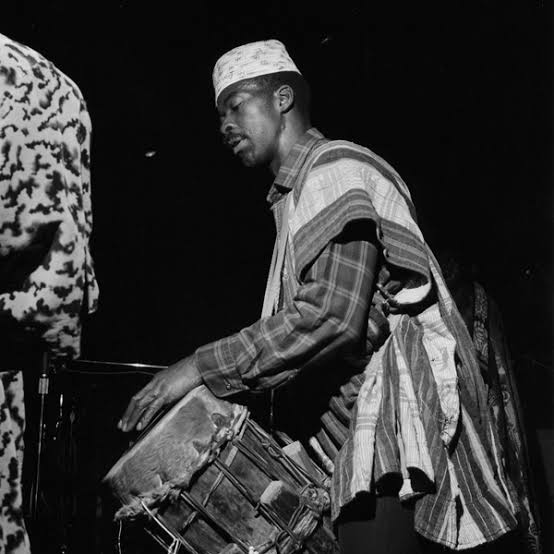
In the buzzing cultural crucible of New York City during the early 1960s, Solomon Gbadegesin Ilori arrived not just as a musician, but as an emissary of Yoruba culture.
A drummer, composer, and bandleader from Nigeria, Ilori embarked on a pivotal journey that would see him integrate the rich traditions of Yoruba music and highlife into the evolving soundscape of American jazz, including his significant Solomon Ilori Blue Note sessions.
His groundbreaking work, documented across three historic Blue Note recording sessions between 1962 and 1964, presented a nuanced vision of African artistry, challenging assumptions and forging new pathways for transatlantic musical exchange. At a time when jazz was casting an eager eye towards Africa, Ilori provided more than mere rhythmic flavour.
A journey from Gold Coast to New York jazz
Solomon Gbadegesin Ilori began his life in 1934, far from the neon glow of New York, in Nsawam, then part of the Gold Coast. Though born outside Nigeria’s modern borders, his identity was firmly Nigerian; his parents hailed from there. A significant shift came in 1945, following his mother’s death, when young Solomon moved to Lagos, Nigeria’s vibrant cultural hub.
Early life and musical training in Lagos
Lagos proved to be a fertile ground for his musical development. He immersed himself in organised musical training, studying voice, drums, and flute, alongside formal music theory. His education extended to completing a secondary-school qualification in music, while he actively participated in local choirs and popular music groups.
This broad foundation, blending formal instruction with traditional and popular performance, shaped the unique musician he would become. It was this rich background that he carried with him before his eventual move to the United States.
Shaping a diasporic cultural network
In 1958, Ilori crossed the Atlantic, initially landing in New York as a photography student at the New York School of Photography. But the allure of music, already deeply ingrained, quickly pulled him beyond the darkroom. He soon found himself performing as a drummer and dancer.
He joined the influential African-American choreographer Pearl Primus, whose work drew heavily on African and diaspora traditions. Ilori also collaborated with Jean-Léon Destiné, a Haitian dancer pivotal in introducing Haitian dance to global audiences. These early connections embedded Ilori within a burgeoning network of African, Caribbean, and African-American artists who were redefining New York’s understanding of diaspora culture.
By 1961, Ilori had cemented his place in New York’s creative scene, forming the Ilori Dancers. This ensemble was a powerful fusion of talent, bringing together African, Caribbean, and African-American musicians and dancers under one banner. Among those associated with his performances was American jazz bassist Ahmed Abdul-Malik, himself a key figure in integrating African and Middle Eastern sounds into jazz.
The Ilori Dancers quickly transcended small community events. They performed at a Nigerian Students’ Union independence celebration, a significant nod to Nigeria’s newfound sovereignty, and even appeared before the United Nations General Assembly. The group also participated in a gala during the visit of Nigeria’s first prime minister, Sir Abubakar Tafawa Balewa.
From 1962 to 1964, the Ilori Dancers toured extensively across the eastern United States, performing in cities like Washington, Philadelphia, New Haven, and Boston. In New York itself, they graced iconic venues including the Apollo Theater, Birdland, and the Village Gate. Their reach extended into educational broadcasting, too; in 1964, they recorded Music of Africa for National Educational Television.
This constant visibility across diverse platforms—from jazz clubs to university lecture halls and public institutions—underscored Ilori’s dual mission. He aimed to entertain while simultaneously educating audiences about the intricate structures and profound meanings of African, particularly Yoruba, musical traditions.
Solomon Ilori’s arrival on Blue Note: Art Blakey’s “The African Beat”
The year 1962 marked Solomon Ilori’s formal entry into the world of Blue Note Records, one of jazz’s most storied labels. This landmark collaboration came through the legendary drummer Art Blakey.
On January 24, 1962, Blakey and his Afro-Drum Ensemble convened at Van Gelder Studio in Englewood Cliffs, New Jersey, to record what would become The African Beat. It was an ambitious project, uniting musicians from African, Caribbean, and American backgrounds.
Ilori was a central figure in this eclectic lineup, joining luminaries such as Yusef Lateef and Ahmed Abdul-Malik. He contributed vocals, played the distinctive pennywhistle, and masterfully handled the talking drum. His role, however, stretched far beyond that of a mere percussionist.
The album famously opened with “Prayer by Solomon G. Ilori,” a short piece establishing his compositional voice from the outset. He also earned composition credits for other tracks, including “Ife L’Ayo,” “Ero Ti Nr’Ojeje,” and “Ayiko Ayiko.” These contributions were crucial. Ilori wasn’t simply adding an “African rhythm” to jazz.
He was instead infusing the project with his own repertoire, distinct musical language, instruments, and deep cultural knowledge. For Ilori, African rhythmic traditions were not just textures but disciplines requiring meticulous study. He consistently stressed the importance of carefully listening to African musicians and recordings before attempting to engage with their complex musical structures.
He believed that African drumming belonged to organised musical and cultural systems. These systems were imbued with specific techniques, conventions, and meanings that any serious musician needed to grasp.
Leading his own vision: the African High Life album
The following year placed Ilori at the centre of his own Blue Note recording. In 1963, he entered a two-album agreement with Blue Note Records, a testament to the recognition he was rapidly gaining. The first fruit of this agreement came on April 25, 1963, when Solomon Ilori and His Afro-Drum Ensemble entered Van Gelder Studio once more to record African High Life.
The album featured six original recordings: “Yaba E,” “Ise Oluwa,” “Jojolo,” “Follow Me to Africa,” “Aiye Le,” and “Tolani,” clocking in at a total of 35 minutes and 5 seconds. Ilori himself anchored the sound with his vocals, pennywhistle, talking drum, and guitar.
The ensemble included a mix of talent, with Hosea Taylor on alto saxophone and flute, Jay Berliner on guitar, and Ahmed Abdul-Malik on bass.
His brother, Josiah Ilori, contributed on sakara drum and cowbell, alongside other percussionists like Chief Bey, Montego Joe, Garvin Masseaux, and Robert Crowder. Composer and conductor Coleridge-Taylor Perkinson served as the musical director, while Alfred Lion produced the session and Rudy Van Gelder handled the recording, ensuring the distinctive Blue Note sound.
African High Life squarely placed Ilori’s vision in the foreground. It centred his compositions, his singing, and the distinct West African musical vocabulary. Highlife guitar patterns, vibrant call-and-response vocals, Yoruba lyrical themes, and intricate layered percussion defined its character. This pivotal album added a significant chapter to the story of African music’s global reach.
This wasn’t a standard American jazz record simply adorned with African drums. Ilori was the undisputed leader, with the musicians working within a framework built around his repertoire. The album marked a crucial moment, showcasing an African musician leading a major American jazz label recording in the early 1960s, a rare feat that redefined the dynamics of musical production.
The 1964 session: an experimental bridge to modern jazz
Ilori’s journey with Blue Note continued into 1964. On October 30 of that year, he returned to Van Gelder Studio for another recording session. This time, the ensemble brought his rich musical ideas into even closer dialogue with some of the most innovative American jazz improvisers of the era.
The lineup was stellar: Donald Byrd on trumpet, Hubert Laws contributing on flute and tenor saxophone, Bob Cranshaw on bass, and the legendary Elvin Jones on drums. Coleridge-Taylor Perkinson again played an important musical role, orchestrating a substantial percussion ensemble alongside Ilori.
This session produced five compositions: “Bamu Baamu L’Ayo,” “Toni Omo Re,” “Agbamurero,” “Gbogbo Omo Ibile,” and “Igbesi Aiye.” Unlike African High Life, these recordings didn’t see an immediate release as a separate Ilori album in the 1960s.
Instead, three of the pieces—”Agbamurero,” “Gbogbo Omo Ibile,” and “Igbesi Aiye”—were later included as bonus tracks on the expanded 2006 CD reissue of African High Life. These bonus tracks, totalling just under 40 minutes, provided an unexpected treasure trove for listeners decades later.
The musical character of these 1964 recordings differed noticeably from the 1963 material. Byrd and Laws were given ample space for jazz improvisation, allowing their individual voices to intertwine with Ilori’s rhythmic foundations. Elvin Jones’s drum kit engaged in a dynamic interplay with Ilori’s percussion ensemble, creating a broader, more integrated sound.
This session truly represented a meeting point between Ilori’s musical world and the cutting edge of modern American jazz, anticipating what some would later describe as the “astral jazz of the late ’60s and early ’70s, and the world jazz which has in turn followed.”
His artistry blossomed amid a period of significant global political transformation and Pan-African awareness, adding another layer to his unique contribution.
The talking drum as language, not just rhythm
Beyond his studio recordings, Solomon Ilori was a dedicated educator, keen to impart the deeper meanings of his musical heritage. A particularly illuminating moment occurred in 1964 at Howard University in Washington. During this appearance, Ilori offered a profound demonstration of the Yoruba talking drum, showcasing its communicative possibilities far beyond simple percussive beats.
His demonstration drew on an essential characteristic of Yoruba: it’s a tonal language, meaning that the pitch patterns of words significantly alter their meaning. Skilled talking drummers, Ilori explained, could manipulate the drum to reproduce these precise tonal and rhythmic patterns, effectively mimicking spoken Yoruba expressions. This meant the instrument held a cultural role extending well beyond ordinary rhythm.
Within Yoruba society, drumming has historically intertwined with praise poetry, ceremonial rites, political leadership, public communication, and the very fabric of social memory. To truly understand the talking drum, Ilori argued, required not just rhythmic skill but also a deep knowledge of the language and cultural conventions. He wanted American audiences to appreciate these intricate dimensions.
His commitment extended to formal study at Columbia University with ethnomusicologist Willard Rhodes, and he even wrote about the political functions of talking drums within Yoruba society. His performances, academic pursuits, and writings all converged on a singular purpose: to present Yoruba musical knowledge as an organised intellectual and cultural tradition, not merely as exotic sound.
Cultural currents: independence, civil rights, and transatlantic dialogue
Solomon Ilori’s career unfolded during a profoundly transformative era. Nigeria gained its independence from Britain on October 1, 1960, a moment that resonated with the broader wave of decolonisation sweeping across Africa. Simultaneously, the American civil rights movement was gaining ferocious momentum, leading African-American artists and intellectuals to increasingly explore their connections to the African continent.
Music became a crucial arena where these complex connections were explored and negotiated. Jazz musicians, in particular, looked to African instruments, rhythms, philosophical ideas, and political symbolism for inspiration. African musicians arriving in dynamic cities like New York found eager American audiences, hungry to discover cultural links to their ancestral continent.
Yet, Ilori was quick to point out that “Africa” wasn’t a monolithic musical culture. His work meticulously highlighted the importance of cultural specificity. He presented Yoruba music not as some vague ancestral echo, but as a contemporary practice deeply rooted in identifiable language, established institutions, and concrete social traditions.
While such encounters could certainly foster solidarity, they also brought differing assumptions about history, identity, and the ownership of musical forms to the surface. The broader wave of decolonisation sweeping across Africa and Nigeria’s own political evolution provided a powerful backdrop. It was a rich, sometimes challenging, dialogue, but one that ultimately deepened understanding.
Ilori’s enduring legacy: redefining African artists in jazz history
The career of Solomon Gbadegesin Ilori fundamentally challenges the often-oversimplified notion that African musicians primarily served as mere sources of rhythm for American performers in 20th-century jazz. Ilori was a fully realised artist: he composed his own music, led his own ensembles, and proficiently played multiple instruments including singing and dancing.
His work transcended clubs and theatres, moving into university lecture halls and television studios, all while recording for one of the most prestigious jazz labels in the world. His participation in Art Blakey’s The African Beat was a genuine musical collaboration, far from an anonymous supporting role.
And with his own African High Life, he stood at the centre of a Blue Note project built entirely around his unique compositions and repertoire. The 1964 session, which paired him with jazz giants like Donald Byrd and Elvin Jones, then pushed his work into direct, improvisational exchange.
These recordings, taken together, form an invaluable documentary record of a Nigerian musician navigating and influencing New York’s intersecting African, jazz, and performance networks throughout the early 1960s.
Most profoundly, Ilori elevated Yoruba music to the realm of intellectual knowledge. The talking drum, in his hands and through his explanations, was revealed as more than a percussive instrument. It was intrinsically linked to language, communication, ceremony, politics, and historical memory.
He showed the world that African musicians possessed not just performance skills, but sophisticated musical systems and rich intellectual traditions. In the rapidly shifting cultural tides of 1960s New York, Solomon Ilori was the vital conduit, carrying this profound message from Nigeria directly into America’s most influential musical spaces.
What lessons might this history offer about celebrating the specificity of African cultures in today’s global conversations?
