




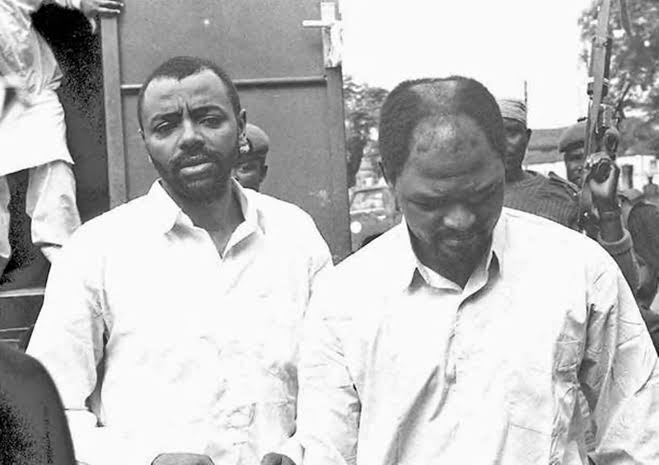
Contrary to expectations, Mohammed Abacha and Hamza al Mustapha faced charges in 1999 for the murder of Kudirat Abiola.
This surprising development marked a crucial moment for Nigeria. It signalled a new civilian government’s willingness to confront past alleged atrocities, even those implicating powerful figures, after years of military rule.
The Kudirat Abiola Murder Case: A Voice Silenced in 1996
Kudirat Abiola, wife of the acclaimed winner of the annulled 1993 presidential election, Moshood Abiola, became a powerful voice for democracy. Her activism was a direct challenge to the military government of General Sani Abacha, which had detained her husband.
On 4 June 1996, gunmen assassinated Kudirat Abiola in Lagos. She was travelling in her white Mercedes Benz around 9:30 AM when two Peugeot cars ambushed her vehicle on the Lagos-Ibadan Expressway, near Oregun Road in Ikeja. She died between 12:15 PM and 12:30 PM at Eko Hospital from a bullet wound to her forehead, a tragic end for the 44-year-old pro-democracy campaigner.
Her murder sent shockwaves across Nigeria and internationally. It underscored the brutal political climate of the 1990s, where dissent was often met with severe repression, leaving a lasting scar on the nation. The killing became a potent symbol of the struggle for Nigeria’s return to civilian rule and the sacrifices made.
The operation, codenamed “Operation Cika Aiki” (finish the job in Hausa), used an F-90 submarine gun. Kudirat’s driver, Dauda Atanda, also died from injuries, while her personal assistant, Lateef Shofolahan, escaped unharmed.
Justice Takes Form: The 1999 Charges
After General Sani Abacha’s death in June 1998 and Nigeria’s transition to civilian government in May 1999, the political landscape shifted dramatically. President Olusegun Obasanjo’s new administration took a different stance on past alleged crimes.
On 14 October 1999, Mohammed Abacha, Major Hamza al Mustapha, and several others appeared before a Lagos magistrate’s court. They faced charges of murder and conspiracy in connection with Kudirat Abiola’s assassination.
Mohammed Abacha’s familial link to the former dictator and al Mustapha’s high-ranking security position ensured intense public and media scrutiny for the proceedings. Military power grabs had shaped Nigeria’s past, and this case tested the resolve of the new democratic era to hold past officials accountable.
Other defendants charged in the case included Ibrahim Yakassai, Aminu Mohammed, Mohammed Rabo Lawal, and Kudirat’s personal assistant, Alhaji Lateef Shofolahan. The prosecution team, at various stages, included prominent legal figures like Prof. Yemi Osinbajo and Mr. Lawal Pedro.
The Abacha Regime’s Dark Chapter
Kudirat Abiola’s assassination did not occur in isolation. It was part of a broader pattern of political repression and violence that characterised General Sani Abacha’s military regime from 1993 to 1998. The government systematically suppressed opposition, detained activists, and was blamed for numerous human rights abuses.
The political climate of the mid-1990s was marked by profound instability, following the annulment of the 1993 presidential election. This era saw widespread protests and a severe crackdown on pro-democracy movements, with many prominent figures facing threats or outright persecution. Even amidst this turmoil, major national events continued to unfold.
The charges against Abacha’s son and Chief Security Officer represented an unprecedented effort to confront these alleged atrocities head-on. It signalled a break from the past, attempting to bring justice to victims who had suffered under the iron fist of military rule. This pursuit of accountability was a defining feature of Nigeria’s nascent democracy.
A Protracted Legal Labyrinth
The Kudirat Abiola murder case wound its way through Nigeria’s judicial system for over two decades, illustrating the inherent difficulties in prosecuting politically charged cases. The original charges were just the beginning of a long and complex journey through various courts.
In 2002, the Supreme Court ruled that a sufficient prima facie case had not been established against Mohammed Abacha. Justice Falihu Belgore delivered the ruling, noting that “suspicion, however well founded, does not amount to a prima facie case,” effectively ending his involvement in the trial.
This decision led to widespread speculation that it was linked to an agreement for the Abacha family to return $2 billion in state funds.
Al Mustapha’s trial, however, continued. Key to the prosecution was Sergeant Barnabas Jabila Mshiela, also known as “Sergeant Rogers.” He confessed in May 2000 to personally shooting Kudirat Abiola with an Uzi gun, testifying that al Mustapha gave the order for “Operation Cika Aiki.”
However, Sergeant Rogers later recanted parts of his earlier testimony in October 2009 in an Ikeja High Court. He claimed his previous statements implicating al Mustapha were “make-up masterminded by the government” due to promises of inducements like cash, a house, and a foreign posting. Despite this complex legal case, he also wept in court, reiterating that al-Mustapha had ordered him to kill Kudirat.
Despite the challenges posed by shifting testimonies and prolonged proceedings, the Lagos State High Court eventually reached a verdict. Justice Mojisola Dada presided over the court that convicted al Mustapha and Lateef Shofolahan.
On 30 January 2012, both men were sentenced to death by hanging for Kudirat’s murder. Al-Mustapha had admitted to supplying the guns used in the murder in an earlier statement to the Special Investigation Panel (SIP) on 13 October 1999. This judgment was a significant moment, yet it was not the final word.
Acquittals and the Case’s Conclusion
The convictions of al Mustapha and Shofolahan were overturned on appeal. On 12 July 2013, the Court of Appeal in Lagos, with a three-member panel headed by Justice Amina Augie, alongside Justices Rita Nosakhare Pemu and Fatimo Omoro Akinbami, acquitted both men.
The appellate court cited “weak and unreliable evidence,” including significant contradictions in key witness accounts, as reasons for their decision. This ruling reversed the High Court’s judgment, meaning the death sentences no longer stood.
Lagos State sought to challenge this acquittal at the Supreme Court, but procedural delays plagued the appeal for years, leaving the case in limbo. The state’s attempt to overturn the Court of Appeal’s decision dragged on for nearly a decade.
Finally, on 22 January 2026, the Supreme Court dismissed the state’s outstanding appeal. Justice Uwani Aba-Aji delivered the lead judgment, faulting Lagos State for its “inexcusable” failure to take necessary legal steps for nine years after being granted leave to re-open the case in 2014.
This Supreme Court decision effectively brought the long-running Kudirat Abiola murder case to a close. It confirmed the Court of Appeal’s 2013 acquittal for al Mustapha, distinguishing his legal path from that of Mohammed Abacha, whose charges had been dropped much earlier.
Lasting Echoes of Accountability
The protracted legal journey of the Kudirat Abiola murder case underscored the fragility of Nigeria’s justice system in handling politically sensitive matters. It highlighted the immense pressure and scrutiny faced by courts in the post-military era, as they grappled with the legacy of authoritarian rule.
The eventual acquittals, despite earlier convictions, sparked debate about the integrity of evidence gathering and witness testimony in such high-stakes trials. It reinforced the principle that justice must not only be done but must also be seen to be done, based on irrefutable proof rather than public sentiment or political expediency.
While the outcome may have disappointed some seeking definitive closure, the case itself remains a crucial reference point. It demonstrated Nigeria’s capacity, albeit with significant challenges, to subject even the most powerful former officials to legal scrutiny, a vital step for a transitioning democracy.
Reflections on Justice and Accountability
The Kudirat Abiola murder case remains a poignant chapter in Nigeria’s modern history. It reveals the challenges inherent in a young democracy seeking to establish the rule of law after a period of military rule. The protracted proceedings and shifting outcomes demonstrated the importance of due process and robust evidential standards, even when allegations are grave.
This legal saga underscores how difficult it was for Nigeria to reconcile its past with its aspirations for justice. The pursuit of accountability for a prominent political killing, despite its complexities, marked an attempt to turn a new page after years of authoritarian governance. The case serves as a powerful reminder of the sacrifices made during the struggle for democracy.
