




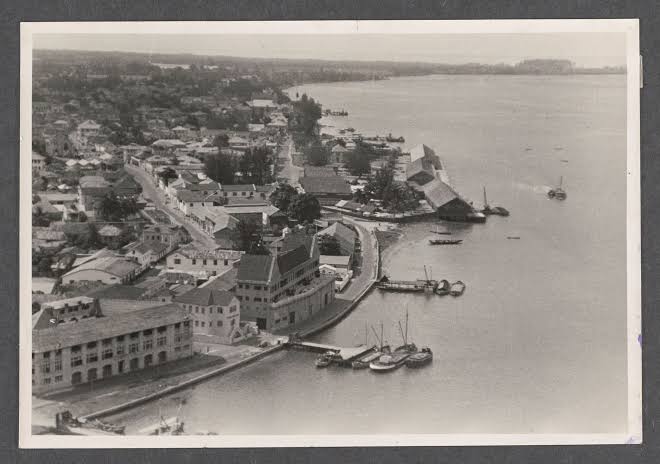
In 1948, British colonial authorities acquired the ancestral land of Iru Town from the Oniru family, initiating a profound transformation that displaced hundreds of residents. This pivotal moment erased an ancient identity to create what would become Victoria Island, Lagos.
This mid-20th-century acquisition highlights how Nigeria’s urban landscape was forged through colonial decisions, often at the expense of established local communities. The area, once an intricate network of swamps and fishing villages, was central to the economic and social life of Lagos for six centuries.
The Iru Town 1948 acquisition by colonial authorities
For generations, the Oniru family held traditional land claims across this extensive coastal region, including the future Victoria Island. Their palace, or Iga, once stood at the Marina, underscoring deep roots in the territory.
The Oniru domain extended across coastal and lagoon areas, reaching beyond to Okun Alajapa. Villages dotted the landscape where inhabitants, primarily fishermen, were among the first to engage with European traders like the Portuguese and Dutch.
Colonial control set the stage
The stage for the 1948 acquisition was set much earlier by British colonial ambitions. In 1851, British forces bombarded Lagos, seizing control amid disputes over the throne and commercial interests. This military intervention led to Lagos’s formal annexation as a British colony in 1861.
With annexation came the assertion of colonial authority over land. In 1907, the government acquired Mekunwen, known as Egbere by natives, near the Five Cowries Creek Bridge, during Lawani Oduloye’s reign as Oniru of Iru.
Further colonial acquisitions prompted the Oniru family to move their palace from Itinrin to Igbodu Village in 1927. These early actions demonstrated a clear pattern of colonial administration reshaping land ownership long before the larger 1948 transaction.
1948: The colonial land acquisition
The Lagos Executive Development Board (LEDB) orchestrated the 1948 acquisition. They purchased a significant portion of Oniru family land for £250,000, a substantial sum at the time, which ultimately paved the way for modern Victoria Island.
An additional £150,000 was paid in compensation for displaced residents and destroyed shrines. However, these figures barely capture the human cost, which included the destruction of homes and traditional spiritual sites. These losses involved more than just physical structures; they eroded community ties and cultural heritage, a theme seen in many Nigerian economic shifts.
Displacement and identity loss
The acquisition forced hundreds of residents from their ancestral homes. The original inhabitants displaced in 1948 were resettled in Maroko village.
For these families, relocation often meant losing familiar fishing grounds and established neighbours. Those dependent on local trading networks faced rebuilding their livelihoods elsewhere. A new settlement offered housing but rarely restored what was lost.
From Iru Town to Victoria Island
The transformation was more than physical; it was an act of renaming and re-identity. The area, once Iru Town, became “Victoria Island,” a name honouring Queen Victoria, the British monarch who ruled from 1837 to 1901.
Queen Victoria never visited Lagos. While Victoria Island’s name honoured her, the precise administrative decision behind this naming, including who selected it and when, is not detailed in readily available historical records. This means the exact motive for the decision remains unconfirmed.
This renaming symbolized a broader colonial attempt to assert control and reshape historical memory. Place names are not merely labels; they preserve history or reflect power. A change in a place’s name can fundamentally alter how its past is remembered.
Beyond 1948: Maroko and subsequent transformations
While the 1948 acquisition set the stage, the physical transformation of Victoria Island unfolded over time. The colonial administration also reclaimed eastern swamps to combat malaria and support urban growth.
The area of reclaimed swampland became Maroko Town, which grew into a large slum. On July 14, 1990, military Governor Raji Rasaki ordered the forced eviction of up to 300,000 residents from Maroko, many with legal titles to their properties. This brutal event, decades after the 1948 acquisition, had its own complex judicial outcomes.
The cleared Maroko land was then sold to residential buyers, transforming into Victoria Island Annex, which is now connected to the Lekki Peninsula and often referred to as “Oniru Estate.” This sequence of events, from colonial acquisition to post-independence displacement, highlights recurring themes in Lagos’s urban development.
Iru Kingdom today: A continuous legacy
Despite these profound transformations, the legacy of Iru Town and the Oniru family endures. The area of His Royal Majesty Oba Abdulwasiu Omogbolahan Lawal’s authority as the traditional ruler of Iru land covers the entire Victoria Island and its environs.
The Iru-Victoria Island Local Government Area, created in 2002 by the Tinubu Administration, further acknowledges this historical connection. The Oniru Royal House continues through its three recognized ruling houses: Abisogun, Akiogun, and Ogunyemi.
This persistence demonstrates that traditional structures and identities can survive drastic urban and political shifts. The modern district’s commercial success should not obscure the deep historical roots and the people whose lives were shaped by its ancient past.
A legacy of uneven development
The story of Iru Town reveals a recurring pattern in Nigerian urban development: the prioritization of commercial growth over the rights and heritage of existing communities. The modern high-rises of Victoria Island stand on land with a forgotten past.
The benefits of urban growth and the costs borne by existing residents were often not shared equally. Understanding this history is crucial; it reminds us that development is not neutral. It involves choices about whose lives are disrupted and whose histories remain visible in Lagos’s urban fabric, impacting future political decisions.
Remembering Iru Town beneath Victoria Island
The transformation of land associated with Iru Town and the Oniru family into modern Victoria Island is a complex narrative of land acquisition, urban expansion, and changing identity. The 1948 acquisition by the LEDB helped prepare the way, while surveying and reclamation changed the physical landscape irrevocably.
But the history is not complete without the people whose lives were connected to the land. Their homes, livelihoods, community ties, and cultural memories form part of the story, just as surely as the roads and buildings that later appeared. These human experiences must be integrated into the district’s historical record.
The name Victoria Island has become familiar across Nigeria, but the history that preceded it deserves to remain part of public memory. Remembering Iru Town is not a rejection of the modern district. It is a recognition that the land had a history before its present identity, and that the people who came before the skyline should not be forgotten.
