




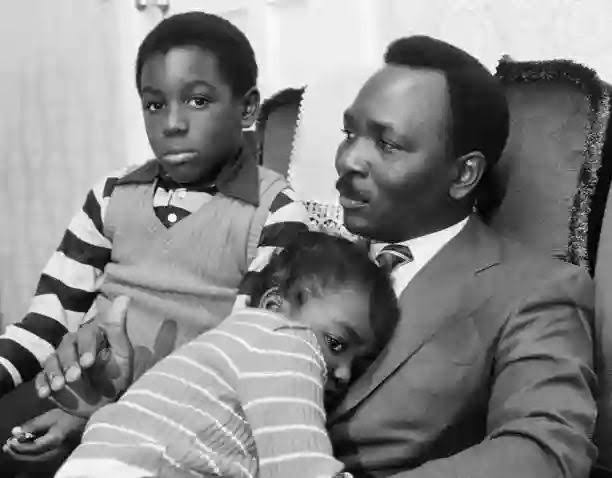
On 25 October 1975, photographer Terence Spencer documented General Yakubu Gowon with his young children, Ibrahim and Saratu, in London. This quiet family portrait, preserved in the Popperfoto collection, offered a stark contrast to the dramatic political upheaval that had engulfed Nigeria just months prior.
It was a rare, intimate glimpse of a leader in exile, far from the halls of power he had commanded for nearly a decade.
Yakubu Gowon posed 1975: end of rule
Gowon, who had led Nigeria through a tumultuous period, found himself removed from office in a bloodless military coup on 29 July 1975. The abrupt change occurred while he was attending the twelfth Organisation of African Unity (OAU) summit in Kampala, Uganda, marking an unexpected end to his long tenure as Head of State.
General Yakubu Gowon assumed leadership in August 1966, navigating Nigeria through one of its most challenging chapters: the Nigerian Civil War. Fought between the federal government and the secessionist Republic of Biafra from 1967 to 1970, the conflict tested the nation’s unity. Gowon’s leadership during this period was pivotal, culminating in the “no victor, no vanquished” policy aimed at national reintegration.
After the war’s end in January 1970, Nigeria experienced a period of significant change. Surging oil revenues fueled expanded public spending and growing aspirations for national development. However, these post-war years also brought increasing criticism of Gowon’s military government, particularly regarding administrative efficiency, corruption, and the persistent delays in returning to civilian rule.
Dissatisfaction within Nigeria intensified after Gowon postponed the promised 1976 transition to elected government in October 1974. He argued that the existing timetable was unfeasible. This decision further alienated many Nigerians eager for democratic governance, and discontent brewed within military ranks as well, setting the stage for the dramatic events of the following year.
Coup from Kampala: A Bloodless Transition
The military officers who moved to depose Gowon chose a strategic moment: 29 July 1975. With the Head of State outside Nigeria, attending the OAU summit, the transfer of power unfolded swiftly. Colonel Joseph Nanven Garba, commander of the Brigade of Guards, announced the change over Radio Nigeria, declaring Gowon was no longer Head of State.
The announcement triggered immediate emergency measures across the country. A curfew was imposed, and Nigeria’s borders and airports were closed temporarily. Diplomatic reports from the time confirmed the coup was largely bloodless, with power transferring peacefully despite the abruptness of the change. This ensured minimal disruption within the immediate aftermath.
Brigadier Murtala Mohammed emerged as the new Head of State and Commander in Chief of the Armed Forces. He quickly appointed Brigadier Olusegun Obasanjo as his Chief of Staff, Supreme Headquarters, solidifying the new administration. Gowon, who had governed for almost nine years, suddenly found himself a former leader, thousands of miles from home.
A Human Face of Exile in London
Less than three months after the coup, the photograph by Terence Spencer offered a strikingly personal view of the former Head of State. Captured on 25 October 1975, the image shows Gowon alongside his young son, Ibrahim, and daughter, Saratu, in London. Ibrahim, born in 1970, would have been around five years old, while Saratu, born in 1972, was approximately three.
The image departed sharply from the official portraits commonly associated with military leaders. Instead of a uniform or a formal setting, Gowon appeared as a father in a private moment. This intimate portrayal lent a human dimension to a figure recently at the centre of national power, revealing a life that extended beyond the political arena.
This visual record provides a tangible link between a monumental political event and the personal aftermath for its central figure.
While it doesn’t reveal Gowon’s private thoughts or feelings about his removal, it clearly documents his presence in London in exile, a crucial piece of the historical mosaic often overlooked in accounts of statecraft and military actions.
It prompts a deeper understanding of how public roles intertwine with private lives, especially in moments of great transition.
From Head of State to University Student
General Yakubu Gowon arrived at Gatwick Airport on 12 August 1975, just weeks after his overthrow, from Lomé. He reunited with his family in London, where he would begin a new chapter. His life in Britain was not one of idle retirement; instead, he embraced academic pursuits, enrolling at the University of Warwick.
At Warwick, Gowon embarked on a doctoral program, researching regional cooperation in West Africa. His academic journey culminated in a PhD in Political Science, with his thesis, titled “The Economic Community of West African States: A Study in Political and Economic Integration,” submitted in February 1984. This academic endeavor highlighted his continued intellectual engagement with issues central to African development.
The subject of his thesis, the Economic Community of West African States (ECOWAS), held particular significance. Gowon had played a crucial role in its establishment, with the Treaty of Lagos creating ECOWAS on 28 May 1975, just two months before his removal from office.
His academic work thus directly explored a regional institution he helped bring into being, demonstrating a continuity of purpose despite his change in circumstance. This commitment to regionalism provided a framework for his post-power intellectual pursuits.
Navigating Allegations and Eventual Return
Gowon’s exile in Britain, though largely focused on his studies, was not entirely free from political turbulence. On 13 February 1976, an attempted coup led by Lieutenant Colonel Buka Suka Dimka resulted in the assassination of Head of State Murtala Mohammed. Lieutenant General Olusegun Obasanjo then succeeded Mohammed, continuing the military government’s programmes.
Gowon was subsequently implicated in allegations connected to this coup attempt. These accusations complicated his ongoing absence from Nigeria and prolonged his period of exile. Such political controversies underscore the persistent intertwining of personal fate with national events, even when individuals are far removed from direct governance. These events formed a distinct episode from the earlier photograph, which predated the assassination by several months.
He remained in Britain for several more years, steadfastly pursuing his academic goals. A significant turning point came in 1983 when he received a pardon under the civilian administration of President Shehu Shagari, allowing him to return to Nigeria.
Later, his military rank was officially restored in 1987 during the government of General Ibrahim Babangida, marking a full circle in his public life and re-establishing his place within the national narrative. The path of Nigerian leaders often involved complex turns.
The Photograph’s Enduring Historical Significance
The 1975 photograph of Yakubu Gowon with Ibrahim and Saratu in London offers more than a simple visual record. It serves as a powerful historical document, revealing a dimension of leadership that often escapes official chronicles: the personal life disrupted by political destiny. It humanises a figure known primarily for his public roles, allowing us to see the private individual amidst national upheaval.
This image helps to ground the abstract narratives of coups and political transitions in tangible, relatable human experience. It forces viewers to consider the impact of state-level events on individual lives, even those of the powerful.
The contrast between his near-decade in power and his quiet life in Finchley, North London, provides a profound commentary on the transient nature of political authority. Understanding historical figures often requires this deeper dive.
Ultimately, the photograph of Gowon in exile with his children reminds Nigerians that leaders are also individuals with families, facing personal challenges even as the nation undergoes seismic shifts. It underscores the profound and often unexpected consequences of political change, not just for the governed, but for those who once governed them.
This visual moment from 1975 offers a lasting insight into the complex interplay of power, exile, and personal resilience in Nigeria’s rich history.
