




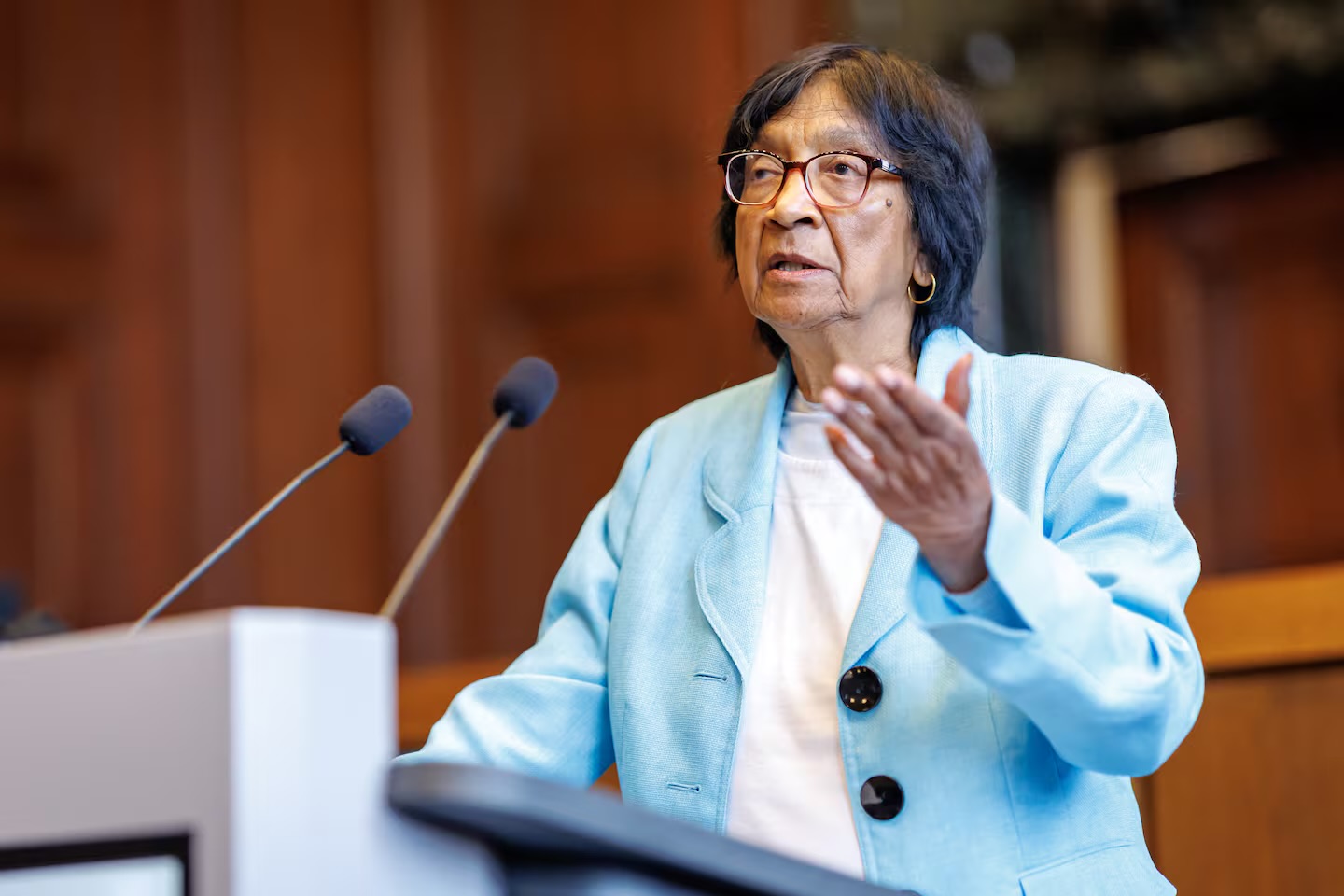
On October 9, 2026, Navanethem “Navi” Pillay, an 85-year-old South African lawyer, was awarded the Nobel Peace Prize, marking her as the first South African woman to receive this esteemed honour. This recognition from the Norwegian Nobel Committee celebrated her lifelong dedication to international law and human rights, a path forged in the crucible of apartheid.
Her extraordinary journey, from a childhood under racial oppression to the pinnacle of global recognition, offers a profound lesson. It shows how unwavering commitment to justice can shatter barriers and resonate far beyond national borders.
Navi Pillay Nobel Peace Prize early life
Pillay’s achievement placed her among a distinguished lineage of African Nobel laureates, including South Africa’s Albert Luthuli and Nelson Mandela, and Kenya’s Wangari Maathai. Her story highlighted how resilience and the relentless pursuit of justice from within Africa could reshaped perceptions of gender globally.
Born in Durban in 1941 to Tamil-Indian parents, Pillay faced severe racial discrimination under the brutal apartheid system. Her grandparents had immigrated to South Africa in the 1890s, working on sugar plantations. She grew up experiencing the daily indignities and systemic injustices of a society divided by race.
Despite these profound limitations, Pillay pursued her education with determination. She earned a Bachelor of Arts in 1963 and a Bachelor of Laws (LLB) degree in 1965 from the University of Natal. Her academic excellence later led her to Harvard University in the United States, where she earned a Master of Law (LLM) degree in 1982 and a Doctor of Juridical Science (SJD) in 1988.
A Groundbreaking Legal Career in South Africa
Pillay did not wait for apartheid to end to begin her fight for justice. In 1967, she became the first Black woman to open her own law practice in Natal Province, a truly audacious step given the prevailing racial and gender biases. Her early career saw her bravely defending anti-apartheid activists, including none other than Nelson Mandela, challenging the state’s oppressive justice system.
She represented individuals charged under severe laws like the Terrorism Act, exposing the practice of torture and solitary confinement of political detainees. Crucially, Pillay won a landmark right for political prisoners, including Mandela, to access legal counsel in 1973. This small victory carved out vital protections within an unjust system, often delivering an alternative to the false promise of stability offered by military coups.
After apartheid’s fall, Pillay’s contributions continued. In 1995, she was appointed an acting judge in the South African High Court, becoming the first Black woman to hold such a position. She also played a significant role in drafting South Africa’s Constitution, advocating for the inclusion of a robust equality clause that prohibited discrimination on various grounds.
Shaping International Justice
Pillay’s courage extended beyond South Africa, shaping international jurisprudence through pivotal roles. In 1995, she was elected as a judge to the International Criminal Tribunal for Rwanda (ICTR) by the UN General Assembly. She served for eight years, including four as its President, making groundbreaking rulings.
It was at the ICTR where Pillay helped establish sexual violence as a prosecutable act of genocide in a landmark 1998 ruling, during the case of The Prosecutor v. Jean-Paul Akayesu. This historic decision set a precedent, affirming that rape could be a means of perpetrating genocide. She then served as a judge on the International Criminal Court (ICC) from 2003 to 2008.
Later, as the United Nations High Commissioner for Human Rights from 2008 to 2014, Pillay consistently championed accountability for mass atrocities. Her role demanded an insistence that human rights remain central, even when political landscapes shifted. She led critical initiatives, always emphasizing judicial rigor and moral courage.
The Nobel Committee’s Bold Statement
The Norwegian Nobel Committee explicitly recognized Pillay’s profound impact. Jørgen Watne Frydnes, Chair of the Committee, underscored Pillay’s “firm moral compass” and her unwavering commitment to universal legal principles. He framed the 2026 award as a direct challenge to forces undermining the international rules-based system, a timely message given current global tensions.
Frydnes noted that the international legal system faced tremendous pressure and its institutions were under attack. The committee believed that lasting peace must build on legal foundations, not on the will of the strong or a fragile balance of power. The prize, he explained, was a “clear response to all the attacks, all the sanctions, that are undermining the international legal system.”
This award highlighted the critical importance of international law and human rights defenders in an increasingly turbulent world. It affirmed that even when nations face complex geopolitical pressures, the principles of justice and accountability must prevail for any genuine peace to endure.
A Legacy of Unwavering Justice
Upon learning of the Nobel Peace Prize award, Pillay said she was “reeling with surprise.” She dedicated it to “all of the survivors of international crimes as well as to practitioners and defenders of international justice whose compassion and courage continue to ensure that impunity will not be allowed to reign.”
She also noted that she had just turned 85 and was still involved as an ad hoc judge in the case brought by Gambia against Myanmar.
Her words resonated globally, drawing praise from leaders like UN Secretary-General António Guterres, who described her as a “champion of international law and human rights.” South African President Cyril Ramaphosa also celebrated her, stating the award allowed the nation to “celebrate the progressive contributions she has made to strengthen peace, uphold human dignity and bring hope.”
Even at 85, Pillay continued her work as an ad hoc judge on the International Court of Justice, notably in the Gambia vs. Myanmar case, where Myanmar faced accusations of genocide. Her career spans more than 50 years, consistently focused on holding perpetrators of mass atrocities accountable and expanding the reach of international law.
Navi Pillay’s journey from an apartheid courtroom to the pinnacle of global recognition proves that African leadership in justice and human rights remains vital. Her legacy underscores that even in the face of immense pressure, principled legal work can forge a path towards a more just and peaceful world for all.
