




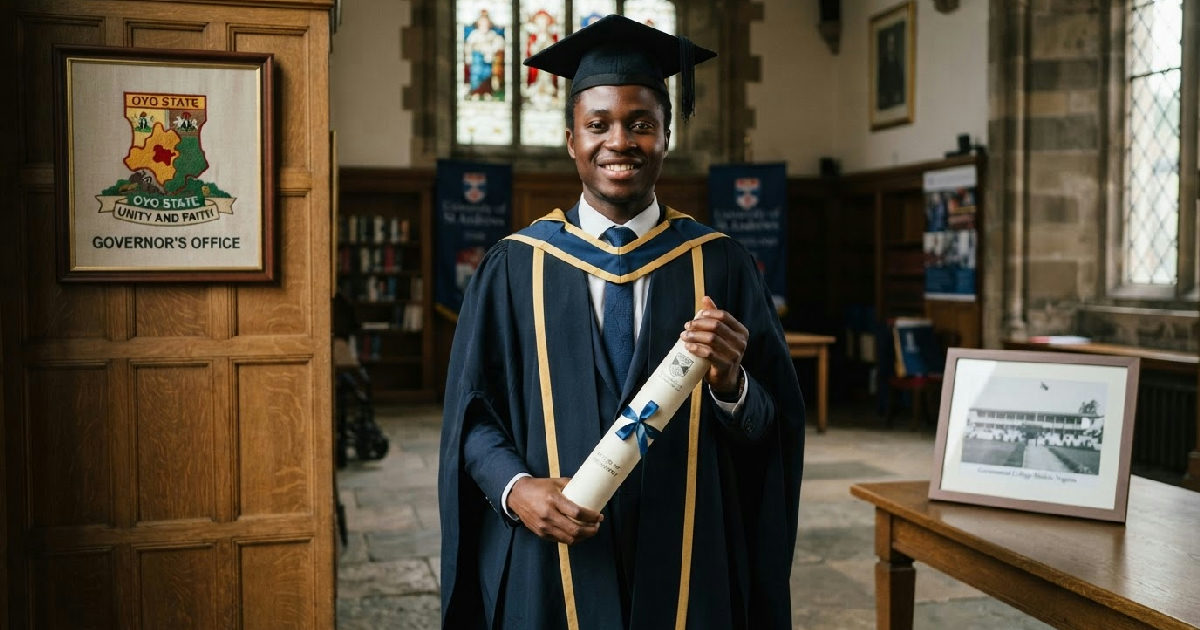
By 1961, Victor Omololu Olunloyo had achieved a doctorate in mathematics at the University of St Andrews, doing so at just 25 years old. He accomplished this feat after first graduating with First Class Honours in Mechanical Engineering.
This astonishing academic achievement often gets overshadowed by his brief three-month tenure as governor of old Oyo State in 1983. His story reveals a man of profound intellectual capability whose journey spanned multiple disciplines and leadership roles, far exceeding the common political narrative.
Future Oyo State Governor’s early education
Born in Ibadan on 14 April 1935, Victor Omololu Olunloyo embarked on an educational journey that crisscrossed colonial Nigeria. He attended Holy Trinity Primary School in Lagos in 1939, moving to Olowogbowo Methodist Primary School the following year.
Between 1941 and 1946, he studied at St Peter’s Primary School in Aremo, Ibadan, before concluding his primary education at St Paul’s Anglican Primary School, Gbongan, in 1947. This diverse primary schooling provided a broad foundation for his future academic pursuits.
His admission to Government College, Ibadan, in 1948 marked a pivotal moment. More than 2,000 candidates competed for places, with Olunloyo securing tenth position and a scholarship to one of colonial Nigeria’s elite secondary schools.
He initially struggled, finishing 21st in a class of 23 pupils during his first year. This occurred because he had completed Standard Five, while most of his peers had finished Standard Six. Yet, Olunloyo quickly recovered, challenging his teachers to provide a full year’s curriculum which he completed in just three months, rapidly rising to the top of his class.
Tragedy struck that same year when his father, Horatio Vincent Sowemimo Olunloyo, died on 29 December 1948 at the age of 42. This left the 13-year-old Olunloyo and his siblings under their mother’s care.
Government College placed him among a generation that would produce many prominent Nigerian figures. These included Nobel laureate Wole Soyinka, physician Oladipo Akinkugbe, and agricultural scientist Olalekan Are. Olunloyo also found time to play cricket, becoming an opening bowler for the school team, demonstrating his well-rounded nature.
A Family of Contrasts
Victor Omololu Sowemimo Olunloyo was the eldest of five children, born to Horatio Vincent Sowemimo Olunloyo and Alhaja Bintu Tejumola Abebi. His family background reflected the unique religious diversity often found in Nigeria’s South-West.
His father, a Christian, was an organist, scholar, and administrator, who also served in the Nigerian Army. His mother, Alhaja Bintu Tejumola Abebi, was a devout Muslim who lived to be 102, passing in October 2013.
This parental blend of faiths underscored a broader cultural openness that likely influenced Olunloyo’s own intellectual flexibility. His younger brother, Vincent Olusegun Sowemimo Olunloyo, also pursued an academic path, becoming an engineer and university lecturer.
Scottish Scholarship and Dual Excellence
Olunloyo continued his higher education at University College Ibadan in 1953, then affiliated with the University of London. His exceptional performance in the Higher School Certificate examinations earned him scholarships for overseas study.
In 1955, he embarked for Scotland, attending Queen’s College, Dundee, which was then part of the University of St Andrews. He notably tested into the second year of his program, excelling in physics, chemistry, and mathematics with scores as high as 98%.
His undergraduate studies culminated in a First Class Honours degree in Mechanical Engineering in 1958, where he was recognized as a University Prizeman. His mathematical prowess was particularly evident; he reportedly scored an astounding 132% in his final year mathematics examination due to an open-marking system.
Without pause, he transitioned directly into doctoral research in mathematics at the University of St Andrews. In just two years, by 1961, he completed his PhD, titled On the Numerical Determination of the Solutions of Eigenvalue Problems of the Sturm-Liouville Type. This made him a mathematics doctor at 25 years old.
Professor John Meadows Jackson, his academic advisor at Queen’s College, Dundee, lauded him as “outstanding, able and hardworking,” highlighting his “exceptional” ability in mathematics. This rapid advancement demonstrated a rare intellectual agility, moving seamlessly from engineering to advanced theoretical mathematics.
His path diverged significantly from a conventional academic career progression. He bridged disciplinary boundaries with remarkable speed, completing his doctorate in a field distinct from his initial undergraduate focus. This intellectual leap underscored his innate talent and dedication.
From Academia to Public Service
Upon his return to Nigeria, the newly independent nation offered fertile ground for bright young minds. Olunloyo joined University College Ibadan as a mathematics lecturer, contributing to the burgeoning educational sector.
His influence quickly extended beyond academia. In 1962, at just 27, he was appointed Commissioner for Economic Development in the Western Region under Dr Moses Majekodunmi. This early entry into government marked the beginning of a long career in public service.
He held various other commissioner roles, including education, special duties, local government, and chieftaincy affairs, and chaired the Western Nigerian Development Corporation. These roles showcased his versatility and commitment to national development during a critical period.
Olunloyo also played a foundational role in establishing The Polytechnic, Ibadan, becoming its first rector. His dedication to education was a consistent thread throughout his public life, shaping institutions that would impact countless Nigerian students.
However, it was his brief stint as governor of Oyo State in 1983 that became his most widely remembered political chapter. He won the election on the National Party of Nigeria (NPN) platform, taking office on October 1, 1983, after a contentious legal battle with incumbent Chief Bola Ige.
His governorship was cut short abruptly when a military coup led by General Muhammadu Buhari overthrew Nigeria’s Second Republic on December 31, 1983. Olunloyo served for only three months, a period that, ironically, often overshadows his decades of academic and administrative contributions.
A Legacy Beyond Politics
The core surprise of Victor Omololu Olunloyo’s life is that his extraordinary intellectual achievements in engineering and mathematics by age 25 are frequently eclipsed by a mere three months in political office. This academic prowess, showcased so early, is a testament to an exceptional mind.
His passing on April 6, 2025, just days before his 90th birthday, reignited public discussions about his extensive legacy. Tributes flowed from political figures and educational institutions, each remembering different facets of his multifaceted career.
During his funeral ceremonies in June 2025, Oyo State Governor Seyi Makinde announced the renaming of The Polytechnic, Ibadan, to Omololu Olunloyo Polytechnic, Ibadan. This move aimed to honour Olunloyo’s crucial role in the institution’s early development.
The renaming, however, sparked debate among students and alumni who advocated for retaining the established name. This public discourse highlights how institutions grapple with commemorating influential figures while preserving their own historical identity. Olunloyo’s life reveals that Nigerian public figures often possess depths of accomplishment that extend far beyond their most visible political roles.
His story challenges the narrow narratives sometimes imposed on those who serve in public office, reminding us of the rich intellectual capital that shaped the nation.
