




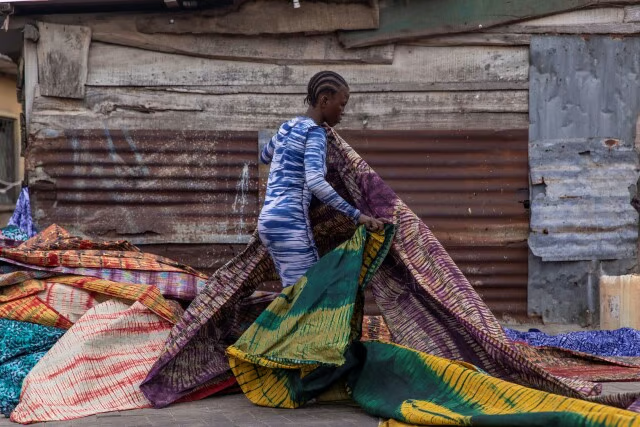
In the markets of Lagos, art galleries from Osogbo to London, and draped on everyday Nigerians, the vibrant patterns of Adire cloth tell a story of Textile Tracing. This traditional Yoruba art form, deeply rooted in history and culture, showcases the intricate process of creating indigo-dyed fabrics.
The craft, known as Adire (Yoruba: Àdìrẹ), is an indigo-dyed textile tradition rooted deep in southwestern Nigeria. It speaks to an artistry passed down through families, a silent language woven into the very fabric of identity.
Understanding Adire Textile Tracing
The name “Adire” itself offers a glimpse into its origins, deriving from the Yoruba words ‘adi’, meaning “to tie or bind,” and ‘re’, signifying “to dye.” This ancient art form originated centuries ago in Yoruba heartlands, with cities like Abeokuta in Ogun State, Ibadan, and Osogbo widely recognised as its birthplaces.
Historically, Adire began as an exclusive fabric, gracing the wardrobes of royalty and the wealthy. But its journey didn’t end there. Over time, it evolved into a powerful symbol of pride and identity, embraced by Nigerians from all walks of life, while steadfastly retaining its deep connection to Yoruba heritage and culture.
Hands That Dye: Crafting Adire’s Intricate Patterns
The magic of Adire lies in its ingenious resist-dyeing techniques, where specific sections of the fabric are treated to prevent the indigo dye from penetrating. This meticulous process creates the intricate, often geometric, patterns that are the hallmark of the cloth.
Traditional Adire relies heavily on indigo, a rich blue dye extracted from the leaves of the Elu (Lonchocarpus cyanescens) plant. These leaves undergo fermentation, transforming into the potent dye liquid. The dyeing itself is a ritual, often performed in large pots sunken into the earth, with cloths dipped repeatedly—sometimes 25 or more times—to achieve a profound blue-black hue.
Techniques That Define the Fabric
Three primary resist techniques are central to the Nigerian Adire tradition. Each requires a distinct skill and yields unique patterns.
Adire Oniko involves tying raffia firmly around individual corn kernels, small pebbles, or even twisting and tying sections of the fabric itself. These tied areas resist the dye, resulting in small white circles or other organic shapes.
Adire Alabere, meaning “stitched Adire,” sees artisans painstakingly stitch raffia onto the fabric following a pre-drawn pattern. After dyeing, the raffia is removed, revealing the design in undyed fabric against the deep indigo background.
Perhaps the most visually striking is Adire Eleko, where a cassava starch paste is meticulously painted onto the cloth. This paste acts as the resist and can be applied freehand using tools like chicken feathers, or through carved calabashes and, more recently, metal stencils fashioned from tin sheets, a development that emerged in the early 20th century.
While these traditional methods are cherished, modern artisans have also begun incorporating synthetic dyes. This adaptation allows for a broader spectrum of colours, expanding the visual vocabulary of Adire while honouring its historic roots.
The Visual Language of Adire
Beyond their aesthetic appeal, Adire patterns are a form of visual communication. They represent elements from nature—plants and animals—as well as tools, proverbs, and abstract concepts.
These motifs are categorized into geometric, figural, skewmorphic, letters, and celestiomorphic types, each potentially encoding values or scenes from daily life. They turn every piece of Adire into a story, a snippet of history, or a cultural reference.
Notable historical designs include the “jubilee pattern,” created to commemorate George V and Queen Mary in 1935, and motifs like “Olokun,” depicting the goddess of the sea, or “Ibadadun,” which translates to “Ibadan is sweet,” reflecting regional pride. These designs speak volumes about the era and the communities that produced them.
Custodians of Culture: Yoruba Women and Adire’s Future
Adire is not just a textile; it’s a legacy largely safeguarded by Yoruba women. They have served as the principal custodians of these intricate dyeing techniques, ensuring its continuity through the generations.
The knowledge, the secret recipes for dyes, and the intricate patterns are typically passed directly from mother to daughter. This intergenerational transfer has cemented Adire as a powerful symbol of female entrepreneurship and cultural preservation.
Women dyers in bustling towns like Abeokuta and Ibadan transformed into both artists and shrewd businesswomen in the early 20th century, fuelling a significant boom for the craft. Their work has historically provided a crucial source of income, fostering social solidarity and economic empowerment for Yoruba women.
Today, this tradition continues to thrive. Cultural figures such as Professor Nike Okundaye-Davis, a fifth-generation Adire maker and the visionary founder of the Nike Art Gallery, champion Nigerian textiles globally. Similarly, Ayodeji Basirat Atinuke, a third-generation artisan from Abeokuta, steadfastly upholds her family’s rich dyeing heritage.
Their efforts, alongside countless others, have ignited a contemporary revival, drawing recognition from bodies like UNESCO for its model of female-led cultural preservation.
Enduring Legacy: More Than Just Cloth
The enduring presence of Adire goes far beyond its aesthetic appeal or economic impact. It represents a tangible link to the past, a continuous narrative of ingenuity and resilience embodied in cloth.
As contemporary designers embrace and reinterpret its patterns, Adire continues to demonstrate its adaptability and timeless appeal, reflecting the dynamic nature of Nigerian cultural expression. This textile isn’t merely a fashion statement; it’s a celebration of heritage, a testament to the power of tradition, and a question to carry forward: how will these indigo threads continue to weave the story of Nigeria?
