




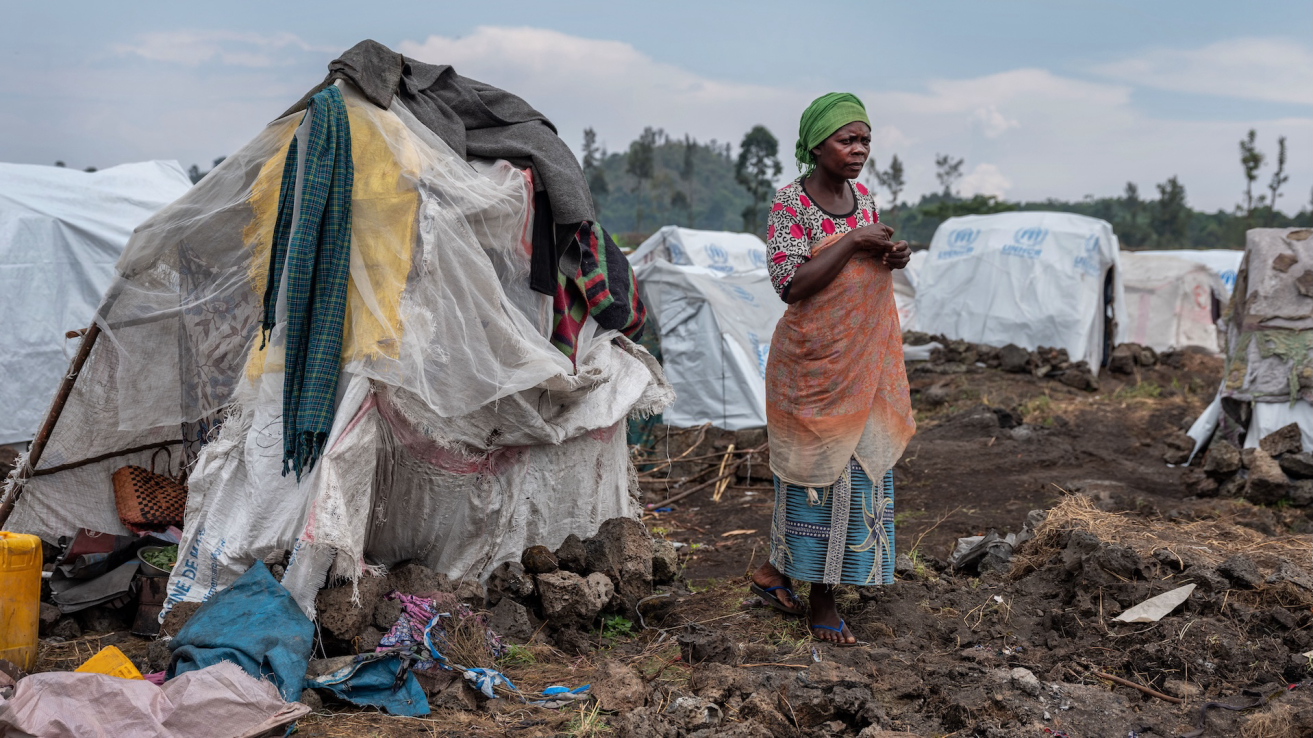
In 2025, after they had already fled the violence in South Kivu, the rains came for them a second time, exacerbating the Great Lakes displacement crisis. Shelters built for approximately 50,000 people in Tanganyika Province, flimsy protection against a hostile world, were simply washed away by floods after a torrential downpour.
To be displaced once is a tragedy; to be displaced again by the weather is a sign of a new, terrifying reality.
Understanding the Great Lakes displacement crisis
This single, devastating moment captures the story of Africa’s Great Lakes region. Here, the old wounds of war and the new wounds of a changing climate have combined into a brutal double threat. By early 2025, the wider region encompassing the Great Lakes and the Horn of Africa was home to an almost incomprehensible 24.7 million displaced people, a population larger than many nations.
The Democratic Republic of Congo (DRC) is the epicentre of this storm. By the end of 2025, the country hosted 4.93 million internally displaced persons (IDPs), the second-largest such population in Africa. This is not a natural disaster; it is a man-made one, overwhelmingly driven by relentless armed conflict that has torn the country’s eastern provinces apart for decades.
The resurgence of armed groups, particularly the Le Mouvement du 23 mars (M23), has triggered waves of mass displacement. In the first quarter of 2025 alone, over a million new IDPs were registered in territories held by the Alliance Fleuve Congo (AFC)/M23. Clashes between these rebels and the Congolese Armed Forces (FARDC) have contributed to a staggering national total of more than 7 million IDPs.
Yet, conflict no longer tells the whole story. Climate-related events accounted for 630,000 of the DRC’s displaced by the end of 2025. People fleeing violence are often forced into precarious, overcrowded camps, which are then battered by extreme weather.
For the 50,000 in Tanganyika, the floods weren’t a separate crisis; they were a direct consequence of the first one, showing how fragile individuals undermine institutions and leave entire populations exposed.
When the rains come: Burundi’s climate exodus
A short distance away in Burundi, the equation is tragically inverted. While the shadow of its 1993 civil war still lingers, climate change has become the dominant engine of displacement. Of the approximately 88,800 officially counted IDPs by the end of 2025, a stunning 92.3%—or 82,800 people—were forced from their homes by climate-related disasters.
Floods, landslides, and the inexorably rising waters of Lake Tanganyika are redrawing the map of who can live where. This new wave of displacement crashes against an older, unresolved one. An estimated 100,000 people, still displaced from the civil war, are not even counted in official statistics.
Their protracted displacement has itself become a driver of conflict over land, a resource made ever scarcer by a changing environment.
This is a story with deep roots. The Great Lakes region has been shaped by decades of instability, from the Burundian war to the 1994 Genocide against the Tutsi in Rwanda. These historical conflicts created a foundation of vulnerability. Communities that never fully recovered are now being hit by shocks that the planet itself is delivering, with devastating consequences.
The weight of the past
Efforts to manage displacement are not new. The Great Lakes Protocol on the Protection and Assistance to Internally Displaced Persons was published back in 2006. But the scale of the problem has outpaced the architecture designed to solve it. In 2004, the region had 1.5 million IDPs; today the figure is more than ten times that, a testament to interlocking failures of peace and planning.
A predictable disaster: The mechanics of the double threat
The interaction between conflict and climate is not a coincidence; it’s a predictable, vicious cycle. War forces people from stable homes into makeshift settlements in areas often more exposed to climate hazards. It destroys infrastructure and systems that might offer protection. Then, when the floods or droughts arrive, they hit a population with no resilience left.
This dynamic is intensified by competition for resources. As climate change makes water, fertile land, and pasture scarcer, it pours fuel on the embers of old conflicts. This is particularly acute in densely populated nations like Burundi and Rwanda, where disputes over land are a constant source of tension. The deep historical systems of community and land tenure are being broken by these modern pressures.
In Rwanda, a country that has achieved relative stability, internal displacement is now almost entirely climate-driven. In May 2023, severe floods and landslides killed at least 130 people and destroyed over 5,000 homes, displacing more than 70,000. For a nation where 62% of the population relies on agriculture, each weather event is an existential threat to livelihoods.
A broken response and a looming question
The international response is struggling to keep pace, hampered by fragmented efforts and shrinking aid budgets. The scale of need is immense. For 2026, UNICEF’s humanitarian appeal for the region is US$34 million.
Meanwhile, the United Nations High Commissioner for Refugees (UNHCR) is attempting to raise $100 million for a Climate Resilience Fund, but these figures are a fraction of what is required to support nearly 25 million people.
The crisis reveals a fundamental flaw in how the world responds to disasters. Humanitarian aid was largely designed for singular events: a war with a beginning and an end, or a flood that recedes.
It was not built for a permanent state of overlapping emergencies, where the displaced from a conflict are immediately re-displaced by a climate shock, making their journey feel less like a remarkable 19th-century journey with a destination and more like a permanent state of wandering.
The situation in the Great Lakes is more than a regional crisis; it’s a look into the future. It poses a difficult question for the world: what happens when the disasters never stop? The answer, for now, is being written in the lives of millions of people who have lost everything, not once, but over and over again.
