



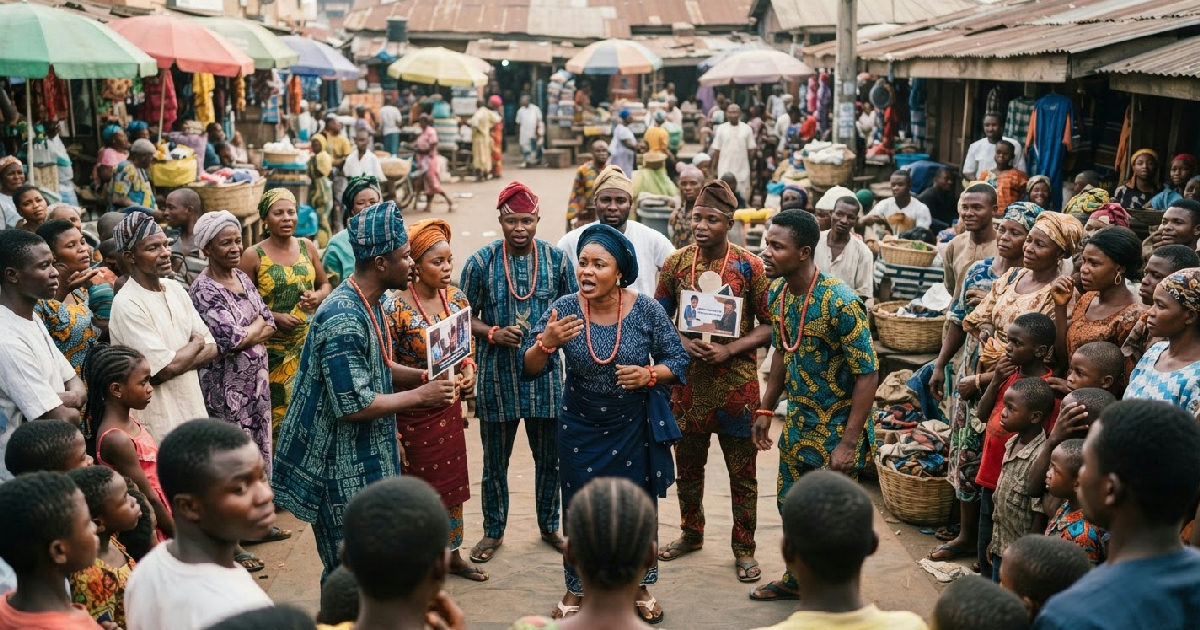
In the middle of Ilupeju Market in Ekiti, amid the clamour of commerce, a different kind of transaction is taking place. A crowd gathers, not around a stall selling yams or textiles, but around a small, clear space where a story is unfolding.
It’s a story many in the crowd know intimately but have never spoken aloud: a young girl, a family’s decision, and a blade. This is not entertainment; it is a reckoning.
Nigerian street theatre tackling FGM
This is Theatre for Development (TfD), a practice that turns public spaces into forums for change. In a recent series of interventions, a team from the Federal University, Oye-Ekiti (FUOYE) did not just perform for communities—they created stages where communities could begin to talk to themselves.
Led by Professor Taofiq Olaide Nasir, they used the raw, immediate power of drama to tackle issues that pamphlets and public service announcements rarely touch: disease, drug abuse, and deeply rooted traditions that harm.
Of all the stages, Ilupeju Market was perhaps the most crucial. Markets are the social heart of Nigerian life, where news, gossip, and consensus are forged. Here, the FUOYE team addressed female genital mutilation (FGM), a practice criminalised by law but protected by custom.
The challenge is immense, as FGM is often seen not as violence, but as a duty—a cornerstone of cultural identity tied to beliefs about purity and marriageability.
Instead of condemnation, the performance offered a narrative. It followed a young girl’s journey from her family’s preparations through the procedure’s trauma and its lifelong consequences. Crucially, the drama gave voice to everyone: the grandmother who believed she was protecting her granddaughter’s future, the community elder citing ancestral obligation.
These characters weren’t villains, but recognizable figures driven by conviction, making the drama a mirror, not a lecture.
This approach is vital for addressing complex cultural beliefs that are resistant to outside messaging. The performance was designed to create a space for internal reflection. When the scripted action stopped, the real work began.
Using a technique called “forum theatre,” the facilitators invited the audience—traders, buyers, young mothers, and elders—to step onto the stage and change the story. The response was electric. Women who had undergone FGM themselves spoke up, some for the first time.
A traditional birth attendant in the crowd challenged the portrayal, sparking an honest public conversation about a topic usually shrouded in silence.
One woman, a trader, quietly approached a facilitator after the performance. “I had this done to me,” she said. “I did not know it had a name. I did not know it was wrong. Now I know. My daughter will be safe.” In that single statement lies the profound power of this work: it doesn’t just inform, it transforms.
Drama against disease in Irare community
From the social theatre of the market, the project moved to the rural community of Irare to confront literal life-and-death stakes: Lassa fever and cholera. In communities like Irare, these diseases are a terrifying reality, compounded by a lack of clean water and the persistence of misinformation.
Formal health campaigns, often delivered in English via smartphones or television, frequently miss the people who need them most.
Theatre operates on different terms. It requires no electricity, no literacy, only a space to gather. The scenes performed in Irare were drawn from the community’s own life. A family storing food carelessly, attracting the rodents that carry Lassa. A woman dismissing early symptoms as “ordinary malaria” with fatal results.
A community health worker battling rumours that the disease is a form of witchcraft. For the audience, this was not an abstract tale; it was a reflection of their daily risks and fears.
The performance didn’t stop at diagnosing the problem. It dramatised the solutions with equal care: how to store food in rodent-proof containers, how to mix oral rehydration salts for a child with cholera, the importance of reporting symptoms early.
By making correct behaviour as compelling as the drama of sickness, the team provided a clear, memorable public health script. The forum theatre session sparked passionate debate about rodent control and local beliefs, which Professor Nasir navigated with both scientific clarity and cultural respect.
The impact was immediate. An elder, initially skeptical, reportedly stood up at the end and told his neighbours, “Everything this drama has shown us, we have been doing wrong. Let us begin again from today.” The performance gave the community not just information, but a shared experience and a collective mandate to change.
Breaking the silence in the classroom
The interventions also turned inward, toward the lives of young people in schools and universities. At St. Augustine High School, the subject was menstrual hygiene, a topic steeped in shame that causes many girls to miss school and suffer in silence.
A powerful scene depicted a student mortified by a menstrual stain on her uniform, a moment of deep resonance for many girls in the audience.
The play opened the door to a conversation that formal lessons often struggle to start. It provided a vocabulary for students to discuss their bodies and health, and deliberately included male students, encouraging them to become allies instead of agents of stigma.
One female student told the facilitators the performance made her feel “seen.” In creating a space to address grief, memory, and wonder associated with growing up, the theatre became a form of care.
At FUOYE’s own Pre-Degree Centre and main campus, the focus was the drug and substance abuse crisis facing Nigerian youth. The dramas depicted the seductive pull of peer pressure and the devastating academic and social fallout of dependency.
Here, the technique of turning spectators into “spect-actors”—active participants who could enter the scene and alter its outcome—was particularly effective. It gave students a rehearsal space for real-life decisions, allowing them to practice resistance and explore alternatives in a safe environment.
The living tradition of theatre for development
This method of using theatre for social change is not new. Theatre for Development has deep roots in post-colonial Africa.
In the 1970s and 80s, cultural figures like Kenya’s Ngugi wa Thiong’o and Nigeria’s own Wole Soyinka and Ola Rotimi championed a vision of theatre not as an elite spectacle, but as a democratic tool for community dialogue and empowerment.
The Ekiti project is a living expression of this powerful tradition, which has a long history connected to the founding of Yoruba kingship and other cultural legacies.
What makes TfD so effective is its participatory nature. A billboard speaks *at* you; a TfD performance speaks *with* you. A government pamphlet delivers dry facts; a drama creates a visceral, shared experience. It is this experience—the shock of recognition, the emotional connection to a story that feels like your own—that has the power to shift attitudes and behaviour where abstract information fails.
Professor Nasir, a leading scholar in the field, sees this work as a core responsibility of a university. “Theatre has always been the most democratic of the arts,” he observed. By taking it out of the lecture hall and into market squares, classrooms, and community grounds, the FUOYE team gives people “the experience of seeing their own lives clearly, and the possibility of choosing differently.”
The success of these five interventions—in five distinct communities, tackling five different challenges—is a powerful testament to the method. As facilitator Mr. Tesleem Salaudeen noted, it shows what theatre can do when used with intention and care.
It’s a model that offers a way forward, suggesting that Nigeria’s universities hold not just academic knowledge, but creative tools that can help communities heal themselves from the inside out.
