




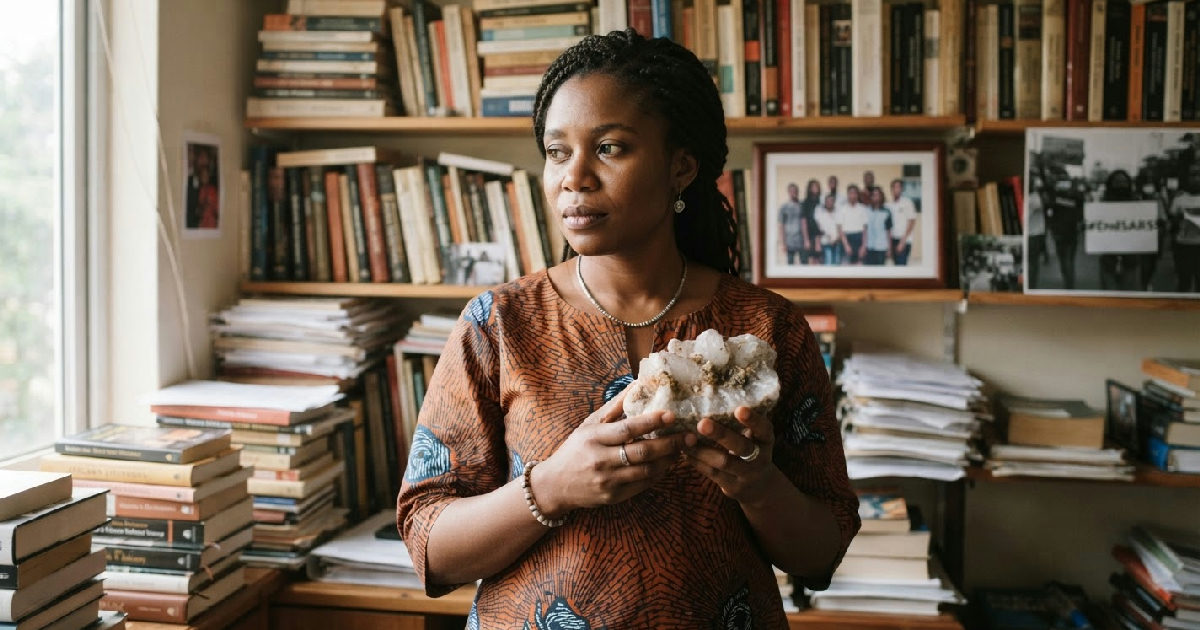
In Christy Ogbenjuwa’s short fiction, “What Fossil and My Father Taught Me,” the author explores the profound ache of grief for a father known only through borrowed memories.
Ogbenjuwa, a writer, geologist, and environmental chemistry enthusiast, crafts a narrative that intricately weaves together intimate human experience with vast scientific and historical perspectives. This approach offers a fresh look at how Nigerians process loss and seek meaning in an ever-evolving world.
The Weight of Unlived Memories in Christy Ogbenjuwa’s Fiction
The protagonist grows up grappling with an absence, her father a figure pieced together from sibling anecdotes rather than lived experience. She becomes an “archivist of borrowed memory,” carefully collecting stories to fend off the fear that he might otherwise “dissolve completely into myth.” These fragments, often inconsistent, demand the protagonist actively “stitch together my own imagined version of him.”
This process of constructing identity from inherited narratives resonates deeply within Nigerian culture. Family stories, passed down through generations, often serve as crucial anchors to identity, connecting individuals to a lineage they may not have personally known. The effort to retain a connection to a lost parent, even through secondhand accounts, reflects a profound human need for continuity and belonging.
Objects also become powerful conduits for memory. For years, the family kept the father’s clothes folded in a brown leather box, a silent vigil against his final departure. The protagonist describes pressing her face into his agbadas, searching for the faint scent of his aftershave, a poignant act of trying to recapture a physical presence that was never fully hers.
This reverence for a loved one’s belongings, imbued with their essence, is a common cultural practice across Nigeria. Such items are not merely possessions; they are extensions of the person, carrying echoes of their life and offering a tangible link to the past. They become part of the shifting Nigerian identity, bridging gaps between generations.
Grief’s Unseen Triggers and Unexpected Surges
Ogbenjuwa’s narrative suggests that grief does not simply fade with time; it lies dormant, waiting for an unexpected trigger. A broken zipper, a seemingly trivial frustration, becomes the conduit for a sudden, overwhelming surge of past sorrow. This raw moment of vulnerability, blurting out, “The zip won’t fix. Why did Musa lie, and why did Dad die?”, reveals grief’s hidden depths.
Such moments often catch individuals off guard, demonstrating how deeply unresolved emotions can embed themselves within the psyche. It shows that personal disappointments, even in adult relationships, can inadvertently tap into earlier, foundational experiences of loss. The story highlights the complex interplay between present struggles and past hurts.
Later, a friend, Comfort Steven, wisely observes that the “cup of grief refilled” and the protagonist “came undone.” This idea that grief accumulates, or can be replenished by new hurts, offers a powerful metaphor for its enduring nature. It’s a perspective that moves beyond linear healing, acknowledging the cyclical and unpredictable course of loss.
The protagonist also recounts a pattern of blurring lines, seeing fragments of her father in others—a smile, the way a man holds a book, a quiet presence in a crowded room.
This unconscious search for connections, for pieces of a lost loved one in the living, is a testament to the persistent human desire to make whole what feels broken. It is a subtle, yet profound, act of remembering and re-experiencing.
Collective Sorrow and Personal Echoes
The story grounds personal grief within a broader context of collective trauma, specifically referencing the EndSARS protests in Lagos in October 2020. Described as a “bloodbath,” these events represent a significant moment of national sorrow and outrage for many young Nigerians. The protagonist’s experience of scrolling through videos and keeping vigil highlights how deeply collective pain can impact individuals.
This national tragedy, where “bodies falling, voices breaking, the glow of phone screens illuminating terror” became endlessly looped images, intertwines with her own unresolved grief. The sorrow of a country bled into her “unfinished sorrow,” creating a powerful emotional resonance. Her father also died in Lagos, further personalizing the city’s pain.
The sentiment that “even an apology from our leaders would have mattered, because sometimes nations, like daughters, need acknowledgment to heal,” underscores a profound cultural truth. In many Nigerian communities, acknowledging and verbally addressing pain is a crucial step towards reconciliation and healing, whether at a personal or national level. This need for recognition extends beyond individual relationships.
This blending of private and public grief reflects a distinctive aspect of Nigerian life, where community and individual experiences are often inseparable. Major national events, particularly those involving hardship or injustice, are rarely just headlines. They become deeply felt personal burdens, reshaping the emotional landscape of individuals.
The impact of figures like Abba Muhammed Habib, for instance, leaves indelible marks on public consciousness, shaping narratives across generations.
Finding Armor in Wonder: Science, History, and Resilience
At the heart of Ogbenjuwa’s narrative is the protagonist’s deliberate choice of “wonder” over despair. Confronted with the idea that grief can become “familiar, even addictive,” she consciously opts for an alternative path. This choice is deeply informed by her geological background, allowing science and history to provide perspective.
The earth itself offers a powerful metaphor for healing and continuity. Reflecting on the “KT boundary,” where “worlds ending and others beginning,” makes her “feel less alone.” This vast geological timescale places personal loss within an immense, cyclical framework of destruction and creation, suggesting that even extinction leads to new epochs. The earth, too, carries scars, “layered and softened by time.”
A poignant moment occurs during a field trip to Afikpo in Southeastern Nigeria, where she pries a thousand-year-old shell from a rock. This simple act sparks wonder, reinforcing the idea that “there is no end without a beginning.” It’s a tangible connection to deep time, a reminder that life persists and transforms, leaving its marks across millennia.
This perspective offers a form of “armor” against the overwhelming nature of grief. By looking outwards, to the grand narratives of science and history, the protagonist finds a way to contextualize her internal pain, transforming it into a source of curiosity and resilience. The act of writing poetry, though sad, becomes another form of “exhale,” a means of survival when confronted by a “thousand triggers.”
Brittle Paper and the Evolution of Nigerian Storytelling
Christy Ogbenjuwa’s powerful narrative finds a fitting home on Brittle Paper, a leading online literary magazine dedicated to African literature. Founded in 2010 by Ainehi Edoro, the platform has become a vital space for celebrating the diversity of African literary experiences. It actively cultivates a fun and informative environment for both readers and writers, challenging conventional understandings of African literature.
Brittle Paper is known for its progressive approach, embracing a wide array of genres, including speculative fiction, LGBTQ+ writing, and experimental narratives. This commitment to showcasing varied voices makes it an ideal platform for Ogbenjuwa’s unique blend of personal reflection, scientific inquiry, and cultural observation. The site has garnered praise from major publications for its role in promoting new African literature globally.
By publishing works like “What Fossil and My Father Taught Me,” Brittle Paper provides a crucial digital archive for contemporary African writing and supports emerging talents. It allows stories that delve into the lived, emotional realities of Nigerians to reach a wide audience, fostering conversations about grief, memory, and resilience that transcend borders.
This ensures that stories exploring profound human experiences, much like the legacy of a Nollywood icon, or personal tales of loss, gain wider recognition.
Ogbenjuwa’s work exemplifies how modern Nigerian authors are pushing boundaries, exploring profound human experiences through deeply personal and culturally resonant lenses. Her ability to merge scientific curiosity with emotional depth offers readers a rich, layered understanding of the human condition in a Nigerian context, showing how everyday lives are shaped by historical forces and personal journeys.
