




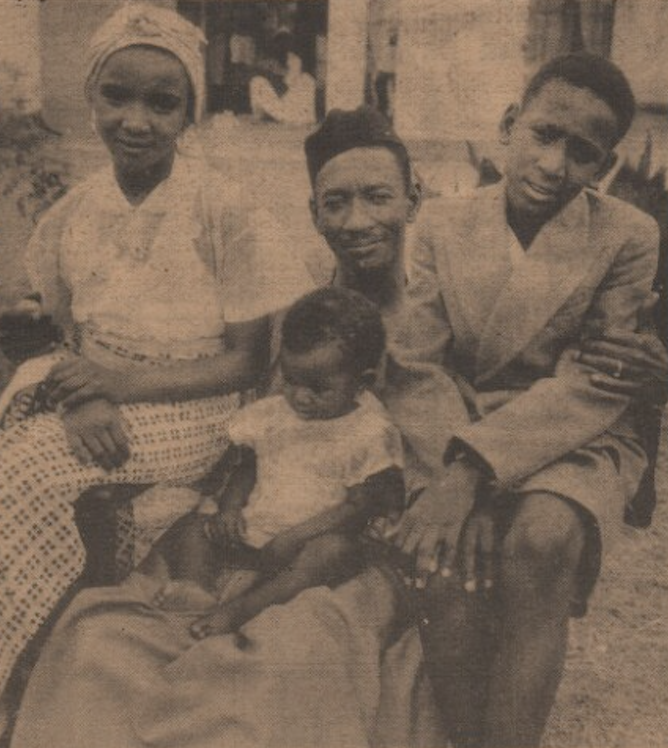
The Abba Habib portrait from May 1956, featured in Gaskiya ta fi Kwabo issue 712, shows the Northern Nigerian politician with his children Mustapha (12), Fati (9), and Kaka (1).
It reveals a personal dimension often lost in the official records of a statesman balancing family with pressing national duties. The image surfaced at a critical juncture for Nigeria, as authority steadily shifted from British colonial hands to emerging Nigerian leaders. Regional governments were gaining power, political parties were vying for influence, and the path to independence was reshaping relationships across the disparate regions.
The Abba Habib portrait 1956 and family life amidst political flux
The 1956 photograph, now preserved on Wikimedia Commons, presented Abba Muhammed Habib not as a stern politician, but as a father. His eldest son, Mustapha, stood on the right, while Fati and the infant Kaka completed the family tableau.
This intimate portrayal contrasted sharply with the weighty political responsibilities he bore, linking Dikwa and Bama to the power corridors of Kaduna, London, and the international stage.
Published on May 1, 1956, the portrait captured Habib at the height of his influence as the first Northern Regional Minister responsible for Northern Cameroons Affairs. It’s a potent reminder that behind every historical decision stood individuals with families, navigating personal lives alongside profound public duties. The photo provides a rare human touch to a political history often dominated by official documents and policy debates.
Abba Habib’s Roots and Early Public Service
Born in Dikwa, Borno State, in 1914, Abba Muhammed Habib came from a distinguished Shuwa Arab family of scholars and administrators. His father served as the District Head of Amchaka, instilling in young Abba an early understanding of governance and community leadership. This lineage deeply influenced his eventual trajectory into public service.
Habib’s formal education began at Borno Middle School, followed by the esteemed Katsina College, which he attended from 1928 to 1933. These institutions were formative, shaping his intellectual foundation and preparing him for a life beyond his local community. They were critical incubators for the emerging Nigerian elite.
From Educator to Native Authority Administrator
His career initially took him into education, where he served as a teacher at Maiduguri Middle School, Kaduna College, and Zaria Middle School. He spent years imparting knowledge before shifting into administration. In 1948, Habib left teaching to become Chief Scribe in the Dikwa Native Authority, an influential local government institution during the colonial era.
He later rose to become the District Head of Bama and, in 1950, was appointed Development Secretary in the Dikwa Division. These roles provided him with invaluable experience in local governance and an intricate understanding of the needs and dynamics of his people. His steady rise within the Native Authority system showcased his administrative acumen.
Negotiating Nigeria’s Future in London
By the early 1950s, Abba Muhammed Habib had firmly entered Northern Regional politics, aligning himself with the Northern People’s Congress (NPC). His early political career saw him representing the Dikwa North constituency in the Northern House of Assembly, elected either in 1951 or 1952. He quickly established himself as a key strategist and stalwart for the NPC in Borno.
In July 1953, styled as Ajiyan Bama, Habib joined the NPC delegation at the pivotal London Conference on the Nigerian Constitution. This gathering was a crucible for Nigeria’s future, with senior figures like Ahmadu Bello, the Sardauna of Sokoto, and Abubakar Tafawa Balewa in attendance.
Habib’s presence placed him at the heart of discussions that would define the constitutional framework of a soon-to-be independent nation. His participation alongside such luminaries underscored his growing importance in national affairs.
The Northern Cameroons Question Takes Center Stage
The 1953 conference unfolded against a backdrop of intense political crisis, marked by regional disagreements over the pace of self-government. A particularly thorny issue was the status of the British Cameroons, administered by Britain under a United Nations trusteeship. Abba Habib, deeply rooted in Dikwa, understood the unique complexities of this frontier region.
During these crucial discussions, Habib advocated strongly for the continued association of the Northern Cameroons with the Northern Region of Nigeria. This position, while not immediately settling the territory’s future, solidified his role as a significant Northern voice in a question that would eventually demand UN-supervised plebiscites. He was keenly aware of how local concerns in Dikwa translated into regional, federal, and international matters.
Ministerial Responsibility in a Defining Era
Abba Muhammed Habib’s political ascent continued, marking significant milestones in Northern Nigeria’s governmental structure. In 1954, he became Minister for Trade and Industry, a newly established ministry located in Kaduna. That same year, he was elected Auditor of the Northern People’s Congress, reflecting his organizational prowess within the party.
His career truly intersected with history when the Northern Regional Government created a specialized ministerial responsibility for the Northern Cameroons. Habib became the very first Minister for Northern Cameroons Affairs, a role he held during the period captured by the 1956 portrait. This appointment underscored the critical nature of the Northern Cameroons question for the region.
International Dimensions of a Regional Portfolio
This was no ordinary regional portfolio. The Northern Cameroons, as a UN Trust Territory, meant Britain remained internationally accountable for its administration. This unique status imbued Habib’s ministerial duties with a distinct international dimension. He wasn’t just dealing with local governance; he was a bridge between regional aspirations and global oversight.
By April 1955, Habib also chaired the Consultative Committee for the Northern Cameroons. This committee served as a vital conduit, advising the Northern Regional Executive Council on the territory’s specific needs and ensuring the views of its people reached the regional government. His efforts in this role were crucial for articulating the aspirations of the Northern Cameroons populace.
A Career Bridging Politics and Tradition
As Northern Nigeria’s ministerial system matured, so did Abba Muhammed Habib’s responsibilities. By 1957, he had transitioned back to serving as Minister of Trade and Industry, a position he would hold until 1959.
This move allowed Abdullahi Dan Buram Jada to take over the Northern Cameroons Affairs portfolio on September 1, 1957, ensuring continuity in addressing that critical issue. His focus shifted to developing Northern Nigeria’s economic base.
Habib remained a prominent member of the Northern Regional Government, actively participating in the Northern legislature and expertly fielding questions related to his portfolio. His ministerial journey — from Local Industries, to Northern Cameroons Affairs, and then to Trade and Industry — mirrored the evolving structure of the government itself.
It showed how Northern Nigeria was steadily assuming greater autonomy in the years leading up to independence.
The Final Verdict on the Northern Cameroons
Even after Habib moved on from the Northern Cameroons portfolio, the core political question of the territory remained unresolved. Nigeria gained independence on October 1, 1960. But the future of the Northern Cameroons was still in flux. A UN-supervised plebiscite in November 1959 saw voters postpone a final decision, preferring not to immediately join the new Nigerian federation.
The ultimate choice came on February 11 and 12, 1961, in a second plebiscite. Voters were given a clear option: join independent Nigeria or the Republic of Cameroon. A decisive majority, with 146,296 votes, chose to integrate with Nigeria, formalizing the union on June 1, 1961.
This outcome validated the constitutional debates Abba Habib had so actively participated in years earlier, underscoring his foresight and commitment to the region’s future.
The Enduring Power of a 1956 Portrait
By the close of 1960, Abba Muhammed Habib entered yet another phase of his remarkable public life. He was appointed an Officer of the Order of the British Empire (OBE) in the New Year Honours published on December 31, 1960, recognized as the Waziri of Dikwa and a former minister. This marked his transition into traditional leadership, merging his political experience with ancestral authority.
He retired as Waziri in 1971 but continued his contributions to public service in various capacities. In 1972, he became North-East Commissioner in the Local Government Service Board. Then, in 1974, he transferred to the Public Service Commission, North Eastern State, and later chaired the Chad Basin Development Authority in 1979. His career spanned decades, demonstrating unwavering dedication to Nigeria.
Historical photographs, such as the 1956 portrait of Abba Habib with his children, possess a unique ability to contextualize and humanize history. Official government records meticulously document policies, debates, and appointments. But they rarely capture the essence of the individuals behind those decisions.
This family image offers precisely that — a poignant counterpoint to the political narrative. It joins other historical images that give faces to the past.
Mustapha, Fati, and Kaka, standing beside their father in 1956, represent more than just a family. They symbolize the personal stakes involved in the grand project of nation-building. The portrait serves as a powerful reminder that while political maps and institutions were being drawn, real people, with real families, were living through these profound changes.
Abba Muhammed Habib’s story, anchored by this image, illustrates how the decisions made by individuals in local and regional offices fundamentally shaped the boundaries and institutions of independent Nigeria.
