




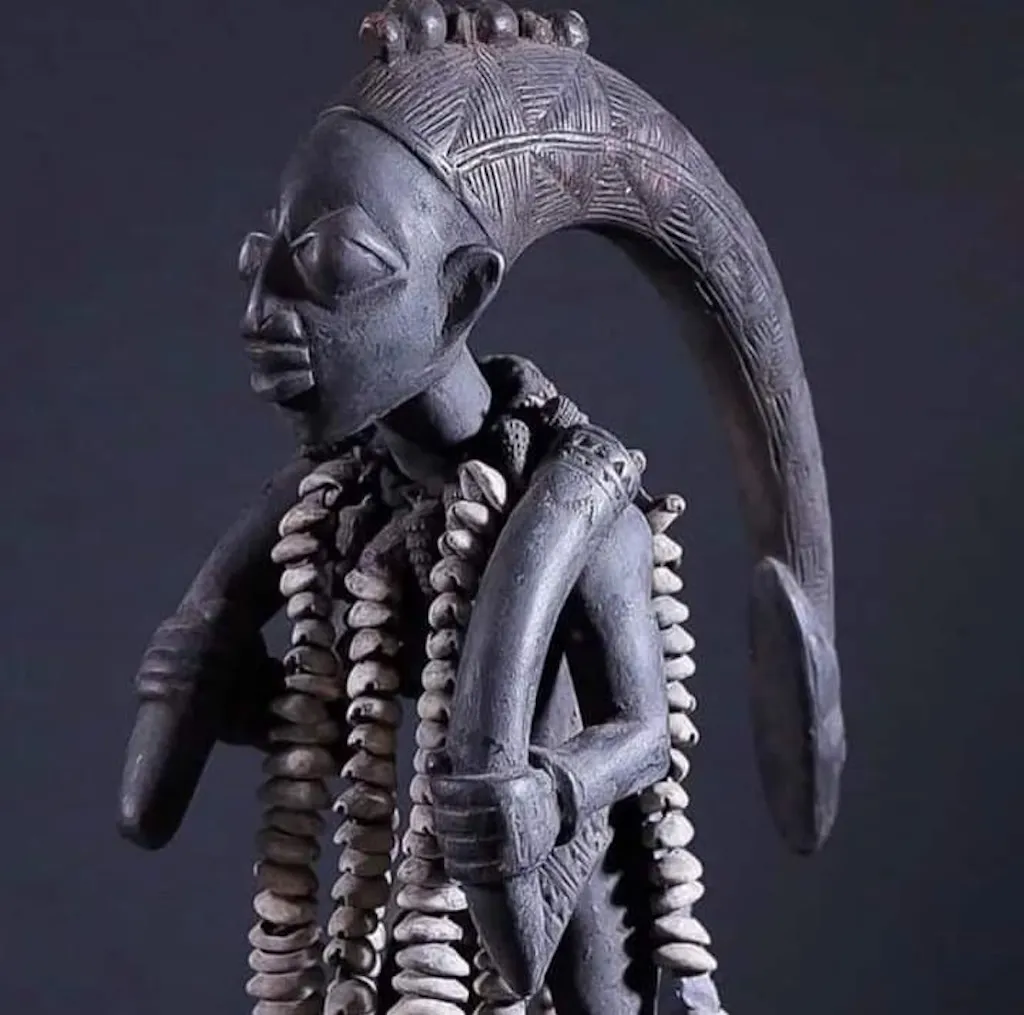
Esu in Yoruba religion occupies a position far more complex than the familiar labels of ‘trickster’, ‘god of chaos’, or ‘Yoruba devil’ suggest.
The widespread identification of Èṣù with Satan developed largely through the history of Christian translation and missionary vocabulary. This historical shift created a misconception that still echoes today. But understanding Èṣù truly requires looking past these imposed interpretations to grasp his original, sacred place within Yoruba religious thought.
Esu in Yoruba religion as a divine messenger and guardian of thresholds
Among the most recognisable characteristics of Èṣù is his association with crossroads and other places of transition. He serves as a divine messenger, facilitating communication between Olodumare, the Supreme Creator, the Orishas, and human beings. Without Esu’s mediation, prayers and offerings from humans would not reach the spiritual realm.
Esu is also the only connection between Earth and the divine, ensuring that blessings and responses are returned to humanity. He is honored first in every ritual or ceremony, acknowledging his essential role as the gatekeeper. Esu’s mastery of languages allows him to translate between the languages of nature and humans, cementing his role in maintaining cosmic balance.
These locations are significant both physically and symbolically. At a crossroads, different routes meet, forcing a traveler to choose a direction. A doorway separates one space from another, marking a boundary. A market brings together strangers, negotiations, and competing interests.
Such places reflect central themes in the religious understanding of Èṣù: movement, choice, communication, uncertainty, and consequence. He governs access between dimensions, opening or closing paths based on an individual’s integrity. This makes him a guardian of life’s complexities.
Understanding Èṣù through ritual art
The visual record also preserves Èṣù’s association with places of transition. Museums in Europe and the United States hold numerous Yoruba staffs, figures, and ritual objects connected with Èṣù-Elegba.
One prominent example is an Ogo Elegba, or Èṣù staff, attributed to the celebrated Ekiti-region sculptor Moshood Olusomo Bámigbóyè, who lived from about 1885 to 1975. The Metropolitan Museum of Art identifies this work as a twentieth-century Yoruba object from Odo Owa in present-day Nigeria.
Staffs associated with Èṣù were carried by worshippers and could incorporate human figures, elaborate hairstyles, and cowrie shells. These materials carried deep cultural and spiritual significance. The Smithsonian National Museum of African Art notes that the long, curved hairstyle found on some examples carries associations with sexuality and spiritual potency, linking art to Yoruba traditions and their living memory.
Such objects demonstrate that Èṣù was not merely a character in oral narratives. He belonged to an established religious system expressed through ritual, sculpture, sacrifice, and public performance. His iconography is equally complex, showing both masculine and, in historical Yoruba art, female figures associated with him. This variety highlights the depth of his religious presence.
The trickster who works within sacred order
Èṣù is widely described as a trickster, a classification that has a long history in scholarship. Joan Wescott’s influential 1962 study, “The Sculpture and Myths of Eshu-Elegba, the Yoruba Trickster”, examined sculpture alongside myths, praise songs, and ritual practices. Her fieldwork on Yoruba art in the 1950s helped define this aspect.
The trickster classification captures an important dimension of Èṣù. Narratives associated with him frequently revolve around contradiction, ambiguity, misunderstanding, reversal, and competing perspectives. People may discover that what appeared obvious was incomplete, or that actions have unforeseen consequences.
Yet, describing Èṣù simply as a mischievous joker diminishes his religious importance. His capacity for disruption can be dangerous, provoking disputes, testing assumptions, or exposing contradictions. He is associated with uncertainty precisely because decisions and obligations matter within the spiritual framework.
This helps explain why descriptions of Èṣù as merely the “god of chaos” are inadequate. Yoruba religious traditions do not present him as a force of meaningless destruction. His activities occur within the sacred order, serving communication, negotiation, correction, and consequence.
The Yoruba term Òrìṣà, or general English terms like deity and divinity, are often more useful than trying to force Èṣù into a Western god-or-goddess category.
Ifá and the profound world of consequence
The importance of Èṣù becomes clearer when placed within the wider religious environment of Ifá. Ifá is one of the most significant surviving bodies of Yoruba religious and intellectual knowledge. UNESCO proclaimed the Ifá divination system a Masterpiece of the Oral and Intangible Heritage of Humanity in 2005, and it was inscribed on the Representative List in 2008.
The Ifá literary corpus consists of 256 odù, which contain numerous verses known as ẹsẹ Ifá. These verses preserve religious teaching alongside aspects of Yoruba history, language, social thought, and cosmology. William Bascom’s Ifa Divination: Communication between Gods and Men in West Africa, published in 1969, became a landmark scholarly account of the system.
Within this religious world, Èṣù is closely connected with communication, sacrifice, and the consequences attached to ritual obligations. His place is therefore substantially different from the Christian concept of Satan. The conventional Christian understanding of Satan places him in opposition to God, associating him with temptation and rebellion.
Èṣù, by contrast, operates within the Yoruba sacred order, making his disruptive character not an enemy of the divine system.
This distinction is fundamental to understanding Esu in Yoruba religion. He is not the sole controller of human destiny either; Yoruba ideas of destiny involve orí, Ifá, and Ọ̀rúnmìlà, among other concepts.
Èṣù intersects with choices, obligations, and consequences, but Yoruba religious philosophy cannot be compressed into a single deity controlling every aspect of destiny, reflecting how complex power dynamics shaped early Yorubaland and its belief systems.
Samuel Ajayi Crowther and the powerful translation
The history of Èṣù changed profoundly with the expansion of Christianity and written Yoruba during the nineteenth century. Samuel Ajayi Crowther was central to this transformation. Born in Yorubaland around 1809, he was captured and enslaved as a boy but liberated in 1822 after a British naval vessel intercepted the slave ship carrying him.
Crowther was then taken to Sierra Leone, where he became a Christian, teacher, linguist, and Anglican clergyman.
On 29 June 1864, he was consecrated at Canterbury Cathedral, becoming the first African Anglican bishop. Crowther also became one of the most important figures in the development of written Yoruba. His Vocabulary of the Yoruba Language, published by the Church Missionary Society in London in 1843, was an early landmark in Yoruba lexicography.
This work formed part of the larger nineteenth-century process through which Yoruba was increasingly written, printed, standardised, and used for Christian literature.
Bible translation was not Crowther’s work alone. A Yoruba Bible published in 1865 identifies Samuel A. Crowther as translator, except for the Gospels of Matthew and John, which Thomas King translated. David Hinderer is named as editor. The Yoruba Bible therefore developed through collaboration involving African and European missionaries, rather than through a single translator.
This massive effort shaped how cultural narratives were documented and disseminated for generations.
The whole Bible had been translated into Yoruba by 1884, with John Hargreaves’ history of the Yoruba Bible recording its eventual publication in a single volume in 1900. Within this expanding Christian vocabulary, the name Èṣù became associated with the Christian devil.
This linguistic association became extremely influential, solidifying by the time the Church Missionary Society published its Dictionary of the Yoruba Language in 1913, explicitly defining Èṣù through English Christian terms including “devil” and “Satan.”
The equation had enormous cultural consequences. Generations of Yoruba Christians came to encounter Èṣù not primarily as an indigenous Òrìṣà but as the Yoruba name for the chief spiritual enemy of Christianity. Crowther and the missionary scholars who followed him worked within a Christian intellectual framework, requiring Yoruba terms to communicate Biblical ideas.
Their translation choices sometimes prioritised Christian categories over concepts formed within a different religious system.
The transformation cannot be reduced to Crowther’s actions alone. It developed through a longer process involving dictionaries, Scripture translation, missionary teaching, revisions, church usage, and generations of Christian Yoruba speakers. Nineteenth and early twentieth-century Christian translation ultimately helped establish an identification whose influence continued long after its missionary origins.
Esu’s journey: from Yorubaland to the Americas
The history of Èṣù extends beyond West Africa. Through the Atlantic slave trade, Yoruba-speaking and neighboring African peoples were forcibly transported to the Americas. Religious traditions traveled with them and developed under new conditions of enslavement, colonialism, cultural exchange, and resistance.
Related forms of the Yoruba tradition emerged in Afro-Atlantic religions. In Cuba, Eleguá or Elegba occupies an important position within traditions commonly associated with Regla de Ocha or Santería. In Brazil, Exu became important within Afro-Brazilian traditions including Candomblé.
The British Museum has discussed the historical transformation of the Yoruba deity as Exu within Brazilian Candomblé. Yoruba Èṣù staffs in museum collections also preserve elements of the West African material tradition from which these broader historical connections developed. These physical objects offer tangible links to a complex past.
Yet, the different traditions should not be collapsed into one supposedly universal deity. Yoruba Èṣù, Cuban Eleguá, and Brazilian Exu share historical relationships, but centuries of displacement and cultural development produced distinctive religious systems. Similarity of names and origins does not mean that their meanings, rituals, and theological positions are identical.
Modern scholarship continues to examine these transformations. In 2026, Ana Paula Vitorio da Costa, Carolina Cerqueira Corrêa, and Malandro Vermelho published a study of Exu and translation in the journal Perspectives. Their work places the subject within wider discussions of African and Afro-diasporic thought, demonstrating the remarkable historical reach of a religious figure whose meanings have crossed languages, empires, and oceans.
The story of Èṣù offers a powerful lesson about the consequences of translating one religious tradition through the categories of another. It reminds us why understanding the past requires attention not only to the words people used, but also to the religious and intellectual worlds from which those words emerged.
