




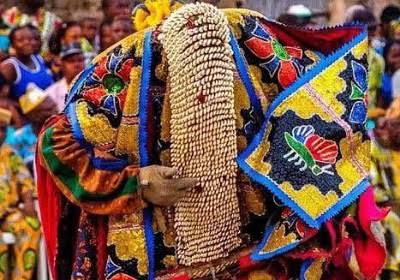
In the sprawling, modern metropolis of Ibadan, a city of millions, the sound of the Oloolu masquerade tradition still travels. This ancient practice, deeply embedded in the cultural fabric of the region, continues to captivate and mystify, its presence a powerful link to the past amidst contemporary life.
Each year, as the annual Egungun festival reaches its climax in July, the city’s paramount ruler, the Olubadan of Ibadanland, issues a familiar advisory. He cautions women to remain indoors, to avoid at all costs catching a glimpse of this specific ancestral spirit. This year was no different, with Oba Rashidi Ladoja issuing the call for observance and peace.
The Oloolu Masquerade Tradition: A Spirit That Walks Among Men
The Oloolu is no ordinary masquerade. It is an Egungun, a sacred costumed figure believed to embody an ancestral spirit, a conduit between the living and the dead. In the hierarchical world of Ibadan’s spiritual life, Oloolu is regarded as the “father of all masquerades,” a being of immense power and historical significance.
Its name offers a stark warning: ‘Oloolu’ is said to mean ‘you will put your life in peril.’ Its purpose is to offer prayers and appease the gods for the peace, security, and progress of Ibadanland. When Oloolu emerges, no other masquerade is permitted to be on the streets. Its dominance is absolute, a core part of a rich Yoruba tradition passed down through centuries.
The masquerade’s appearance is as formidable as its reputation. The costume is an imposing, pyramid-like structure of layered cloth, topped with a net. But it’s the adornments that carry the weight of its story and its taboo: a human thigh bone and, most chillingly, a female skull are attached to its head.
A story of conquest written on a skull
The prohibition against women seeing Oloolu is not an abstract rule; it is a story. It is a narrative of war, conquest, and a brutal choice that has echoed through the ages. The origin is traced back to a warrior named Ayorinde Aje, the founder of the Ode Aje compound that remains the masquerade’s custodian.
Legend holds that Aje, a formidable Ibadan warrior, captured the Oloolu in battle from the town of Ogbagi in Ondo State. The captured masquerade’s bearer was taken to Ibadan, but his wife refused to follow. In an act of unyielding finality, Ayorinde Aje beheaded her, attaching her skull to the masquerade’s costume as a permanent trophy and a warning.
From that moment, the fate of the masquerade and the fate of women in its presence were intertwined. It is believed that any woman who lays eyes on Oloolu—and on the skull of the woman who defied its conqueror—will suffer grave consequences. The lore speaks of ceased menstrual cycles, permanent infertility, paralysis, or even death.
The annual advisory from the Olubadan is a reinforcement of this foundational story.
The sacred duties of the bearer
The man who carries the weight of this history, the bearer of the Oloolu costume, is bound by his own strict set of taboos. For thirty days leading up to the festival, he must abstain from all sexual relations. During the procession itself, he must walk barefoot, a direct connection to the ancestral ground he treads.
His role is one of immense sacrifice and spiritual responsibility. He is the living vessel for an ancient power, and his adherence to these rules is believed to be essential for the efficacy of the rituals and the safety of the community. The custodianship held by the Aje family is a-line of duty passed from one generation to the next.
A calendar marked by spirits, not just dates
The Oloolu festival is the grand finale of the wider Ibadan Egungun Festival, which begins in June and culminates with Oloolu’s appearances in late July. Its procession is not a simple parade but a carefully mapped spiritual journey through the heart of old Ibadan. The route is a testament to the city’s unseen cultural geography.
On Monday, July 27th, the masquerade first offered prayers for the Olubadan and his council. It then visited the residence of the Otun Olubadan, Oba (Sir) Eddy Oyewole, in the Foko Area of Ibadan. This was the initial leg of its multi-day journey.
Tuesday’s itinerary took Oloolu to His Excellency the Executive Governor of Oyo State, Engr. Seyi Makinde, at Government House, Agodi, Ibadan. From there, it visited Aliiwo, Yemetu, Oje Market, Isale-Afa, Oke Aremo, Popo–Yemoja, Bode Market, Molete, Isale-Ijebu, Elekuro, and Kobomoje, before concluding its visits for the day at Oranmiyan.
On Wednesday, July 29th, Oloolu’s procession continued, stopping at Ojagbo, Alafara Olubadan, Ita-Bale, Ogboriefon, Labo, and Kobomoje. The masquerade often uses “Agbole,” or shortcuts between houses, reinforcing its otherworldly ability to navigate spaces beyond the ordinary.
Thursday, July 30th, marked the final day of the Oloolu Masquerade festival celebration for this year. The masquerade completed its tour by visiting Ile-Aperin, Agugu, Iyana Idi-Iroko, Awotunde Jegede, Itamerin-Gangansi, and Babanla, concluding its appeasement and prayers for Ibadanland.
When ancient rules meet modern lives
The persistence of the Oloolu masquerade tradition highlights a fascinating tension in modern Nigeria: the negotiation between ancient cultural practices and the rhythms of contemporary life. In a city bustling with commerce, technology, and social media, a centuries-old taboo still commands widespread respect and adherence, enforced by the highest traditional authority.
This tension became particularly vivid in August 2026, when a female TikTok content creator, Wasilat Olalere, was reported to have filmed the Oloolu procession. The incident sparked a firestorm of debate. While the Olubadan’s spokesperson later clarified she may have only filmed an associated figure, reports claimed she faced health challenges and underwent traditional cleansing rites, illustrating the real-world consequences of crossing these unseen lines.
This is not unique to Ibadan. The Oro festival, celebrated in other Yoruba communities, also enforces a curfew on women, with severe traditional penalties for violation. Such practices have drawn criticism from human rights advocates who argue they infringe on freedom of movement. Yet, for many participants and believers, these are not simply restrictions but vital components of a spiritual ecosystem that ensures communal well-being.
The question that lingers in the quiet
Organizations like the Gender Mobile Initiative (GMI) have called for a national review of cultural practices to address those that conflict with constitutional rights. The debate is often framed as one of culture versus rights, tradition versus modernity. But on the streets of Ibadan during the Oloolu festival, the reality is more nuanced.
The annual disappearance of women is not just an act of prohibition; it is an act of participation. It is a collective observance that reaffirms a shared history and a complex cultural identity. The story of Oloolu is the story of Ibadan itself—a city founded by warriors, steeped in powerful legends, and still governed by rhythms that defy easy explanation.
As the Oloolu recedes back into the spirit world for another year, the question it leaves is not simply about whether such a tradition should exist in the 21st century. It’s about what its persistence tells us about memory, power, and the unseen forces that continue to shape Nigerian life. The silence it commands is as loud and meaningful as any sound.
