




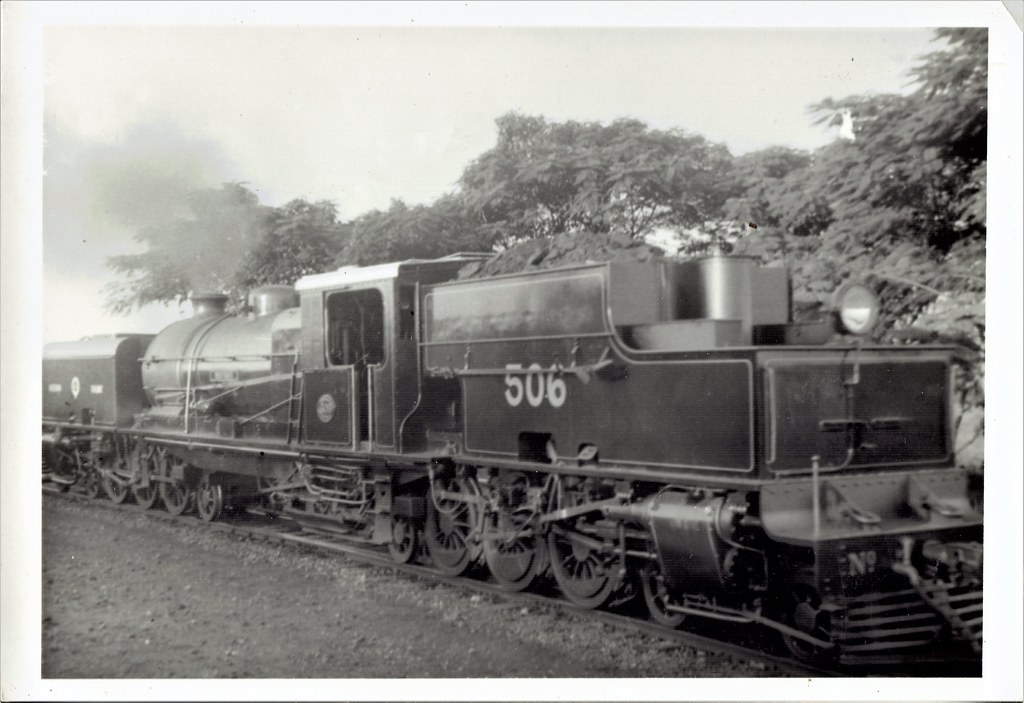
On a March morning in 1936, a massive articulated steam engine, Nigerian Railway No. 502, stood ready for its photograph.
Named the “Emir of Katsina,” this Beyer-Garratt locomotive was more than just an impressive machine; it embodied the intersection of industrial ambition, colonial strategy, and traditional authority that shaped Nigeria’s burgeoning railway system during the 1930s.
Forging Nigeria’s colonial transport network
Its story explains a crucial layer of infrastructure that underpins much of the country’s economic and social geography even today.
This powerful engine represented a technological solution to a complex challenge. The Nigerian railway administration needed to move substantial loads across vast distances but faced limitations imposed by track conditions and axle weight restrictions. The arrival of the Beyer-Garratt locomotives was a turning point, allowing the network to expand its capacity and solidify its role as the nation’s primary transport artery.
By 1938, Nigeria’s railway network had grown significantly, boasting approximately 1,900 route miles of single track. Including sidings, this figure stretched to 2,184 miles, primarily using the 3 feet 6 inches (1,067 millimetre) Cape gauge.
This extensive system was divided into three main operational districts: Western, Northern, and Eastern. The Western District connected Lagos to Jebba on the River Niger, while the Northern District extended from Jebba towards Nguru and included vital branch lines. The Eastern District ran from Kaduna Junction down to Port Harcourt.
A growing network of steel
The scale of railway activity was truly remarkable for the era. In 1938 alone, the Nigerian Railway transported over seven million passengers across its vast network. Goods traffic, encompassing everything from railway materials to livestock, exceeded 880,000 tons, highlighting the network’s central role in the colonial economy.
These railways were not just for movement; they were the central nervous system of colonial Nigeria’s economy. They facilitated the efficient transportation of raw materials from the interior to major trading centres and coastal ports, serving the commercial and administrative priorities of British rule. The entire system was a carefully constructed mechanism designed to extract and export resources.
Connecting producing regions
The expansion of the railway was instrumental in linking disparate regions. It created corridors for trade and administration, connecting agricultural hubs with export points and allowing for easier troop movements and communication. Without this network, the colonial project would have been far more challenging to execute and maintain.
The railway network connected Lagos and Kano, facilitating the flow of resources. The construction of lines like this, including essential infrastructure like the Jebba Bridge construction, was crucial for moving goods from the northern hinterland to the southern ports. This integration meant local economies became increasingly tied to global markets controlled from London, shifting traditional patterns of trade and production.
The engineering behind the power
The Beyer-Garratt locomotive was a marvel of railway engineering, specifically designed to address a critical problem: how to achieve substantial hauling power without placing too much weight on individual axles. This was especially pertinent in Nigeria, where parts of the existing track and bridge infrastructure were not built for heavy concentrated loads.
Unlike conventional locomotives, the Garratt design separated the boiler and cab, suspending them between two distinct powered engine units. This unique articulation distributed the locomotive’s immense weight across numerous wheels. It allowed for a much larger boiler, which meant greater steam production and power, without exceeding the load limits of the tracks.
Overcoming axle weight challenges
The 4-6-2+2-6-4 wheel arrangement of Nigeria’s Beyer-Garratts was key to their success. This configuration spread the weight over twelve axles, a crucial adaptation for routes with less robust infrastructure. Beyer, Peacock & Co. Ltd, the Manchester-based manufacturer, custom-built these engines to meet specifications laid out by M. P. Sells, the Chief Mechanical Engineer of the Nigerian Railway.
The distributed weight also meant these machines could navigate tighter curves more effectively than a comparably powerful rigid locomotive. This flexibility was invaluable on a network spanning varied terrain, ensuring trains could maintain speed and efficiency across the colonial territory.
Power and flexibility on tracks
Another significant advantage of the Garratt design was its ability to run equally well in either direction. This eliminated the need for turntables at termini, streamlining operations and reducing turnaround times. One Beyer-Garratt, manned by a single crew, could often replace two double-headed tender locomotives, drastically improving efficiency and reducing labour costs.
The large firebox and unrestricted air supply of the Garratts also meant they could operate effectively even with lower-quality fuel, without compromising steaming capacity. This adaptability made them particularly suited to local conditions and available resources within Nigeria. The Class 501 Garratts, including No. 502, were designed to be suitable for 45 lb/yard track in the Highlands and could run all the way to Lagos.
The “Emir of Katsina” and symbolic naming
When Nigerian Railway No. 502 was photographed in March 1936, it proudly bore the name “Emir of Katsina” on its nameplate. This was not a personal dedication to an individual, but a direct association with the powerful office held by Muhammadu Dikko, who reigned as Emir of Katsina from 1906 until 1944.
Dikko’s long tenure saw significant changes in transport, communications, and political authority under British colonial administration in northern Nigeria. His journeys to Britain in 1921 and 1924, documented by historian Moses Ochonu, demonstrate his engagement with imperial institutions and technology, reflecting a complex relationship with the colonial power.
Muhammadu Dikko’s influential reign
The decision to name locomotives after Nigerian chiefs was a strategic move by the colonial railway administration. It aimed to legitimise this new technology within the existing traditional power structures. By linking modern industrial machinery to revered local leaders, the British sought to foster acceptance and cooperation.
So, No. 502 became a potent symbol, bringing together the established authority of the Katsina emirate with the burgeoning industrial might of the colonial railway. This blending of traditional and modern reflected the often-contradictory forces at play in Nigeria during the early 20th century, where local governance persisted alongside sweeping colonial changes.
Blending tradition with technology
The “Emir of Katsina” locomotive, with its imposing physical presence and symbolic name, stood as a testament to these shifting dynamics. It represented a deliberate effort to integrate disparate elements of Nigerian society and colonial rule into a cohesive, albeit imposed, system. This strategy extended beyond mere infrastructure to touch upon cultural and political landscapes.
The very act of naming such a powerful machine after a traditional ruler underscored the colonial administration’s approach. They recognised the importance of indigenous leadership, even as they introduced technologies that would fundamentally alter the societies these leaders governed. It was a subtle, yet profound, act of appropriation and integration.
Running the rails: routes and operations
The Beyer-Garratts, including the “Emir of Katsina,” became indispensable workhorses on key sections of the Nigerian railway network. A 1936 account noted their primary deployment on the Jebba to Minna section for approximately six months during the heavy export season. This period was crucial for moving agricultural produce and other commodities.
For the remainder of the year, these powerful locomotives were reassigned to long-distance passenger services. They regularly worked the through passenger routes between Lagos and Kano, a demanding journey spanning approximately 700 miles. This dual role cemented their value to the railway system, handling both heavy freight and critical passenger transport.
Vital links across the country
The Annual Report on the Social and Economic Progress of the People of Nigeria, 1938 confirmed the consistent and satisfactory service provided by the 501 Class Garratts on the Jebba to Minna section. They managed all trains on this route, with the exception of the Limited and Mail services. This reliability showcased their robust design and operational efficiency.
This ongoing investment underscored the railway’s expanding role in the late 1930s, forming a critical part of Nigeria’s growing transport infrastructure, alongside important river crossings. A further five Garratt locomotives of the 4-6-2+2-6-4 arrangement entered service in early 1938, demonstrating the Nigerian railway administration’s ongoing commitment to this locomotive type, recognising its superior capabilities for the expanding transport demands of the time.
African hands on the throttle
One of the most compelling aspects of this era is the human element behind these colossal machines. The 1938 colonial report explicitly stated that the 501-Class Garratts on the Jebba to Minna section were crewed by African drivers. These weren’t just operators; they were skilled professionals who mastered complex machinery.
Operating a large steam locomotive demanded a deep understanding of its mechanics and the railway environment. Drivers needed to be experts in engine behaviour, gradient navigation, braking systems, and managing steam pressure and water levels. Firemen tirelessly maintained the intense heat of the firebox, ensuring a constant steam supply. Behind them, fitters and workshop employees kept the engines serviceable, often performing intricate repairs.
The 1938 report also highlighted continued apprentice training for locomotive work and for carriage and wagon fitting. This indicates a deliberate effort to cultivate local technical expertise within the railway system. While the locomotives were designed and manufactured in Britain, their daily operation and maintenance relied heavily on Nigerian labour, marking an early chapter in the development of indigenous technical skills.
A legacy beyond the tracks
The “Emir of Katsina” locomotive, and its class, stands as more than just an impressive piece of steam engineering. It’s a powerful artifact that encapsulates multiple dimensions of Nigeria’s colonial past. It reflects the global reach of railway technology, specifically the success of the Beyer-Garratt design, and its adaptation to the unique challenges of the Nigerian landscape.
It also represents the strategic intent of the colonial transport system. This network was a tool for connecting distant regions, facilitating administration, and, crucially, serving British commercial interests by streamlining the movement of goods for export. The railway was a physical manifestation of economic control and integration into the global imperial system.
Echoes of a bygone era
The name “Emir of Katsina” on the locomotive provides a fascinating link between modern industrial power and enduring traditional institutions. It symbolises a period where such seemingly disparate elements coexisted and, at times, were strategically woven together by the colonial power. This blending reflects the pragmatic approach often taken by the British in managing their vast territories.
Most importantly, the story of the “Emir of Katsina” is incomplete without acknowledging the African drivers, firemen, apprentices, and workshop employees. Their labour was the invisible force that kept these giant machines moving, literally powering the colonial economy and forming the backbone of Nigeria’s emerging industrial workforce.
This early participation in complex technological systems laid groundwork for future generations of Nigerian engineers and technicians, contributing to the development of modern Nigerian infrastructure.
Shaping modern Nigeria
Today, the sight of a Beyer-Garratt on Nigerian tracks is a distant memory, yet the legacy of this railway era persists. The routes established, the towns that grew around railway stations, and the economic patterns that emerged all owe a debt to this period of intense infrastructure development.
It was a time when Nigeria was being physically reconfigured to serve external interests, but also, in the process, irrevocably transforming its internal geography and social fabric.
The Nigerian Railway No. 502, “Emir of Katsina,” remains a compelling symbol of a period when traditional authority, colonial infrastructure, industrial engineering and African technical labour met on the same railway. It invites us to consider how technology, governance, and human endeavour converged to build the foundational systems that continue to influence the country’s trajectory.
What does this blend of power, symbol, and labour tell us about the systems we inherit and build today?
