




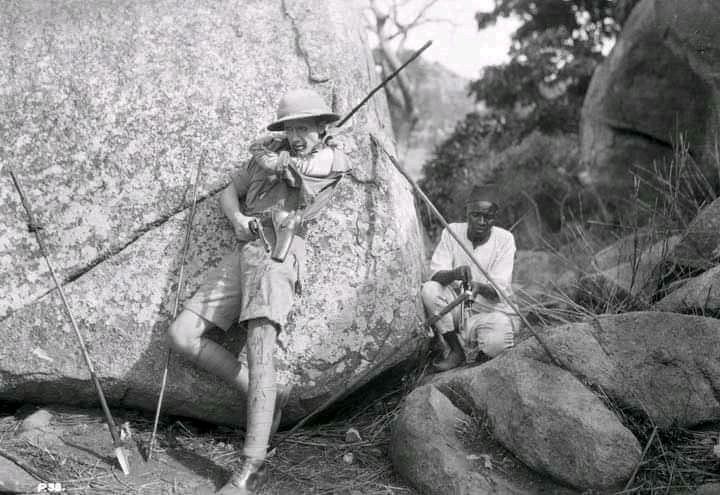
In 1926, the silent film Palaver: A Romance of Northern Nigeria began production on the vast plains of colonial Northern Nigeria, sparking debate about Nigerian cinema’s colonial roots.
For many years, the film was celebrated as the definitive starting point for cinema in the nation, despite its clear British creative and institutional control. But this perspective overlooks the true drivers of its creation and the deeply problematic worldview it enshrined. The centennial therefore provides a crucial lens through which to understand how narratives about national heritage are constructed, and often, misconstrued.
Palaver’s troubled claim as Nigeria’s first feature film
The notion that Palaver represents the absolute genesis of Nigerian cinema is a persistent one, yet it’s misleading. Moving pictures had already reached Lagos by August 1903, with historian Oladipo O. Olubomehin documenting organized film shows at the Glover Memorial Hall. These early exhibitions confirm that Nigerian audiences were familiar with cinema long before Barkas ever set foot on the Bauchi Plateau.
What Palaver did introduce was a new scale of filmmaking on Nigerian soil, a feature-length fictional drama produced by British Instructional Films. But its production was firmly under British direction. Geoffrey Barkas wrote the script and directed, while Stanley Rodwell handled cinematography. The colonial administration even provided significant logistical support, including transport and access to local communities.
This critical distinction matters deeply. While the film was indeed made within the geographical bounds of colonial Nigeria, it was not conceived or controlled by Nigerians. It was a British endeavor through and through, a product of London’s film industry with local landscapes and people serving as backdrop and actors.
Filming on the Bauchi Plateau: Actors and colonial administration
The production of Palaver was an ambitious undertaking for its time, immersing European filmmakers directly into communities in colonial Northern Nigeria. Barkas and Rodwell, who previously worked together filming the Prince of Wales’s African tour in 1925, leveraged their African experience for this project. Their six months of filming heavily relied on assistance from the Nigerian colonial administration.
Perhaps one of the most compelling aspects of Palaver is the prominent role given to local African performers. Contemporary records identify communities like the Sura and Angas as central to the filming. Performers such as Yiberr, who portrayed Dawiya, King of the Sura, and Yilkuba, who depicted a witch doctor, were incorporated into the dramatic narrative.
These were not anonymous figures in the background; they occupied significant, named dramatic roles. While modern accounts sometimes erroneously claim they had “speaking roles,” the film was silent, relying on intertitles for dialogue. Nevertheless, their substantial presence marked an unusual engagement for African participants in feature filmmaking during that era.
A narrative shaped by empire: The film’s problematic plot
The storyline of Palaver itself serves as a stark reflection of the colonial power structures that produced it. It centers on a love triangle between Captain Peter Allison, a British District Officer; Jean Stuart, a nursing sister; and Mark Fernandez, a cynical tin miner. Their personal conflicts quickly escalate, spilling over into the surrounding African communities.
Fernandez, revealed to be a deported conman, manipulates King Dawiya into tribal conflict, fueled by a prophecy from Yilkuba. This narrative culminates in a battle where Allison’s forces defeat the Sura warriors, and Allison punishes Dawiya by burning his village. The film concludes with Stuart and Allison reconciling after her apology for doubting his judgment against Fernandez.
The film’s focus on a tin miner like Mark Fernandez was historically resonant, given the significant role tin mining played in Northern Nigeria’s colonial economy, particularly on the Jos Plateau. This placed three powerful forces — government authority, commercial extraction, and local society — into a single, fictional conflict. Early colonial city development often saw similar entanglements of power and commerce.
But the perspective remained resolutely British colonial. Barkas himself, in comments from 1926, described selecting his African cast from what he termed “cannibal pagan tribes.” Such language reveals the deep-seated racial attitudes and assumptions of European superiority prevalent at the time, framing African societies as primitive and savage.
The long shadow of Palaver: Not Nollywood’s true ancestor
It’s tempting, yet ultimately incorrect, to draw a direct historical line from Palaver to the vibrant dynamism of Nollywood today. The modern Nigerian film industry evolved through a far more complex series of developments that did not directly inherit from this colonial production. There was no uninterrupted tradition linking the two.
Post-independence, Nigerian filmmakers began producing their own celluloid features, often interacting with burgeoning television dramas that cultivated new audiences and production cultures. The late twentieth century then saw a profound transformation with inexpensive video technology, fueling the commercial video film boom of the 1990s that became Nollywood.
Palaver belongs to a deeper, more foundational history of cinema’s presence in Nigeria, but it’s crucial not to mistake it for the institutional beginning of an indigenous Nigerian film industry. The story of Nigerian cinema is one of gradual creative assertion, where Nigerians eventually gained control over their own narratives and representations. Many pioneering Nigerian figures across various fields contributed to this journey of self-determination.
The film’s historical importance doesn’t lie in being a precursor to Nollywood. Instead, it serves as a powerful illustration of the early encounters between global filmmaking and Nigeria, shaped by unequal power dynamics. It highlights a period when the infrastructure and creative control rested firmly in foreign hands.
Reconsidering the legacy: A mirror of early power dynamics
A hundred years after its production, the enduring value of Palaver lies precisely in its inherent contradictions. It stands as an early artifact showcasing Nigerian landscapes and African performers on the silver screen at a time when local filmmaking resources were almost nonexistent. But it also starkly exposes the colonial system that dictated how those images were framed and interpreted.
British filmmakers held the reins, determining the portrayal of African communities, the representation of colonial officials, and the interpretation of conflict for audiences abroad. This dual nature—technological milestone and document of political inequality—forces us to ask critical questions about ownership and perspective.
Who truly controlled the camera’s gaze? Whose worldview shaped the narratives presented? And who possessed the institutional power to transform Nigerian people and their lands into cinematic stories? These are questions that resonate far beyond the film itself, touching upon broader themes of cultural sovereignty and historical agency.
Understanding Palaver within this context helps clarify its true place in Nigerian film history. It’s an early landmark in the history of filmmaking in Nigeria, rather than an indigenous product of Nigerian filmmakers. The journey from that early colonial encounter to a robust, self-directed film industry like Nollywood speaks volumes about the nation’s evolving identity and creative autonomy.
This historical reflection on Palaver invites us to acknowledge the complexities of Nigeria’s cinematic beginnings. It reminds us that history is rarely a straightforward progression. Rather, it’s a constant negotiation of influence, control, and the powerful impulse for self-expression, much like the navigating of economic policy during challenging times.
The film, for all its problematic aspects, remains a vivid snapshot of a particular moment. It captures the very real tension between being the subject of someone else’s story and the eventual, hard-won right to tell your own. This ongoing journey, from external representation to internal creation, defines the rich and evolving history of Nigerian cinema.
