



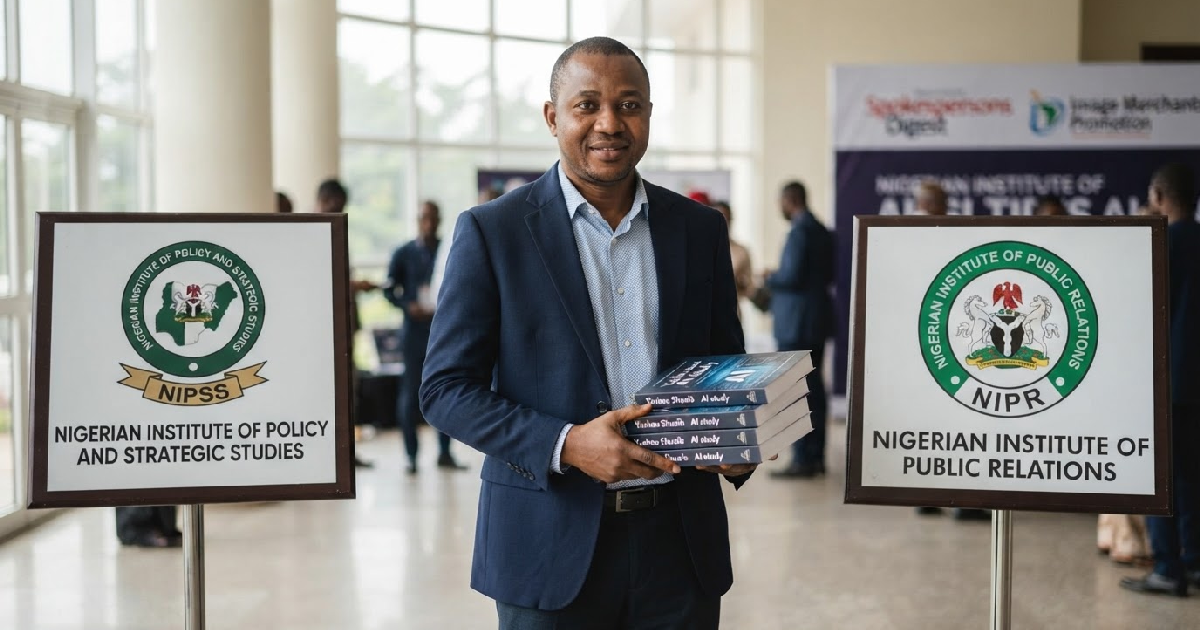
Yushau Shuaib’s AI study originated from institutional friction between NIPSS and NIPR. Shuaib’s study on artificial intelligence has emerged from institutional friction between the National Institute for Policy and Strategic Studies (NIPSS) and the Nigerian Institute of Public Relations (NIPR).
Kabir Abdulsalam, Associate Editor of Spokespersons Digest, chronicles this journey in his recent commentary, highlighting how personal adversity transformed into intellectual opportunity for Mr. Shuaib. The two books, seemingly disparate, collectively narrate a story of resilience, illustrating how a derailed academic path ultimately yielded work of significant national and international relevance.
The Yushau Shuaib AI study’s institutional conflict
The core of Shuaib’s memoir, MNI versus MNIPR in NIPSS, lays bare a challenging period marked by institutional disagreements. His withdrawal from NIPSS was swiftly followed by an invitation to appear before the NIPR Council’s Ethics Panel, an institution he had served for decades. This episode, detailed in Chapter Eight as “The NIPR Betrayal,” delves into questions of professional loyalty and organizational discipline.
For Shuaib, a professional deeply entwined with public relations since his undergraduate days at Bayero University, Kano, the experience was profoundly painful. He had been the first recipient of the NIPR President’s Prize for Best Graduating Public Relations Student in 1992 and was later named the Kano/Jigawa Chapter’s Public Relations Person of the Year.
A seemingly minor detail, the NIPR’s reported initial invitation addressing him as “ANIPR” instead of “MNIPR,” the professional designation he’d held for years, spoke volumes. This bureaucratic misstep, later compounded by a revised invitation omitting any designation, deepened his sense that his extensive contributions were no longer being acknowledged by the institution.
A partnership dissolved, a reputation endures
The memoir also sheds light on the trajectory of the National Spokespersons Awards, an initiative conceived in 2019 during Mallam Mukhtar Sirajo’s tenure as NIPR President. IMPR, under Shuaib’s leadership, independently organized the inaugural awards in 2021 with the NIPR’s endorsement, before a formal Memorandum of Understanding solidified their partnership in 2023.
These awards quickly became a prominent platform, celebrating excellence in strategic communication across Nigeria. They honored professionals from corporate affairs, public information management, and military communications. However, the memoir reveals that the partnership was abruptly terminated by the Ike Neliaku-led NIPR, even before its agreed expiration.
What followed was equally surprising: the institute launched a new awards platform under a different name. Shuaib’s reflection on this turn of events speaks to a deeper truth: “Organizations can withdraw endorsements. Partnerships can be terminated. Titles can be withheld. But one’s name — carefully built over decades — must remain answerable first to conscience, history and truth.”
Turning disappointment into opportunity
Chapter Nine, aptly titled “A Blessed Disappointment,” marks a pivotal shift in the narrative, moving from conflict to growth. Shuaib openly discusses the personal toll of these institutional battles, including experiencing hypertension for the first time. He notes the irony of navigating a reputational crisis himself, after years of helping others do the same.
But the chapter isn’t a litany of complaints; it’s a testament to redirection. Encouragement came from his family and from the graduates of the Young Communication Fellowship, many of whom traveled to offer support. These interactions reinforced his belief that true success is about impact, not just institutional accolades.
The NIPSS experience also unexpectedly spurred the expansion of the Young Communication Fellowship. Inspired by the residential model of NIPSS, Shuaib developed plans for hostel facilities at PRNigeria Centres in Kano and Ilorin. This vision caught the attention of Professor Adamu Abubakar Gwarzo, President of MAAUN, during a visit to the Kano Centre.
When Shuaib shared his financial constraints regarding an Abuja facility, Professor Gwarzo made an extraordinary donation: a large building in Lugbe. This became a training and residential center for the fellowship, demonstrating how a setback created a unique pathway for future opportunities.
The AI study’s resilience and reach
Perhaps the most compelling narrative within the broader account is the genesis and enduring impact of AI in Crisis Communication in Nigeria: Challenges and Prospects. This research project was originally approved as “Artificial Intelligence and Crisis Communication in Nigeria’s Public Sector: An Assessment” during Senior Executive Course 47 at NIPSS.
Its aim was to examine how artificial intelligence could bolster crisis communication within Nigeria’s public institutions.
Following Shuaib’s withdrawal from the NIPSS program, the institutional framework supporting his research simply vanished. Many scholars would have understandably abandoned the project. However, propelled by professional conviction and the encouragement of colleagues at the Centre for Crisis Communication, Shuaib independently completed the study within three months.
His research revealed what he termed Nigeria’s “awareness-adoption gap.” While communication professionals are increasingly aware of AI, its institutional application often remains confined to basic tasks like drafting documents and monitoring media. More advanced capabilities, such as predictive analytics for crisis forecasting, sentiment analysis, and misinformation detection, are significantly underutilized.
The study also unearthed a “trust paradox.” Despite AI’s potential for speed and efficiency, communication professionals expressed caution about relying on it during crises. Concerns ranged from deepfakes and misinformation to algorithmic bias and the irreplaceable human element of empathy and judgment. The balanced conclusion was clear: AI should enhance human decision-making, not replace it.
Catalysing policy and international acclaim
Beyond its diagnostic insights, the research pinpointed structural barriers hindering AI adoption in Nigeria. These included inadequate digital infrastructure, erratic electricity supply, limited broadband penetration, a shortage of specialized expertise, weak institutional coordination, and underdeveloped policy frameworks. These are not minor hurdles; they are systemic challenges that touch the very fabric of the Nigerian business landscape.
Crucially, Shuaib’s work did not remain confined to academic circles. Its findings were shared with the Centre for Crisis Communication and the National Information Technology Development Agency (NITDA). This engagement culminated in the National Symposium on Artificial Intelligence and Crisis Communication, held at the National Defence College, Abuja, in November 2025.
A tangible outcome of that symposium was the establishment of the Crisis Communication Hub (CCHub). This multi-stakeholder platform aims to improve crisis management capabilities and combat the spread of misinformation across Nigeria, reflecting a direct policy impact stemming from the research. This demonstrates how rigorous academic inquiry can directly inform and shape practical solutions for urgent national issues.
The study later evolved into a comprehensive 200-page book, AI in Crisis Communication in Nigeria: Challenges and Prospects, earning endorsements from prominent figures like NITDA Director-General Malam Kashifu Inuwa Abdullahi, Major General Chris Olukolade (Rtd), Professor Abdalla Uba Adamu, and Professor Abiodun Adeniyi.
Its most notable achievement came when it was shortlisted as a finalist for the 2026 International Public Relations Association (IPRA) Golden World Awards in Athens, Greece.
The irony here is palpable. A research project that faced internal institutional disruption ultimately achieved broader relevance and international recognition, precisely because it transcended its initial institutional confines. Had it remained solely an academic exercise within NIPSS, its impact might have been limited to an archived paper. Instead, it became a catalyst for national dialogue, a published book, and a globally acknowledged contribution.
Lessons from enduring ideas
The story of Yushau A. Shuaib’s journey, as illuminated by Kabir Abdulsalam, offers a profound lesson on the interplay between personal tenacity and the life of ideas. Institutions, whether policy think-tanks like NIPSS or professional bodies like NIPR, undeniably provide opportunities. They offer frameworks, platforms, and connections that can nurture careers and scholarship.
But the true strength of an idea, once fully formed and driven by mission, often outlives the boundaries of its originators. As the memoir’s closing reflection powerfully states: “Institutions may grant opportunities, but they do not own ideas. Once knowledge becomes a mission, it acquires a life of its own.
No withdrawal letter can take that away.” This resonates particularly in Nigeria, where navigating institutional complexities often defines the path of progress.
This perspective forces us to consider how much of Nigeria’s progress, or lack thereof, is shaped by individuals who push beyond institutional constraints. What happens when a singular vision, like the improvement of public infrastructure, meets bureaucratic resistance? Shuaib’s experience suggests that foundational insights, born of personal investment, possess an inherent vitality that can overcome systemic hurdles.
Ultimately, the dual narrative presented in these volumes is a testament to the fact that adversity, rather than being an end, can become a crucible. It can forge contributions that not only address pressing national challenges, but also achieve international recognition, leaving an indelible mark far beyond the initial points of friction.
It prompts us to ask what other critical knowledge might be waiting to blossom outside traditional institutional gardens.
