




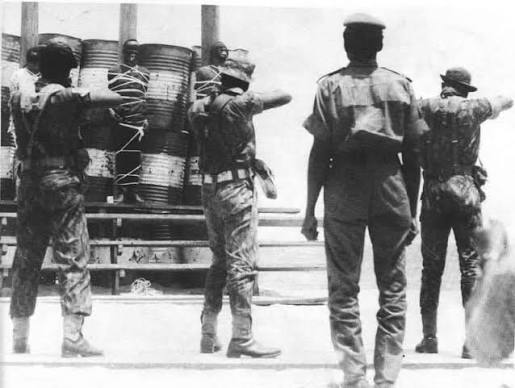
On Wednesday, July 15, 1885, three condemned men—Kanogbe, Ogunbuyi, and Ateneroh—were led to the scaffold at the Lagos Gaol. Their execution, stemming from their conviction for the murder of a man named Darkoya in Okurige, Leckie district, should have been a grim but routine assertion of colonial authority.
Instead, it erupted into a violent, half-hour struggle between the prisoners and their captors, challenging the very order colonial Lagos sought to impose.
Lagos Gaol Execution: A Colony in Flux
This dramatic incident, reported in stark detail by The African Times on October 1, 1885, laid bare the fragility of British control within its burgeoning penal system. It was a moment when the human will to resist confronted the machinery of a foreign power, forcing a brutal confrontation that reverberated far beyond the walls of the Broad Street Prison.
Lagos in 1885 was a colonial project still very much in its making. Britain had formally seized the territory on August 6, 1861, following the Treaty of Cession signed by King Dosunmu. This period saw British officials rapidly expanding the courts, police, prisons, and administrative institutions designed to entrench their presence and project authority.
Yet, the colonial structure remained somewhat unsettled. In July 1885, Lagos was still administered as part of the Gold Coast Colony, an arrangement that would shift dramatically just months later. Letters Patent in January 1886 formally separated Lagos, establishing it as a distinct colony and marking a further stage in the evolution of British rule.
This context of administrative transition underscores the pressures felt by officials on the ground.
The Violent Resistance at Lagos Gaol
The morning of July 15, 1885, was scheduled for the hanging of Kanogbe, Ogunbuyi, and Ateneroh. As officers entered the gaol to prepare them for the gallows, the prisoners reportedly produced knives and sticks, launching a desperate resistance. Policemen were wounded in the ensuing melee, and the struggle to regain control stretched on for approximately 30 minutes.
Officials found themselves in an unexpected battle, ultimately resorting to breaching part of the prison structure to approach the men from multiple directions. They fought from the front and the rear, eventually subduing the condemned men by force.
The African Times described the scene as “most disgraceful,” noting that such an event had “never been witnessed in Lagos since the cession of Lagos to the British Crown in 1861.”
The violent confrontation exposed a serious lapse in prison security, sparking widespread public disgust and calls for an official inquiry into how the prisoners acquired weapons.
Broad Street Prison: A System Under Strain
The Lagos Gaol, also known as Broad Street Prison, stood as the principal colonial penal institution. Its development mirrored the expansion of British judicial and penal systems following the annexation of Lagos. However, by the 1880s, the prison was grappling with severe overcrowding and inadequate facilities.
In 1885, the same year as the violent execution incident, significant rebuilding work was underway. The colonial government imported bricks from England, spending a substantial £16,000 to reconstruct the prison, aiming for a more secure and durable structure.
This expenditure starkly contrasted with the mere £700 allocated for education in Lagos that year, highlighting the colonial administration’s priorities: order and punishment above all else. British colonial rule often sought to establish control through robust punitive systems.
Security Lapses and Regulations
The dramatic resistance pointed to systemic failures within the prison. John Augustus Otonba Payne’s Lagos and West African Almanack and Diary for 1885 detailed strict regulations for the prison, including mandatory searches for new inmates and a ban on alcohol, save for medical authorization. The discovery of knives and sticks in the possession of condemned men, and reportedly alcohol, directly contradicted these rules.
This breach of security suggested deep-seated issues. Officials like Mr. Willoughby, the Deputy-Sheriff, often juggled multiple roles—Superintendent of Police, Political Interpreter, and Paymaster of the Constabulary—leaving little time for direct, day-to-day oversight of prison operations. Such diffused responsibility likely contributed to the breakdown in control, making the prison vulnerable to internal disturbances.
The Role of Colonial Officials and Medical Personnel
The Lagos Gaol execution brought together various arms of the colonial administration, revealing the interconnectedness of their roles. Mr. Willoughby, acting as Deputy-Sheriff, was directly involved, even placing the rope around one prisoner’s neck himself. His multiple administrative functions underscore a common characteristic of nineteenth-century colonial governance: a small cadre of officials often performed wide-ranging judicial, policing, and administrative duties.
Medical officers also played a crucial, if often overlooked, part in the colonial prison system. Dr. Grant, identified as Senior Assistant Colonial Surgeon, was present to treat wounded constables after the struggle. Figures like J. D. Macarthy, the Colonial Surgeon, and J. F. Easmon were integral to the broader colonial medical establishment.
Beyond treating injuries, surgeons held authority over certain aspects of prison life, such as authorizing alcohol for medicinal purposes, a critical detail given the prohibition of spirits within the gaol. This highlights how medical services were deeply entwined with the administration of punitive institutions.
Capital Punishment as a Display of Power
Capital punishment represented the ultimate assertion of colonial judicial power. By the 1880s, Lagos possessed a fully developed apparatus for enforcing criminal law: courts, police, prison officers, and constabulary personnel. A death sentence activated this entire system, from the moment of conviction to the final act on the scaffold.
The violent resistance from Kanogbe, Ogunbuyi, and Ateneroh directly challenged this display of power. Their fight, immediately before the ultimate sanction, disrupted the carefully orchestrated ritual of execution.
It was a moment of profound defiance, revealing that even at the scaffold, the colonial state’s control over the individual was not absolute, and that some would choose to fight until their last breath. This act of resistance became a powerful, albeit tragic, counter-narrative to the colonial project’s self-assured march toward order.
Leckie and the Eastern Reach of Lagos
The crime that led to the executions occurred in Okurige, within the district of Leckie, located east of Lagos. This area held significant historical ties to former King Kosoko, who, after his deposition in 1851 by British intervention, established himself at Epe and maintained influence over key trading settlements in the eastern territories.
Kosoko officially relinquished his claims over Palma and Leckie in 1863, bringing these regions fully under the Lagos Government.
By the 1880s, Leckie remained a recognized geographical and commercial hub, documented through references to traders, jurors, and postal connections. This indicates the expanding reach of British administrative and legal frameworks beyond the immediate confines of Lagos Island.
The fact that the murder and subsequent conviction originated from this outlying district further illustrates how the colonial justice system extended its grasp across the evolving landscape of British-controlled territories.
Echoes in The African Times
The detailed account in The African Times on October 1, 1885, played a crucial role in disseminating the story of the Lagos Gaol execution. As a London-based newspaper dedicated to African affairs, it served as a vital link between West Africa and Britain. Reports from its “Lagos News” section, alongside correspondence and commercial networks, ensured that local events quickly reached a global audience.
For merchants, missionaries, government officials, and educated African readers, this expanding world of print offered a window into the realities of colonial life.
The widespread reporting of the violent disturbance within a Lagos prison underscored the challenges faced by the colonial administration, conveying a narrative of resistance and disorder that complicated the official image of effortless control. This historical account offers a specific glimpse into how communication shaped perceptions of Lagos’s early infrastructure and its administration.
A Question of Control and Legacy
The Lagos Gaol execution of 1885 stands as more than just a historical footnote; it is a dramatic incident that illuminates the complex dynamics of colonial rule.
It reveals a burgeoning state attempting to impose order through courts, prisons, and policing, but encountering fierce resistance even at the final, most solemn moment of its judicial process.
The challenges faced by officials, the strain on prison infrastructure, and the defiant actions of Kanogbe, Ogunbuyi, and Ateneroh all offer insights into the human cost and operational difficulties inherent in the colonial project.
The incident forces a question: how secure was colonial authority if its most visible symbols of power—its prisons and gallows—could be so dramatically challenged? This episode, preserved in the historical record, reminds us that the story of Nigeria’s past is not merely one of imposition, but also of constant negotiation, struggle, and human resilience against overwhelming forces.
