




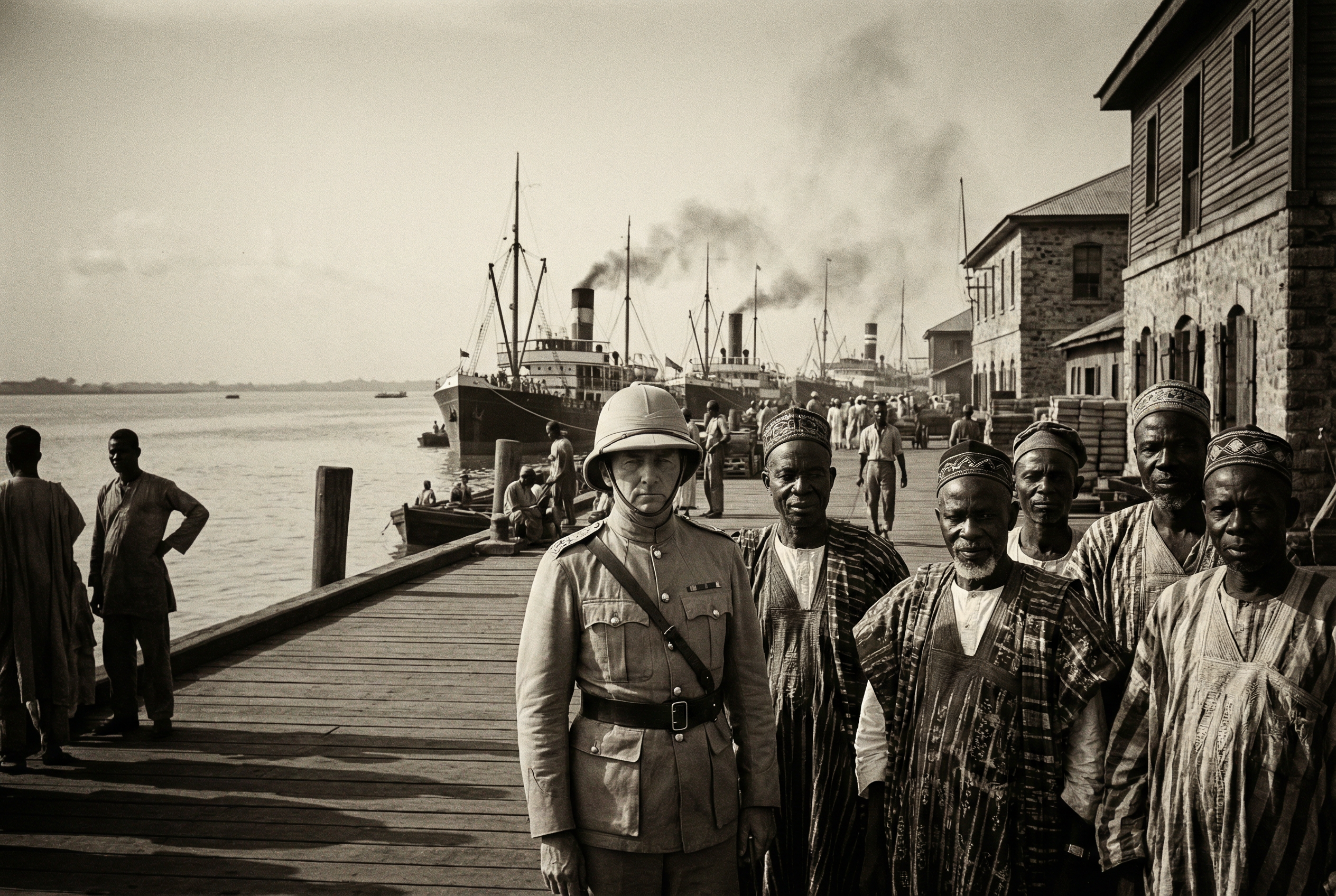
The story of Nigeria’s modern economy does not begin with British colonial rule. Long before the first colonial administrator arrived, the lands that would become Nigeria were alive with commerce. Great cities like Kano anchored trans-Saharan trade routes. Yoruba towns hosted sprawling markets, and Niger Delta merchants were sophisticated players in Atlantic trade. Britain did not create an economy; it captured one.
The central pillar of British economic policy was not invention, but redirection. Existing systems of farming, trade, and currency were systematically reorganised to serve a new master: the British Empire. It was a project of extraction, executed through new railways, new taxes, and a new economic logic.
British colonial rule re-engineered an agricultural economy for export
This transformation, solidified during the era of the 1914 amalgamation, created the basic economic architecture Nigeria would inherit at independence.
One of the most profound shifts under British rule was the reorientation of agriculture. The colonial government aggressively promoted the cultivation of cash crops for export. In the southwest, cocoa became king. In the southeast, it was palm oil and palm kernels, while the north was reorganised around vast groundnut pyramids.
These three primary commodities collectively accounted for approximately 70% of Nigeria’s total exports during the colonial period. This was not a gentle evolution, but a deliberate restructuring to benefit British imperial interests. Farmers who had once focused on food crops found themselves under pressure to shift production.
Palm oil exports, for instance, dramatically increased by a factor of 25, surging from 800 tons to 20,000 tons annually between 1815 and 1840. By 1840, these exports alone were valued at £1 million each year. This intense focus on a few key exports led to regional specialisation, making the entire economy vulnerable to global price fluctuations and the neglect of subsistence farming.
The iron arteries of extraction
Railways were among the most visible symbols of British colonial investment in Nigeria. Construction began in 1898, with the first line originating from Iddo in Lagos. It reached Abeokuta and Ibadan by 1901, covering approximately 190 kilometres.
The explicit goal of this infrastructure was to facilitate the export of agricultural produce and minerals to British interests, rather than to integrate Nigeria’s regions for balanced domestic development. An eastern line later connected Port Harcourt and Kaduna, reaching the Jos terminal in 1927 and Kaduna in 1932. This linked northern Nigeria to eastern seaports.
The network expanded rapidly, with the Lagos line amalgamating with the Baro-Kano Railway in 1912 to form the Government Department of Railways (GDR). The railway reached Kano in 1911, and its impact on commerce was undeniable.
Colonial Reports of 1913 indicated that the value of Northern agricultural exports jumped by 150% a year after railways were introduced there, with groundnuts increasing by 666%. This expansion of pre-independence railways connected productive interior areas to the seaports.
The rise of new mining economies
Alongside agriculture, the British accelerated the extraction of Nigeria’s mineral wealth. Organised mining began in 1903 with the Mineral Survey of the Northern Protectorates. The Jos Plateau soon became a major producer of tin and columbite.
It was the discovery of coal in Enugu in 1909 by British mine engineer Albert Kitson at the Udi Ridge that created one of colonial Nigeria’s most important industrial centres. The Ogbete Mine opened by 1916, primarily to fuel the new railway system. Coal production reached 180,122 long tons by 1920, and by 1960, it stood at 565,681 long tons.
Enugu transformed from a rural area into a bustling mining town, attracting workers from across the region. Mining created employment, migration, and urban growth, but it also developed under a political system capable of compelling African labour through various means, including forced labour. The 1914 ordinances, for instance, allowed the Crown to seize indigenous-owned lands for mineral prospecting.
A new system of money and taxation
To control the economy, the British had to control money itself. They systematically replaced the diverse currencies—cowries, manillas, beads, and salt—that had existed for centuries. A colonial ordinance in 1880 introduced British Shillings and Pence as legal tender in British West Africa, replacing traditional forms of exchange.
Then, in 1912, the West African Currency Board (WACB) was established. It issued banknotes and coins for Nigeria and other British West African territories, standardising the currency and firmly linking the entire region to Britain’s sterling-based financial arrangements. This simplified taxation, wage payments, and long-distance commerce.
This new monetary system was enforced through a new system of taxation. While Northern emirates possessed established revenue systems before British conquest, the colonial state reorganised and expanded taxation. Direct taxation was introduced in Northern Nigeria in 1906, Western Nigeria in 1917, and Eastern Nigeria in 1928.
The purpose was twofold: to generate revenue for the administration and to compel Nigerians into the cash economy. To meet these government obligations, households increasingly required colonial currency. The imposition of taxes, often without regard for the people’s ability to pay, led to economic hardship and civil unrest.
Among the Ngwa people of south-eastern Nigeria, men had been subjected to direct taxation from 1927. In 1929, the counting of women and children by tax assessors at Oloko contributed to fears that women would also be taxed. The resulting protests spread rapidly across much of south-eastern Nigeria in what became known as the Women’s War of 1929, also popularly called the Aba Women’s Riot.
The inherited structure and lasting impact
By the time Nigeria gained independence on 1 October 1960, it inherited an economy with a very specific design. It possessed modern infrastructure like railways and ports, a single currency, and established commercial centres. But it was an economy overwhelmingly structured around the export of raw materials—cocoa, palm oil, groundnuts, tin, and coal—to foreign markets. There was very little large-scale manufacturing to speak of.
The discovery of oil in 1956 at Oloibiri, in the Niger Delta region of present-day Bayelsa State, did not change this fundamental structure. Shell D’Arcy received exploration rights during the late colonial period, and Nigeria’s first shipment of crude oil followed in 1958. Petroleum simply replaced agricultural goods as the primary commodity for export.
This new commodity slotted perfectly into the extractive economic model the British had built. The transport networks were already pointed towards the ports, and the commercial logic was already geared towards selling raw resources rather than building a diverse domestic industrial base. This structure became one of the most significant economic inheritances Nigeria faced at independence.
This inheritance is not an excuse for every economic challenge Nigeria has faced since. More than six decades of independence have brought military governments, civilian administrations, oil booms, recessions, policy changes, and major changes in world commodity markets. These factors, alongside efforts like a post-war industry loan, have profoundly shaped the country’s economic path.
The system was never designed to build a balanced, self-sustaining Nigerian economy; it was designed to serve an empire.
