




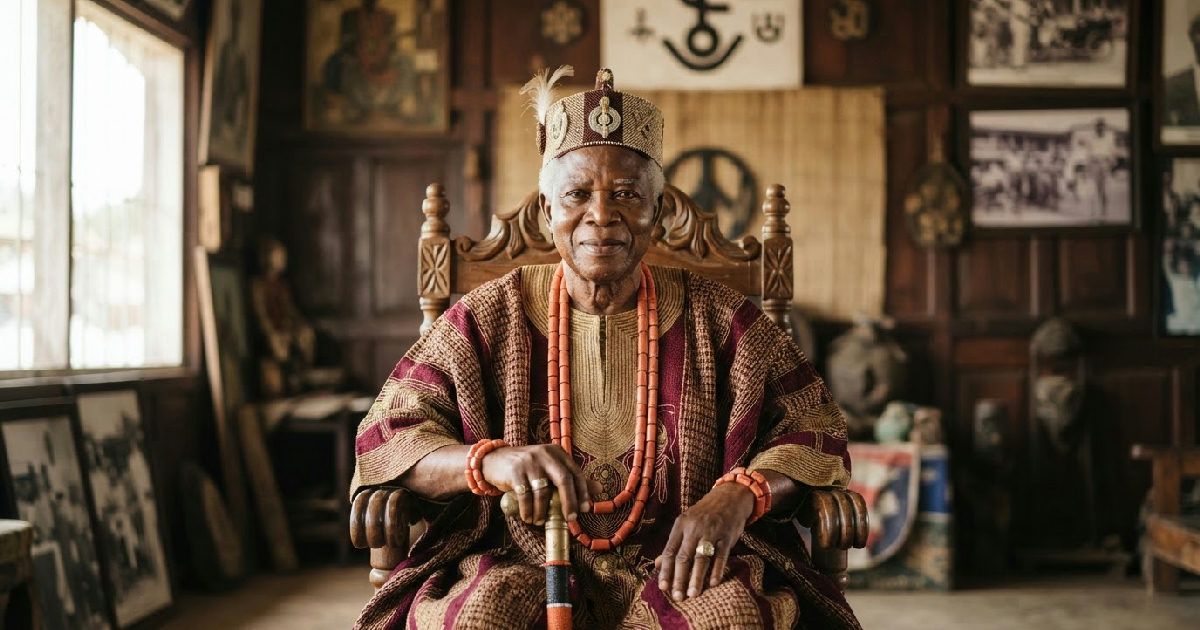
In 1957, in the ancient town of Badagry, Chief Nunayon Mobee took on the revered title of Menu-Toyon I, the Mobee of Badagry Kingdom. This was a pivotal moment, not just for him, but for the very system of traditional authority he now represented.
He stepped into a role shaped by centuries of history, just three years before Nigeria itself would claim independence, ensuring the Mobee institution continued its legacy.
Born on February 16, 1891, Nunayon Mobee’s life spanned the tumultuous end of the 19th century, the expansion of British colonial power, and the dawn of a sovereign Nigerian state.
The enduring structure of Badagry’s traditional power
His story, and that of the Mobee institution in Badagry, offers a sharp lens through which to understand how indigenous systems of governance adapted, persisted, and redefined themselves amid profound political upheaval, eventually becoming a critical link in the nation’s historical memory.
Badagry, located in present-day Lagos State, always held a crucial position along the Bight of Benin. Its access to both inland trade routes and the Atlantic coast made it a vibrant hub for regional and international commerce long before European powers arrived.
This strategic location meant that Badagry’s political landscape was never simple. It wasn’t governed by a single, all-powerful ruler. Instead, the town comprised several quarters, or wards, each with its own chiefs who wielded considerable political and commercial influence. This decentralised structure allowed powerful chiefly families, like the Mobee family, to cultivate direct relationships with merchants, neighbouring communities, and foreign traders.
The Mobee institution specifically anchored itself within the Boekoh Quarters. Its historical roots were deep, stretching back to a period when its chiefs played a significant, albeit challenging, role in the region’s economic life. Understanding this historical foundation is key to grasping the later evolution of the Mobee chieftaincy.
Inheriting a difficult past: Sumbu Mobee and the slave trade
The Mobee institution’s legacy is inextricably tied to Badagry’s participation in the Atlantic slave trade during the 18th and 19th centuries. Enslaved Africans were a significant part of the commerce that flowed through this strategic port. Local political figures and African intermediaries collaborated with European and Brazilian merchants, participating in the capture, transport, and export of enslaved people.
One of the most prominent figures from this era was Chief Sumbu Mobee, a High Chief of Boekoh Quarters. Historical accounts confirm his involvement in slave-trade traffic during the 19th century, before his death on December 16, 1893. His actions left an indelible mark on Badagry’s history and the collective memory of the Mobee family.
Nunayon Mobee was born in 1891, two years before Sumbu Mobee died. Their lives overlapped briefly, but their public careers belonged to vastly different historical periods. Sumbu’s authority emerged from the slave-trading economy of 19th-century Badagry.
Nunayon, by contrast, would rise to prominence in the 20th century, a period defined by intensifying colonial rule and the eventual drive for independence. The Mobee name, therefore, represents a lineage of office-holders, not a continuous individual narrative, demonstrating how Yoruba kingship and other traditional systems could evolve.
It’s a distinction vital for understanding the complexities of inherited power.
Navigating colonial influence: Nunayon Mobee’s early public role
Even as the British colonial government extended its reach, older indigenous political institutions like the Mobee chieftaincy didn’t simply disappear. They continued to function, albeit often in modified forms, alongside the new colonial structures. Nunayon Mobee grew up witnessing this intricate dance between tradition and foreign administration.
By 1950, when Nunayon Mobee was about 59 years old, his public standing was already well-established within Badagry. That year marked a significant event in his public life: his appointment as a Justice of the Peace. This appointment placed him among the recognised local figures entrusted with public authority within the colonial administrative framework, acknowledging his influence within the community.
This period coincided with the governorship of Sir John Stuart Macpherson, who served Nigeria from 1948 to 1954. Macpherson’s tenure was crucial for Nigeria’s constitutional development, leading to the Macpherson Constitution of 1951, which broadened Nigerian participation in governance.
Nunayon Mobee’s appointment underscored how colonial authorities often co-opted or formally recognised traditional leaders to facilitate their administration, cementing their local power within a new bureaucratic system.
This dynamic, where political figures navigated shifting allegiances, meant he was effectively a bridge figure even before inheriting his full traditional title, adapting to the colonial system while retaining his local roots.
The Mobee institution in a new Nigeria
When Chief Nunayon Mobee finally assumed the title of Menu-Toyon I in 1957, Nigeria was on the cusp of nationhood. Independence lay just three years away. This timing imbues his accession with profound historical significance, placing the Mobee institution directly at the crossroads of colonial departure and sovereign self-rule.
Traditional institutions, despite the rise of modern electoral and administrative structures, remained deeply important to local communities.
Menu-Toyon I’s public life thus became a vivid illustration of the intersection between indigenous chiefly authority, the outgoing colonial administration, and the burgeoning Nigerian nation-state. He held his position through the final years of British rule and continued to serve after independence on October 1, 1960. His experience encapsulated the transition, witnessing firsthand the dismantling of one system and the birth of another.
He died on June 24, 1963, less than three years after Nigeria gained its sovereignty and just months before it became a republic on October 1, 1963. He belonged to a unique generation of traditional leaders who personally experienced both the mature British colonial government and the exhilarating, if challenging, dawn of independent Nigeria.
This survival of traditional authority beyond the colonial era speaks to the resilience and deep cultural roots of these systems across the nation.
Bearing the burden of memory: The Mobee Family Museum
The Mobee institution’s endurance highlights a broader truth about Nigerian history: independence didn’t simply erase older forms of traditional authority. Chiefs, kings, and hereditary titles continued to play vital cultural, social, and community roles, even as modern governments and administrative structures grew around them. For Badagry, the Mobee institution became particularly significant due to its profound connection with the town’s Atlantic slave-trade history.
Today, the Mobee Royal Family Slave Relics Museum in Boekoh Quarters stands as a powerful testament to this enduring legacy and the willingness to confront a difficult past. The museum houses objects associated with the slave-trading era, including chains and restraints.
These artefacts are not merely relics; they are tangible reminders of the role played by earlier generations in the system of enslavement, including those within the Mobee lineage.
This collection transcends a simple family inheritance, transforming into a crucial part of Nigeria’s public memory of the Atlantic slave trade.
It represents a distinctive form of historical stewardship, allowing present and future generations to grapple with the complex reality of a system where African intermediaries, including some traditional leaders, participated alongside European and Brazilian merchants. The museum forces a direct engagement with history, confronting uncomfortable truths about the past.
The Mobee legacy today and moving forward
The traditional institution connected to High Chief Menu-Toyon I didn’t cease with his death. It continued, adapting and maintaining its role in Badagry. High Chief Patrick Yedenu Mobee, known as Menu-Toyon II, now serves as the current Mobee figure for Boekoh. He acts as a custodian of the family’s historical heritage, ensuring the lineage endures.
In April 2026, Patrick Yedenu Mobee celebrated his 70th birthday, an occasion that also marked his continued traditional leadership and his stewardship of the slave-relic collection. The Mobee Family Museum remains an integral part of Badagry’s recognised historical landscape, drawing visitors who seek to understand the town’s deep and often painful past.
The objects within its walls, connecting to the Mobee lineage, offer a unique perspective on this history.
The survival of the Mobee title, the family compound, and the museum gives the story of Menu-Toyon I a relevance that stretches far beyond his lifespan of 1891 to 1963. The institution he inherited and led endured, as did his family and the physical objects of their history. More profoundly, the difficult questions surrounding the family’s past, questions of responsibility and memory, also survived him.
These questions continue to shape Badagry’s engagement with its past, especially as its historical sites become increasingly important for Nigerian heritage tourism and the broader remembrance of the Atlantic slave trade. The Mobee collection, in particular, offers a unique bridge.
It connects tangible artefacts with the living history of a traditional institution that has persisted from the 19th century well into modern Nigeria, forcing a reckoning with origins while affirming resilience.
The changing role of traditional leadership
The transformation of the Mobee institution, from its historical role in commerce to its current position as a guardian of memory, mirrors the evolving function of traditional leadership across Nigeria. These institutions, once wielding significant political and economic power, have adapted to democratic governance while retaining cultural and community significance.
The story of Menu-Toyon I embodies this shift, showing how traditional authority can persist through radical changes in national structure.
In colonial Nigeria, figures like Nunayon Mobee found ways to operate within the new administrative frameworks, often becoming intermediaries between the British and their communities. This pragmatic approach allowed traditional systems to retain relevance and influence, ensuring their survival even as they ceded ultimate political power. Their authority shifted from direct governance to custodianship of heritage and community identity.
Post-independence, these roles continued to evolve. Traditional rulers often act as cultural ambassadors, peacekeepers, and upholders of local customs and traditions. The Mobee institution’s active preservation of the slave relics museum exemplifies this modern role—not just recalling history, but actively managing its interpretation for contemporary society. This ongoing engagement with the past, rather than a dismissal of it, strengthens the institution’s relevance in present-day Nigeria.
Lessons from Mobee’s enduring legacy
The Mobee institution offers powerful lessons on how historical legacies, even deeply problematic ones, can be confronted and integrated into a national narrative. By preserving the tangible remnants of the slave trade, the Mobee family takes on a role far beyond mere chieftaincy; they become keepers of a difficult truth.
This isn’t an attempt to erase ancestral involvement but to ensure it is remembered and understood.
Menu-Toyon I’s life and the ongoing presence of the Mobee institution underscore the intricate relationship between continuity and change in Nigeria. It shows that systems built on tradition can adapt to external pressures, from colonial rule to modern statehood, without entirely losing their essence.
The persistent existence of these traditional structures provides a unique layer of governance and cultural identity that often complements, rather than conflicts with, contemporary political systems.
Ultimately, the story of the Mobee institution in Badagry is a reminder that Nigeria’s past is not a singular, simple narrative. It’s a complex interplay of forces, decisions, and inherited responsibilities. How communities choose to remember and engage with these deep histories will continue to shape their identity and understanding of themselves in the future.
The Mobee institution provides a framework for this vital, ongoing conversation, ensuring that the past, however challenging, remains alive and instructive.
