




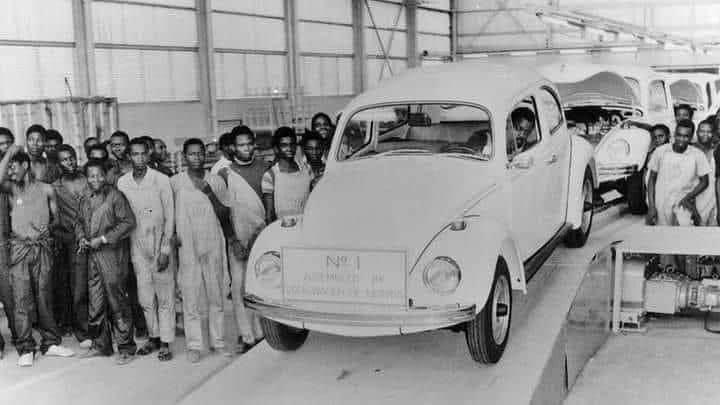
In March 1975, Nigeria’s automobile industry saw the inauguration of two major assembly plants, one in Kaduna and another in Lagos, seven days apart. General Yakubu Gowon, then Head of State, formally inaugurated two pivotal automobile assembly plants. These openings were just seven days apart, first in Kaduna and then in Lagos.
On Friday, March 14, 1975, Gowon cut the ribbon at Peugeot Automobile Nigeria (PAN) in Kaduna. A week later, on Friday, March 21, he unveiled the Volkswagen of Nigeria (VWON) plant in Lagos. These were not just ceremonial events; they were bold statements of a nation determined to build its own industrial might.
Nigeria automobile industry 1975: a grand strategy
The Federal Military Government, under Gowon, harboured grander ambitions than merely assembling cars. These twin projects were cornerstones of the Second and Third National Development Plans. Nigeria aimed to reduce its dependence on imported vehicles.
The government sought to develop domestic industrial capacity. It also wanted to create skilled employment and foster the local manufacture of automotive components. This was a profound shift from the earlier practice of importing semi-knocked-down components for basic assembly by private firms.
In the early 1970s, the government actively courted foreign automobile manufacturers. It sought partners willing to establish large assembly operations as joint ventures. These ventures would include Nigerian public and private interests, forming a new industrial blueprint.
Beyond Peugeot and Volkswagen, four commercial vehicle assembly projects followed. These involved partnerships with Mercedes Benz, Leyland, Steyr, and the National Truck Manufacturers operation. This broader strategy aimed to establish a comprehensive automotive ecosystem.
Kaduna’s Peugeot Plant: A Northern Industrial Anchor
The journey for Peugeot Automobile Nigeria began well before its official opening. On August 11, 1972, the Federal Government of Nigeria signed a joint venture agreement with Automobiles Peugeot of Paris, France. Peugeot Automobile Nigeria Limited was then incorporated on December 15, 1972.
The decision to site the plant in Kaduna was a strategic one. It reflected the government’s desire to spread major industrial projects beyond Lagos’ bustling commercial capital. This move aimed to encourage geographically broader industrial development and economic opportunity.
General Gowon formally opened the PAN assembly plant at the Kakuri Industrial Estate in Kaduna on March 14, 1975. The project carried an approximate cost of ₦8.5 million. Operations began shortly after, on March 2, 1975, according to some reports.
The plant was projected to employ about 1,500 people. Its initial installed capacity stood at an impressive 60,000 vehicles annually. Early models included the Peugeot 504, which quickly became an enduring symbol on Nigerian roads.
The 504 served as private, official, and commercial transport across the nation. The initial design also allowed for assembling the Peugeot 203, 304, 404, and 800cc cars. This versatility boosted its widespread adoption.
The equity structure showed a clear collaborative effort. Peugeot Citroen held 40%, while the Nigerian government owned 35%. Kaduna State held a 10% share, and the Nigerian Industrial Development Bank secured 5%. This distribution highlighted the blend of foreign expertise and local ownership.
Part of the agreement mandated a gradual deletion program for imported parts. The target was to achieve at least 30% local content by ex-factory value within three years. This commitment aimed to foster a genuine domestic manufacturing base.
Volkswagen’s Lagos Gateway: Crafting a National Car
Just a week after Kaduna’s celebration, attention shifted southwest. General Yakubu Gowon inaugurated the Volkswagen Assembly Plant on the Lagos-Badagry Road on March 21, 1975. The plant, costing ₦11.5 million, rolled out its first Volkswagen Beetle on the same day.
Volkswagen of Nigeria was also structured as a joint venture. Volkswagen AG of Germany held 40% equity, with the Federal Government of Nigeria holding 35%. The Lagos State Government owned 4%, and a German financial institution 11%.
Nigerian distributors held the remaining 10% of the equity. This spread ownership across multiple local and international entities. The venture sought to combine global expertise with local market understanding.
The plant’s location along the newly constructed Lagos-Badagry expressway positioned it strategically. It quickly began producing a range of models. Beyond the iconic Beetle, the plant assembled the Audi 100 cd, Golf, Kombi bus, Jetta, and Passat.
The Beetle, specifically the 1300cc, 1500cc, and 1600cc versions, gained immense popularity. Its affordability and ease of maintenance made it a favourite among Nigerians. By 1976, Volkswagen of Nigeria produced over 16,000 vehicles, capturing a significant share of the passenger car market.
The Promise and Peril of Local Content for Nigeria’s Automobile Industry
The ambition underpinning these assembly plants went far beyond simply bolting imported parts together. The Federal Government aimed for a gradual progression towards increasing the use of locally manufactured components. The long-term objective was to replace imported parts with Nigerian alternatives.
This vision recognized the potential for widespread industrial stimulation. A thriving automotive sector could spur growth in tyre production, glass manufacturing, and paint companies. It could also benefit battery makers and upholstery businesses.
Metal fabricators and electrical component manufacturers would also find new demand. This comprehensive approach aimed to create a robust, interconnected industrial ecosystem. The ripple effect was expected to transform various ancillary sectors.
However, the plants initially depended heavily on imported completely knocked down (CKD) kits. While assembly lines offered employment and technical training, this reliance proved to be a critical vulnerability. It became particularly apparent when Nigeria’s economic landscape shifted.
The country’s oil-driven economy of the 1970s had provided substantial government revenues. But during the 1980s, economic conditions deteriorated, and foreign exchange became increasingly scarce. Industries reliant on imported machinery and components faced severe problems.
Automobile assembly was especially susceptible to these changes. Foreign exchange shortages and import restrictions severely constrained Volkswagen production from 1982. The Lagos factory struggled as the flow of imported parts dwindled.
The Nigerian operations later found some relief through a 1985 trade arrangement with Brazil. This deal improved access to Volkswagen components from Brazil, offering a temporary lifeline. Yet, it underscored the persistent external dependencies, echoing colonial economic structures.
PAN experienced similar pressures, highlighting a major flaw in Nigeria’s automotive program. The nation had successfully established major final assembly operations. But domestic component manufacturing had not developed sufficiently to protect production when access to imported materials was restricted.
A Legacy Transformed: From 1975 to Present Day
The original Volkswagen operation eventually faced a prolonged decline. German involvement in the venture diminished, and the Lagos facility became moribund. However, the site’s industrial legacy persisted.
The former Volkswagen complex was later taken over by interests associated with the Stallion Group. It became the base of VON Automobiles Nigeria Limited. This transformation reflected the shifting dynamics of Nigeria’s automobile industry.
Foreign brands, local investors, assembly arrangements, and government policies changed repeatedly. Yet, the ambition of creating sustainable domestic vehicle production endured. VON Automobiles continues to operate from the historic Badagry corridor location.
PAN Nigeria also underwent significant changes. Peugeot Automobile Nigeria eventually became PAN Nigeria Limited, broadening its focus beyond just Peugeot vehicles. The company was privatized in 2006, with private management taking control the following year.
After subsequent financial and operational difficulties, the Asset Management Corporation of Nigeria (AMCON) intervened. A new strategic investor took over management in 2020. PAN then adopted a multi-brand strategy, now producing HIGER H5C and H6C buses, including an ambulance configuration.
The Kaduna plant retains its historic industrial location. Its survival and evolution demonstrate the profound impact of the industrial decisions made in the early 1970s. These choices continue to shape Nigeria’s automotive landscape.
More than five decades after those pivotal openings, Nigeria still strives for stronger domestic automotive production. In August 2026, the National Automotive Design and Development Council (NADDC) reported nearly 40 vehicle assembly plants were operating. But reality lags ambition.
Across West Africa, vehicle production remains well below the combined capacity of existing plants. The ECOWAS Regional Automotive Industry Development Forum, held in Abuja from August 4 to 6, 2026, highlighted this gap.
Plants operating at the semi-knocked-down level possess a combined installed capacity exceeding 100,000 vehicles annually. Yet, actual production struggles to reach 10,000 units. This significant disparity points to underutilized potential.
ECOWAS also reported that West Africa imports more than 450,000 vehicles each year. These imports are predominantly used vehicles and those entering through grey import channels. This reveals a vast market still untapped by local production.
These figures underscore the monumental scale of the industrial challenge. Assembly plants alone cannot forge a self-sustaining automobile industry. Crucial roles are played by production volume, robust domestic component manufacturing, and engineering capability.
Access to finance, reliable infrastructure, consistent industrial policy, and strong consumer purchasing power are all vital. The story of Nigeria’s automobile industry, beginning in March 1975, is a testament to persistent ambition.
It also shows the complex interplay of factors required for lasting industrialisation. This is a lesson that continues to unfold as Nigeria pursues later industrial breakthroughs.
