




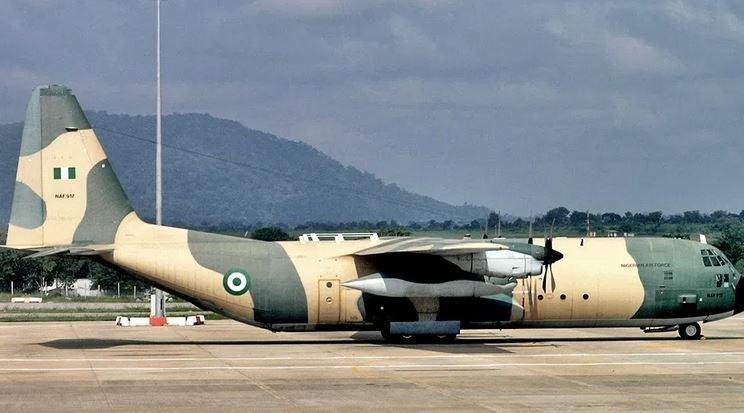
Most people believed the investigation into Nigeria’s deadliest military air disaster would provide clear answers. But the official report on the 1992 crash of the Nigerian Air Force C-130 Hercules, NAF 911, was never released to the public, and the findings from its black box remain a mystery to this day.
The catastrophe occurred on the evening of September 26, 1992. The aircraft took off from Lagos and disappeared from radar within three minutes, plunging into a swamp in Ejigbo. There were no survivors. More than 150 people, mostly middle-ranking military officers from Nigeria and several other African nations, lost their lives in a tragedy that echoed another unresolved Nigerian aviation mystery.
The 1992 C-130 crash during political turmoil
The crash happened during the uncertain final years of General Ibrahim Babangida’s military government. By 1992, Nigeria was in a delicate transition towards civilian rule, yet the armed forces remained central to political power. This complex environment amplified public scrutiny and suspicion after the disaster.
The C-130 Hercules was a vital asset for the Nigerian Armed Forces, acquired from the United States in the 1970s to transport troops and equipment. NAF 911 was a well-established workhorse. So, when it crashed shortly after takeoff from Murtala Muhammed International Airport, killing all 159 people on board, including 151 Nigerians and officers from Ghana, Tanzania, Zimbabwe, and Uganda, the loss was profound.
The victims represented a significant concentration of Nigeria’s military leadership, many of them students returning to the Command and Staff College in Jaji after a squash competition in Lagos. Immediately, the Defence Minister at the time, General Sani Abacha, ordered a full investigation. A panel was formed, and the nation waited for an explanation.
The aircraft’s final moments and contested causes
The aircraft’s end came swiftly. Aviation records reconstructed its final moments as a rapid loss of engine power, with two engines failing shortly after takeoff and a third following. Operating at low altitude and in the critical climb phase, the crew had little time to recover before the Hercules stalled and plunged into the Ejigbo swamp.
The central technical question quickly became: why did it lose power? International aviation accident records cited fuel contamination, specifically water and bacteria, as a probable cause. This explanation is technically plausible, but Nigeria’s official investigation report, which would have confirmed or disputed this, never saw the light of day.
Allegations of overloading also circulated widely. While the C-130 was a robust transport aircraft, its performance depended on factors like weight and engine condition. Reports suggested NAF 911 was heavily loaded, with more people than seats and unsecured luggage. The shifting weight during engine failure could have worsened the situation, though no definitive loading manifest was ever publicly released.
Maintenance questions and sabotage rumours
The aircraft’s age and maintenance history also became points of contention. NAF 911 had served for many years since its construction in the 1970s. Claims of prior mechanical problems and inadequate maintenance plagued the narrative, with some accounts suggesting it was due for major foreign maintenance soon after the crash. However, a complete public record of its maintenance history never emerged.
In the highly charged political climate of 1992, with Nigeria under military rule and grappling with political uncertainty, rumours of deliberate sabotage gained traction. One widow even petitioned the Oputa Commission, alleging that her husband and others were deliberately ordered to fly a faulty aircraft. However, no reliable evidence ever substantiated these claims, leaving them as unproven allegations rather than historical fact.
The stunning Oputa commission revelation
The fight for truth came to a head almost a decade later. At a hearing of the Human Rights Violations Investigations Commission, popularly known as the Oputa Commission, in July 2001, the widows’ representatives again demanded the report. Their persistence exposed a shocking institutional failure, mirroring other instances where bureaucratic flaws were laid bare.
These families, who had lost breadwinners, also pressed for unpaid pensions, gratuities, housing, and educational support for their children. The commission, established in 1999 by President Olusegun Obasanjo to investigate human rights abuses during military rule, became a crucial forum for these long-ignored grievances.
In a settlement agreement submitted to the commission that September, the Ministry of Defence made a startling promise. It agreed to give the crash report to the families as soon as the Chief of Air Staff received it from the American manufacturer of the C-130. This admission, nine years after the crash, meant the government itself effectively did not have the final, crucial report.
The enduring mystery of the black box
Central to the unresolved questions was the flight recorder, or black box. Such devices provide critical data on an aircraft’s performance and cockpit communications, information that would have been invaluable in understanding NAF 911’s final moments, particularly with three of its four engines reportedly failing.
But like the report itself, the black box’s fate is not part of the public record. While Vice President Augustus Aikhomu initially announced efforts to retrieve it for analysis in America, later reports suggested military C-130s of that era might not have carried them for security reasons.
Other accounts claimed it was never returned or its findings never publicized. The expression “black box nobody ever heard” became a potent symbol of the enduring secrecy.
The lack of a public report became a national symbol of unresolved questions, so much so that when hijackers seized a Nigeria Airways flight in October 1993, one of their demands was a new investigation into the crash. The event became a reference point for those seeking accountability, a cause championed by figures like television host Onyeka Onwenu in her own work.
A lasting legacy of unanswered questions
More than three decades later, the NAF 911 disaster remains one of Nigeria’s most devastating military aviation tragedies, not only for the lives lost but for the persistent silence surrounding its cause. The families of the victims continued their fight for answers and entitlements well into the 2020s, highlighting a wound that never truly healed.
The Nigerian Air Force did commemorate the pilots, Wing Commanders J.P. Alabesunu and A.S. Mamadi, and engineer Squadron Leader J.A. Adeiza, by naming newly constructed married officers’ quarters after them. A memorial cenotaph was also unveiled at the National Military Cemetery in Abuja, serving as a solemn reminder of the immense loss.
But a monument, however respectful, cannot replace official accountability. The failure to make the investigation public prevented Nigeria from learning crucial lessons about aviation safety, maintenance protocols, and crisis management. It perpetuated an environment where fact struggled against rumour, undermining public trust in state institutions.
What the missing report reveals about Nigeria
The real story of NAF 911 is not just a tragic accident; it’s the story of what happens when institutions fail to provide answers, especially during periods of national uncertainty. The absence of an official, transparent account allowed suspicion and conspiracy theories to take root, deepening the pain of the families who lost their loved ones.
By failing to make the investigation public, the military prevented Nigeria from learning crucial lessons about aviation safety and institutional accountability. The disaster remains a memorial not only to the lives lost but to a moment when the truth itself was buried, leaving a permanent scar on the nation
