




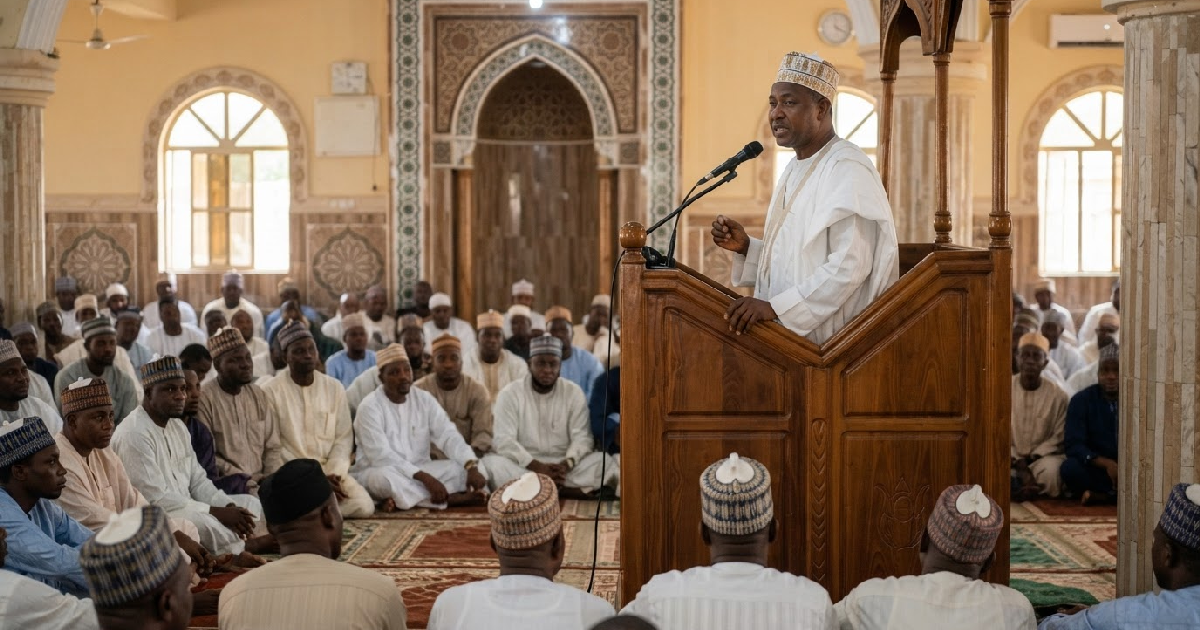
The air was thick with anticipation on Friday, August 7, 2026, as congregants gathered at the Nagazi-Uvete Jumu’ah and the late Alhaji Abdur-Rahman Okene’s Mosques in Okene, Kogi State. Chief Imam Murtadha Gusau prepared to deliver a Jumu’ah Khutbah that would echo through the community, focusing on his sermon about scholars’ flesh being poisonous.
His sermon, titled ‘Beware, the flesh of Islamic scholars (Ulama’) is poisonous!’, aimed to address a critical issue. It was a potent message against the spiritual dangers of attacking the honour of religious learned figures. This Murtadha Gusau sermon sought to remind the Ummah of timeless Islamic principles.
The enduring warning from Murtadha Gusau sermon against slander
At the heart of Imam Gusau’s address was a profound Islamic maxim. ‘The flesh of Islamic scholars is poisonous’ is a phrase steeped in centuries of religious jurisprudence and tradition. It carries a heavy weight for believers.
This isn’t a new concept, but a powerful revival of ancient wisdom. The classical historian and Islamic scholar, Al-Hafiz, Imam Abul-Qasim Ali Ibn al-Hasan Ibn Asakir, originally coined it. His monumental work, ‘Tarikh Madinat Dimashq’ (The History of Damascus), remains influential.
Imam Ibn Asakir’s specific warning comes from his book, ‘Tabyin Kazib al-Muftari’. He wrote, ‘Know, O my brother—may Allah guide us and you—that the flesh of the Islamic scholars is poisonous.’ He added that ‘Allah’s custom in exposing and destroying those who belittle them is well known.’
Echoes of ancient wisdom
Ibn Asakir’s words carry a severe spiritual injunction. He warned that ‘Whoever lets their tongue loose against the Islamic scholars with slander will be afflicted by Allah with the death of the heart.’ This affliction includes spiritual numbness and ruin, ‘before they even die physically.’
Other revered figures, like Imam Ahmad Ibn Hanbal, also echoed this maxim. Their collective wisdom underscores the gravity of disrespecting those who carry sacred knowledge. It is a cautionary tale for the Muslim Ummah.
This historical consensus highlights the perceived direct link. To dishonor a scholar is to open oneself to divine retribution and a profound inner decay. It reveals the seriousness with which Islamic tradition views such actions.
Scholars as guardians of faith
Imam Gusau clarified that Islamic scholars are not infallible. They are human beings, susceptible to errors like anyone else. However, their unique role makes attacks on them exceptionally grave.
Scholars preserve and transmit the enduring legacy and teachings of Prophet Muhammad (Peace be upon him). For this reason, attacking them becomes a direct assault on Islam itself. It strikes at the very vehicle of divine guidance.
The noble Qur’an likens consuming the ‘flesh’ of a person through backbiting to eating the dead flesh of one’s own brother. When the slandered person is a sincere religious guide, the spiritual toxicity and punishment are multiplied further. Allah intervenes to defend those who believe and guide others.
Those who habitually find fault or fabricate lies against Islamic scholars often face humiliation. They frequently become spiritually bankrupt. Their actions create fitnah, a deep discord that fractures the unity and peace of the Muslim Ummah.
The prophetic legacy in a modern age
The importance of scholars extends beyond their immediate teachings. Abdullah Ibn Masʿud (RA) explained a sobering truth. He stated that ‘There will not come upon you a day except that it is worse than the day that came before it until the Hour is established.’
This worsening isn’t about wealth or affluence. It concerns a diminution of knowledge. ‘So when the Islamic scholars have passed away and died, the people will all be at the same level,’ Ibn Masʿud said. ‘So they will not enjoin the good, nor forbid the evil, and at that point, they will be ruined.’
Abdullah Ibn Amr Ibn Al-As relayed a Hadith from Prophet Muhammad (Peace be upon him). It warned that ‘Allah does not take away the knowledge by taking it away from the hearts of the people, but He takes it away by the death of the Islamic scholars till no Islamic scholar remains.’
The Hadith continues to illustrate the perilous consequence. ‘Then people will take as their leaders the ignoramuses,’ it states. ‘They will give their verdict (fatwa) without knowledge. So they will go astray themselves and will lead the people astray.’ This underscores the scholar’s irreplaceable role.
Contemporary challenges for the Ulama’
Imam Murtadha Gusau observed a disheartening trend in contemporary society. He pointed to a prevalent negativity towards Islamic scholars. This negativity often comes from ‘misguided political singers’ or ‘ignorant politicians,’ as he put it. Callers to misguidance also contribute to this problem.
These individuals frequently ‘revile the Islamic scholars and belittle their worth.’ They accuse them of being out of touch with current affairs or the realities of Muslim communities. The ultimate goal, Gusau suggested, is to sow doubt and turn people away from authentic Islamic knowledge.
When ‘numerous speakers, musicians, content creators, mostly young, ignorant and reckless’ attack scholars, confusion reigns. People struggle to distinguish between genuine knowledge and the ‘riff-raff’ who promote misguidance. This erosion of discernment, Gusau fears, leads to ruin.
The Imam stated plainly that ‘ignoramuses, who falsely ascribe themselves to Islam and Muslims wallahi are more harmful to the Islam and Muslims than the unbelievers.’ This powerful indictment highlights the internal threat to the Ummah. It reflects a deep concern for the spiritual well-being of the community.
Defending the truth, defending Islam
Ash-Shaikh Rabīʿ Ibn Hadī Umair Al-Madkhali, a prominent scholar, addressed the issue of reviling scholars. He called it a ‘very dangerous matter indeed.’ Criticising those upon the truth leads to attacking the religion itself.
This is because it ‘prevents people from the Path of Allah.’ Such attacks, he explained, target the ‘callers to Tawhid’ and those who fight against *shirk*, *bidʿah*, and misguidance. The goal is to discredit their message, mirroring how past prophets were slandered.
The role of Islamic scholars is undeniably crucial in preserving the Religion of Allah. Prophet Muhammad (Peace be upon him) said: ‘This knowledge will be carried by the trustworthy of every generation.’ These trustworthy individuals ‘will expel from it the distortions of those who go to extremes, the lies of the falsifiers, and the interpretations of the ignorant.’
Therefore, to attack these scholars is to harm those specifically chosen by Allah to guard His Religion. It means blocking people from the true Path of Allah. This underscores the grave responsibility associated with criticising religious authority, as articulated in the legacy of community support.
The scholar’s sacred duty
The responsibility doesn’t rest solely on the followers to respect scholars. Scholars themselves carry a heavy burden of integrity and adherence to divine command. Islam strictly prohibits Ulama from participating in or endorsing injustice against citizens. They must guide society towards equity.
Allah Almighty states in a sacred tradition (Hadith Qudsi) that ‘O My servants, I have forbidden injustice for Myself and have made it forbidden among you, so do not wrong one another.’ Islamic scholars, inheriting the mantle of the Prophets, view the defense of justice as an absolute religious duty.
Prophetic traditions warn against scholars who validate a leader’s falsehoods. Assisting in oppression dissociates them from the Prophet’s guidance. Authentic Islamic scholarship demands confronting wrongdoing directly and advising leaders with ‘love, justice and wisdom.’ Their role is to speak truth to power.
Assisting an unjust system, even through minor acts or silent endorsement, violates the Qur’anic injunction: ‘And do not cooperate in sin and injustice.’ Scholars are obligated to defend victims of tyranny, regardless of their background or belief. This is a core tenet of their spiritual mission.
The spiritual weight of an oppressed person’s supplication is immense. When that person is a man or woman of religious knowledge, their plea carries devastating power. Prophet Muhammad (Peace be upon him) warned: ‘Beware of the supplication of the oppressed, for there is no barrier between it and Allah.’
Countless historical accounts serve as a stark warning. Leaders and common folk who ruined the dignity of righteous Islamic scholars often found their own lives collapsing in sudden ruin. Divine Justice moves swiftly to dismantle the oppressor’s peace, wealth, or standing. Gusau’s sermon thus serves as a dual reminder.
Chief Imam Murtadha Gusau, from his pulpit in Okene, Kogi State, brought an ancient, profound message to a contemporary audience. He reminded his listeners of the deep spiritual consequences of maligning Islamic scholars. But he also highlighted the equally vital duty of these scholars to uphold justice and speak truth without fear.
This delicate balance, he implies, is essential for the health and unity of the Muslim Ummah in Nigeria and beyond.
