




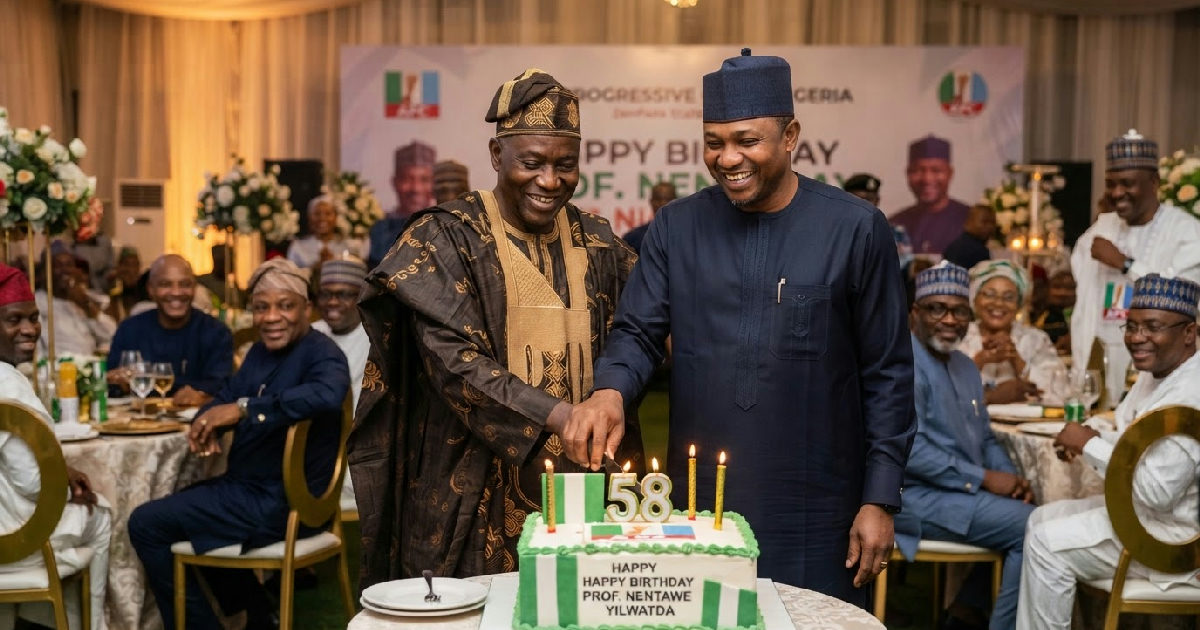
On Saturday, August 8, 2026, Governor Dauda Lawal of Zamfara State extended warm felicitations to Professor Nentawe Goshwe Yilwatda, the National Chairman of the All Progressives Congress (APC), on his 58th birthday.
This public acknowledgement from a governor of an opposing party offers a rare glimpse into the complex dynamics of Nigerian politics, suggesting a potential for cross-party respect and an appreciation for principled leadership.
The engineer who rose through the ranks
It highlights a moment when individual character might transcend typical party lines, particularly concerning the internal processes that shape the nation’s political future. The praise specifically singled out Professor Yilwatda’s stewardship of the contentious 2027 general election primaries, a period fraught with internal party rivalries.
Born on August 8, 1968, in Dungung, Kanke Local Government Area of Plateau State, Professor Nentawe Goshwe Yilwatda’s journey into the highest echelons of Nigerian politics wasn’t a conventional one. He started his professional life rooted in academia and engineering, far removed from the clamour of political rallies and party conventions.
Yilwatda earned his Bachelor’s degree in Electrical/Electronic Engineering from the Federal University of Agriculture, Makurdi, in 1992, later securing a doctorate in Electronic and Computer Engineering from the University of Nigeria, Nsukka.
For over two decades, he immersed himself in scholarly pursuits, holding leadership roles focused on university ICT development. This background, heavy on technical expertise and systematic thinking, offered a different preparation for the complexities of party administration.
His academic career eventually paved the way for public service when he served as a Resident Electoral Commissioner for the Independent National Electoral Commission (INEC), a role demanding impartiality and meticulous organization.
From ministerial office to party leadership
Professor Yilwatda’s political ambitions truly solidified when he emerged as the governorship candidate for the APC in Plateau State in 2023. Though he ultimately lost that contest to Caleb Mutfwang of the PDP, the experience proved to be a significant stepping stone. Following the elections, President Bola Tinubu appointed him Minister of Humanitarian Affairs and Poverty Reduction in 2024, taking over from Betta Edu.
This ministerial tenure, though relatively brief, provided Yilwatda with an executive-level understanding of national governance and policy implementation. However, the trajectory of his career shifted once more in July 2025. He was unanimously elected as the APC National Chairman at the party’s National Executive Council meeting, succeeding Dr. Abdullahi Ganduje.
This move underscored a deliberate elevation within the ruling party, placing him at the helm of its strategic direction ahead of crucial national elections.
Steering the ruling party through fierce primaries
Professor Yilwatda’s leadership was immediately tested by the intricate and often turbulent landscape of internal party politics. The recent All Progressives Congress primary elections, held in May 2026, were designed to select candidates for various elective positions in anticipation of the 2027 general elections. These primaries are fundamental to the democratic process, but they frequently expose the fault lines within political parties.
He famously characterized these contests as “the most competitive internal party process in Nigeria’s political history,” a reflection of the party’s expanding national acceptance but also of the intense competition for power within its ranks. His comments acknowledged the high stakes and the fierce ambitions at play, which can often destabilise party unity.
It was a critical period for the ruling party, setting the stage for its electoral fortunes.
Allegations and Professor Yilwatda’s defence
The primary elections were not without controversy. Professor Yilwatda issued stern warnings to aspirants, cautioning them against actions that could undermine the credibility of the process and threatening immediate suspension for those who violated party rules. Concerns about a tense and contentious primary process were widespread, with allegations of candidate imposition and a lack of internal democracy surfacing in various states.
Reports detailed instances of vote-buying, intimidation, parallel contests, and sudden disqualifications, particularly during the House of Representatives primaries. Consensus arrangements, often favouring governor-backed aspirants, also sparked accusations of malpractice and irregularities.
Yet, Professor Yilwatda maintained that the APC primarily conducted direct primaries nationwide, asserting that the party had established robust internal mechanisms to resolve conflicts and reconcile aggrieved members.
Prominent figures like Speaker of the House of Representatives Tajudeen Abbas, Deputy Speaker Benjamin Kalu, Senate President Godswill Akpabio, and Deputy Senate President Jibrin Barau successfully secured their tickets, underscoring the party’s capacity to manage these complex contests.
A bridge across partisan divides
The congratulatory message from Governor Dauda Lawal, a PDP stalwart, to Professor Nentawe Goshwe Yilwatda, the APC’s national helmsman, represents a striking moment in contemporary Nigerian politics. It’s not everyday a governor from the opposition offers such effusive praise to the chairman of the ruling party.
Governor Lawal’s words were precise and significant: “On his birthday, I felicitate with our Chairman, Professor Nentawe Goshwe Yilwatda, a refined academic and committed party leader who prioritises the development of the All Progressives Congress.”
He continued, “The exemplary leadership and vision displayed by Professor Nentawe have played a vital role in promoting major initiatives and in encouraging cooperation among the members of our great party.” This acknowledgment of Yilwatda’s leadership qualities, vision, and commitment, particularly regarding the handling of internal party affairs, provides a rare moment of bipartisan recognition.
It hints at a political figure who commands respect even from those on the opposing side, perhaps for his adherence to principle.
Defining the “progressive family” in Nigeria
Governor Lawal’s description of Professor Yilwatda as an asset to the “progressive family” and Nigeria’s political development invites a deeper look at what the term “progressive” truly signifies in the Nigerian context.
The All Progressives Congress itself embodies this label, having been formed in February 2013 from a merger of several opposition parties, including the Action Congress of Nigeria (ACN), the Congress for Progressive Change (CPC), and the All Nigeria Peoples Party (ANPP).
Historically, the term has often been associated with political figures from the South-West region, tracing roots back to the Action Group (AG). But in its broader, contemporary usage, “progressive” in Nigeria often points to a commitment to national stability, growth, and security, rather than a strict ideological alignment with Western social or economic theories.
Yilwatda’s background, blending academic rigour with administrative experience, might be seen to embody this broader interpretation, focusing on functional governance and orderly process over purely partisan gains.
Yilwatda’s influence on Nigeria’s political landscape
Professor Nentawe Goshwe Yilwatda’s trajectory, from a quiet life in academia to the intense spotlight of national political leadership, offers a compelling narrative about the forces shaping Nigeria.
His ascent to the APC national chairmanship, particularly after a direct ministerial appointment by President Bola Tinubu, signals a deliberate choice by the party to place a figure with a reputation for discipline and integrity at its helm. This move could influence the tenor of political discourse and internal party governance.
The praise he received from a rival governor after navigating the complex 2026 primaries underscores a potential for a different kind of political leadership in Nigeria—one that perhaps places a higher premium on process and principle.
This approach is particularly critical in a nation often grappling with questions of fairness and legitimacy in its electoral processes. It’s a subtle but significant nod to the kind of character that shapes Nigeria’s post-war era, where integrity can become a rare currency.
What the future holds for the APC chairman
As Professor Yilwatda marks his 58th birthday, his role as APC National Chairman positions him at the very heart of Nigeria’s political future, particularly with the 2027 general elections on the horizon. He will be instrumental in guiding the ruling party through candidate selections, coalition building, and the articulation of its vision for the nation.
His academic and technical background could bring a more analytical and methodical approach to party strategy, potentially tempering the often-unpredictable nature of Nigerian politics.
The challenges remain immense: managing internal dissent, presenting a unified front, and addressing the socio-economic issues that resonate with ordinary Nigerians. Governor Lawal’s words, wishing him “many more years of complete mental, physical, and social well-being so Nigeria continues to benefit from your vast knowledge and experience,” are not just a personal tribute.
They represent a recognition that the effectiveness of leaders like Professor Nentawe Goshwe Yilwatda has far-reaching implications for the nation’s stability and development, touching all Nigerians regardless of their political affiliation.
