




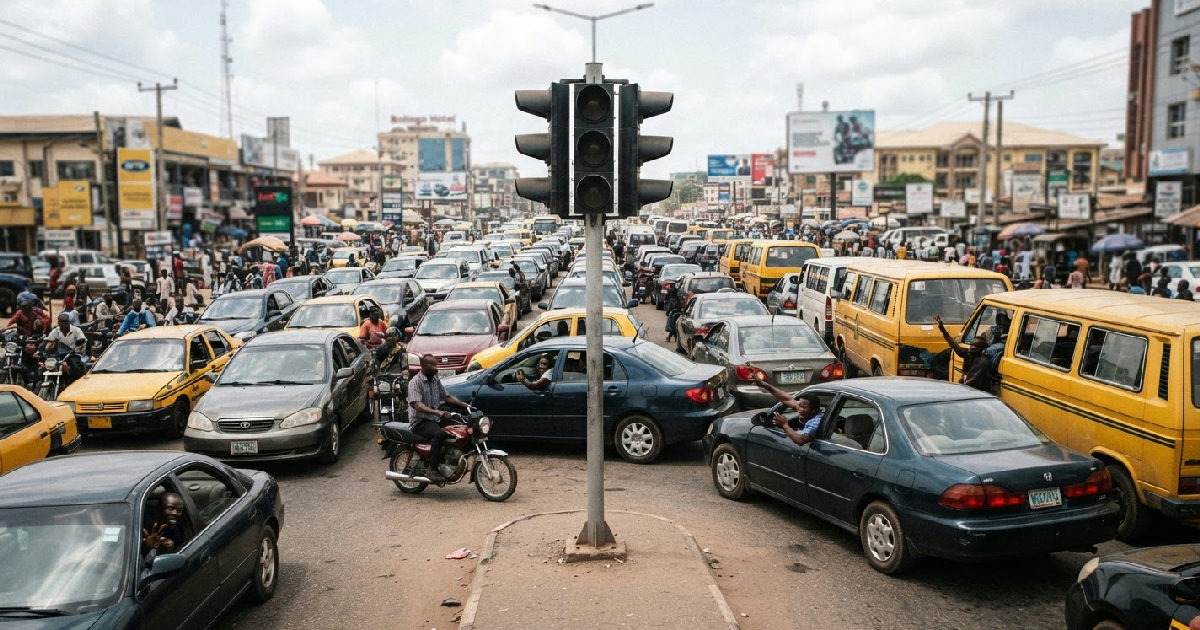
A widespread failure of Abuja traffic lights across Nigeria’s Federal Capital Territory (FCT) fuelled a rise in road accidents and crippled daily commutes with extensive congestion in 2023.
Key commercial and strategic locations across Abuja, including Bolingo Junction, Jabi, Life Camp, and the Banex Junction in Wuse II, have become hotspots for collisions and gridlock. The absence of functioning signals leaves drivers to navigate complex intersections based on guesswork and aggression.
Abuja traffic lights: A city gripped by traffic anarchy
This breakdown of order has become a daily source of frustration and fear for the city’s inhabitants, with many reporting near-misses and witnessing serious crashes directly attributable to the signal failures.
The daily experience for commuters in Abuja has become a portrait of disorder. At junctions where traffic lights are dead, a dangerous free-for-all ensues. Commercial driver Onehr Ali described the situation at Bolingo Junction as dire.
“I can even say there are accidents there everyday,” he stated, adding, “The kind of accident that occurs at this junction, they are always serious ones. Because everybody just passes anyhow, and mostly speeding.”
This sentiment is shared widely. “Once the traffic light stops working, everybody becomes confused,” said Daniel, an Abuja resident. “You have to watch the vehicles coming from different directions before you can move. It is dangerous because not every driver is patient.” The peril extends beyond motorists.
Pedestrians, including children and the elderly, are forced to risk crossing multi-lane highways without the assurance of a signal, as recounted by another resident, Nuhu. The situation underscores a breakdown in basic urban management, affecting public safety and economic productivity.
A long history of neglect
The current crisis is not a sudden development but the result of years of systemic neglect. Reports dating back to at least 2017 highlighted the deteriorating state of Abuja’s traffic infrastructure.
A grim assessment in August 2021 revealed that out of 172 traffic light units installed at strategic points across the FCT, only 62 were functional. Major arteries like Herbert Macaulay Way had none of their 14 signalised intersections working, while Tafawa Balewa Way had only two of nine lights operational.
Even significant investments have failed to solve the problem. In 2015, a bilateral agreement with the Chinese government saw the installation of 76 new solar-powered traffic signals at a cost of approximately N830 million. Yet, within a few years, many of these, too, fell into disrepair.
A traffic warden at Banex Junction noted in 2017 that authorities had seemingly ceased repairs, blaming a “lack of government care.” This pattern points to a deeper issue than simple hardware failure; it reveals a persistent inability to maintain critical public assets, a challenge that requires significant state accountability and a bold pivot in governance.
Official responses and deeper problems
The Federal Capital Territory Administration (FCTA) insists it is addressing the situation. Okey Ichie, the Director of Traffic Management for the FCTA, recently confirmed that the directorate has initiated new contracts to repair and replace faulty signals and CCTV cameras.
“The maintenance contracts are ongoing, and a traffic light violator solution is also being tested at some selected junctions before expanding to other areas,” Ichie said. He also noted efforts to synchronise the city’s traffic lights for central monitoring.
In August 2026, the FCTA, alongside the Federal Road Safety Corps (FRSC) and other security agencies, launched a special enforcement operation targeting traffic light violations. However, some analysts argue that these measures only treat the symptoms, not the root cause.
The city’s persistent gridlock, they argue, is a direct consequence of its original design and subsequent deviations from the master plan. Similar to the long enduring battle Nigeria fought against fake drugs, tackling infrastructure decay requires more than just reactive enforcement; it demands a systemic overhaul.
Is Abuja a victim of its own design?
The Africa Development Studies Centre (ADSC), a policy think tank, has framed Abuja’s traffic woes as a “structural governance problem.” According to ADSC President Victor Oluwafemi, the hyper-concentration of government ministries, departments, and agencies in the city centre is the primary driver of the crippling congestion.
This forces a mass daily migration of workers into a small central zone, overwhelming the road network regardless of its capacity.
“The more Abuja continues to concentrate government activity into the same tight centre, the more congestion becomes inevitable, regardless of how many interchanges are built,” Oluwafemi warned. He argued that Abuja must move from a road-focused response to a “governance-led, spatial planning strategy” that decentralises administrative functions.
This would reduce the daily commuter pressure that strains the infrastructure to its breaking point.
This perspective challenges the official narrative that simply fixing lights or building more roads can solve a problem rooted in the city’s fundamental layout and administrative structure, a city whose ambition has at times been exploited in schemes like the infamous sale of a fake Abuja airport decades ago.
Searching for a sustainable solution
As the FCTA pushes forward with road rehabilitation projects under Minister Nyesom Wike, completing approximately 221 kilometers of an ongoing 317-kilometer contract, the question of sustainability remains. While improved road surfaces enhance mobility, they also invite more traffic, potentially exacerbating congestion at poorly managed intersections. The cycle of building new infrastructure without a corresponding commitment to long-term maintenance has proven to be a failing strategy.
Experts have called for the adoption of modern, technology-driven solutions. AI-powered traffic management systems, which use real-time data to adjust signal timings dynamically, have proven effective in other densely populated cities. Such systems, combined with a robust public transportation network and stricter enforcement powered by technology, could offer a path out of the current chaos.
For now, Abuja’s drivers and pedestrians can only navigate the city’s broken intersections with caution, hoping for a day when a green light is a reliable signal of safety, not a rare occurrence.
