




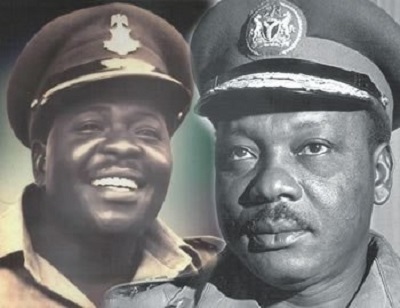
Lieutenant Colonel Adekunle Fajuyi chose death with Aguiyi-Ironsi in July 1966, a pivotal moment during the 1966 counter-coup. This event marked a significant turning point in Nigeria’s history.
Aguiyi-Ironsi’s Brief Reign and Mounting Tensions
Aguiyi-Ironsi had assumed leadership just six months earlier, on January 16, 1966. He stepped in after quashing the first military coup, becoming Nigeria’s most senior officer at the time. His unexpected ascent to power marked the beginning of Nigeria’s first military government.
The initial coup, largely led by junior Igbo officers, resulted in the assassinations of prominent Northern political leaders like Prime Minister Abubakar Tafawa Balewa and Northern Premier Ahmadu Bello, along with senior military officers such as Brigadier Zakariya Maimalari and Colonel Kur Mohammed. This created deep ethnic suspicion across the nation. Aguiyi-Ironsi’s regime inherited a volatile and mistrustful political environment.
His administration’s attempts to unify the nation quickly backfired. Aguiyi-Ironsi introduced Decree No. 34 in May 1966, which sought to replace Nigeria’s existing federal structure with a more centralised system. This measure sparked widespread opposition, particularly among those in the Northern Region who feared it threatened their autonomy and intensified existing ethnic anxieties of Igbo domination.
The January Coup’s Lingering Shadow
The counter-coup on July 29, 1966, did not erupt in a vacuum. It was a direct, violent response to the grievances simmering since the January 15 coup. Northern officers viewed the earlier putsch as an “Igbo coup” due to the ethnicity of many plotters and the prominent Northern casualties.
Compounding this anger was the perceived inaction against the January coup plotters, who were reportedly still being paid while detained. Rumours of an “Igbo coup” to eliminate Northern soldiers gained traction. Aguiyi-Ironsi’s centralising policies and the promotion of several Igbo Majors to Lieutenant Colonel further fuelled fears of ethnic favouritism.
The Bloody July 1966 Counter-Coup Unfolds
The second, deadly coup began around midnight on July 28, 1966, and escalated into the morning of July 29. Northern soldiers, driven by a desire for retribution for the January killings and strong objections to Aguiyi-Ironsi’s centralising policies, moved decisively against the government. They targeted the existing military leadership and officers associated with Aguiyi-Ironsi’s administration.
Major General Aguiyi-Ironsi was in Ibadan, the Western Region capital, staying at Government House as Fajuyi’s guest. He had arrived on July 28, 1966, to address a conference of traditional rulers, part of a nationwide tour intended to foster national unity. Soldiers, under the command of Lieutenant Colonel Murtala Muhammed and led by Major Theophilus Y. Danjuma, surrounded the Government House.
Both men were abducted from the premises in the early hours, stripped of their military insignia, and subjected to brutal treatment. Their bullet-riddled bodies were later discovered in a shallow pit within a forest at Lalupon, outside Ibadan.
This brutal act ended Aguiyi-Ironsi’s six-month and 13-day rule, paving the way for Lieutenant Colonel Yakubu Gowon to emerge as the new Head of State on August 1, 1966.
Fajuyi’s Unyielding Loyalty and Sacrifice
The most enduring account of those final moments centres on Fajuyi’s extraordinary decision. Faced with certain death, he was reportedly given an opportunity to separate himself from Aguiyi-Ironsi. He firmly refused, insisting that if his Head of State was to die, he would die with him.
This profound act cemented Lieutenant Colonel Francis Adekunle Fajuyi’s legacy as a symbol of unwavering loyalty and personal honour. Born in Ado-Ekiti on June 26, 1926, Fajuyi had a distinguished career, working as a teacher and clerk before joining the military. He earned a reputation for discipline and service, rising to become the first Military Governor of the Western Region following the January coup.
Fajuyi’s decision resonated powerfully within the national consciousness. It expressed a principle that loyalty could transcend deep ethnic and regional divides, even when the nation itself seemed fractured by political and military turmoil. In 1966, Chief T.O. Kuti, for instance, visited a British car factory, showcasing a different facet of Nigeria’s engagement with the world during this tumultuous period.
A Symbol of Loyalty Amidst Regional Strife
Fajuyi’s sacrifice became a powerful narrative, shaping public memory and ideas about heroism for decades. His refusal to abandon Aguiyi-Ironsi, an Igbo man, by a Yoruba military governor, sent a clear message. It demonstrated a commitment to principle beyond regional or ethnic affiliation, a rare commodity in the deeply fractured Nigeria of 1966.
Historian Wale Adebanwi noted how Fajuyi’s death came to symbolise not just an individual officer, but a broader discussion about honour and national unity. This enduring story shows that loyalty can bridge divides, even when political forces threaten to tear a country apart. It offered a poignant counterpoint to the escalating ethnic tensions.
This act of ultimate fidelity, while tragic, provided a glimmer of what Nigeria could have been. It highlighted the profound personal cost of political instability. Demands for accountability in national leadership, even decades later, echo the desperate need for principled actions witnessed in Fajuyi’s final moments.
The Unravelling: From Counter-Coup to Civil War
The July 1966 counter-coup was more than a change in military leadership; it unleashed a terrifying wave of violence across the country. Following the assassinations, targeted massacres of Igbo people erupted in Northern Nigeria. These brutal acts caused widespread fear and displacement.
Millions of people fled their homes, seeking refuge in the Eastern Region. This exodus further inflamed ethnic hostilities and crippled trust between regions. The federal government, now under Lieutenant Colonel Yakubu Gowon, found its authority increasingly challenged.
Lieutenant Colonel Chukwuemeka Odumegwu Ojukwu, the military governor of the Eastern Region, became outright defiant. All attempts at negotiation failed in the face of escalating tensions and the deep-seated grievances. On May 30, 1967, Ojukwu declared the independence of the Republic of Biafra.
Legacy: A Nation Plunged into Conflict
The Nigerian Civil War began on July 6, 1967, and raged until January 1970. The deaths of Aguiyi-Ironsi and Fajuyi, occurring almost a year before the war’s outbreak, remain potent symbols of the profound political and ethnic fault lines that ultimately plunged Nigeria into a devastating civil conflict.
The events of July 1966 were not the sole cause, but they were an undeniable catalyst, transforming simmering resentments into open warfare.
The counter-coup and the ensuing violence destroyed the already fragile foundations of national unity. It solidified the cycle of retribution and mistrust that had begun in January.
Both Aguiyi-Ironsi and Fajuyi never witnessed the full horrors of the war, yet their fates are inextricably linked to its origins and the tragic collapse of Nigeria’s first experiment with military rule. Later events, like the Kudirat Abiola murder case, would continue to underscore the impact of political violence in Nigeria.
