




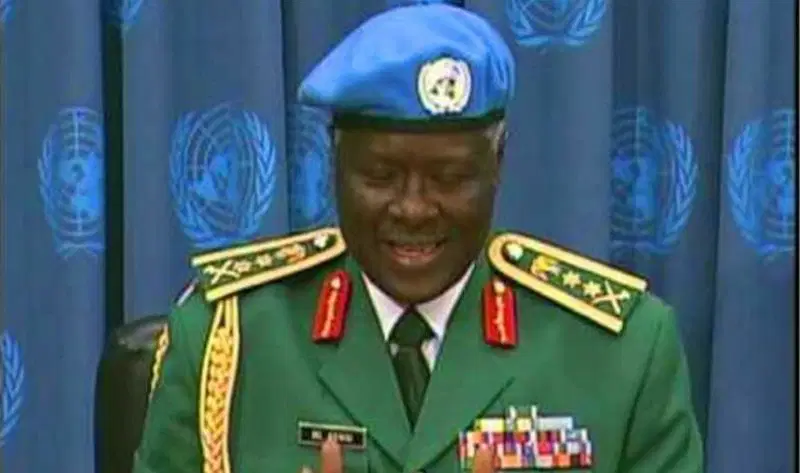
In 2007, Nigerian General Martin Luther Agwai assumed command of the African Union-United Nations Hybrid Operation in Darfur (UNAMID), an unprecedented peacekeeping force. He became its first Force Commander, a role that placed a Nigerian at the helm of the world’s most ambitious joint mission. This assignment highlighted Nigeria’s critical contributions to global stability during a period of immense crisis.
His leadership of UNAMID, formally established on July 31, 2007, was a testament to his distinguished career. Agwai’s journey reflected Nigeria’s deep commitment to international security. It showcased the nation’s capacity to lead complex multinational military efforts on the global stage, much like the dedication of a veteran police chief.
A Nigerian General Led Darfur Peacekeeping Efforts Early in His Career
Martin Luther Agwai, born in Kaduna on 8 November 1948, began his cadet training in 1970. He was commissioned into the Nigerian Army in 1972. His military education included prestigious institutions in Nigeria, Britain, and the United States.
Agwai’s roles covered command, military education, intelligence, and diplomatic assignments. He served as Nigeria’s Military Adviser in Harare and as Chief Instructor at the Command and Staff College in Jaji. These early appointments built a solid foundation for his future international roles.
From Sierra Leone to New York
Agwai’s international experience deepened significantly during his service in the United Nations Mission in Sierra Leone (UNAMSIL). From November 2000 to November 2002, he served as Deputy Force Commander, working closely with Kenya’s Lieutenant General Daniel Ishmael Opande.
Sierra Leone was ravaged by civil war, marked by horrific civilian attacks and mass displacement. Agwai and Opande played a crucial role in disarmament and demobilisation efforts. They helped stabilise the nation by processing tens of thousands of former combatants.
In November 2002, Agwai moved to the UN Headquarters in New York as Deputy Military Adviser. This posting provided invaluable exposure to United Nations peacekeeping operations at a strategic level. It prepared him for even greater responsibilities.
Rise to Nigeria’s Top Military Brass
Returning to Nigeria, Agwai continued his ascent through the ranks. He became Nigeria’s Chief of Army Staff in June 2003, holding the position until May 2006. This was a critical national leadership role.
He then rose to Chief of Defence Staff in June 2006, placing him at the apex of Nigeria’s military establishment. This combination of national command and international peacekeeping experience would prove vital for his next challenge.
By this time, Darfur had become one of the world’s most severe humanitarian crises. The African Union Mission in Sudan (AMIS) struggled to cope with the vast, insecure region and limited resources. A new, more robust approach was desperately needed.
The Birth of UNAMID
International negotiations aimed to restructure the peacekeeping effort in Darfur. The solution was groundbreaking: a joint African Union and United Nations operation, known as UNAMID. This hybrid model sought to merge African political and military commitment with the UN’s institutional might.
On 24 May 2007, General Martin Luther Agwai was appointed Force Commander of AMIS. The appointment came with the clear expectation that he would also command the planned hybrid mission. This ensured seamless continuity between the outgoing and incoming forces.
UNAMID represented an unprecedented experiment in international collaboration. Its design included a unified command structure, with military leadership provided by an African officer. This placed a significant onus on Agwai and his team.
The United Nations Security Council formally authorised UNAMID on 31 July 2007, through Resolution 1769. This resolution sanctioned a massive deployment of up to 19,555 military personnel and thousands of police. UNAMID’s mandate included protecting civilians and aiding the development of an inclusive political future.
Agwai became UNAMID’s first Force Commander, leading its military component from its inception. The mission formally took over from AMIS on 31 December 2007. Its headquarters were established in El Fasher, North Darfur.
Commanding a Challenging Mission
Deploying UNAMID proved immensely difficult despite its ambitious mandate. The mission faced severe shortages of aircraft, transport, and other essential equipment. Personnel arrived gradually, tasked with operating across a vast, hostile territory with poor infrastructure.
Peacekeepers themselves became targets in the volatile region. On 8 July 2008, an attack on a UNAMID patrol in North Darfur killed seven peacekeepers and wounded 22. Such incidents underscored the extreme dangers faced by the mission.
Tragedy struck again on 16 July 2008, when Nigerian Major Shehu Gada was shot dead in West Darfur. Agwai personally visited Nigerian personnel in the area, emphasising the importance of security. The mission navigated a delicate balance, protecting civilians while operating within complex political and practical limitations. The deployment challenges highlighted broader bureaucratic flaws in global operations.
Agwai commanded a multinational force whose effectiveness relied on more than military strategy. Logistics, international diplomacy, troop contributions, and cooperation among numerous institutions were all critical. He guided UNAMID through its turbulent early deployment.
Agwai remained Force Commander until August 2009, overseeing UNAMID’s formative period. Lieutenant General Patrick Nyamvumba of Rwanda succeeded him on 1 September 2009. Agwai retired from the Nigerian Armed Forces in December 2009, ending a career defined by service.
Agwai’s enduring legacy in Darfur
UNAMID continued its operations in Darfur for over a decade after Agwai’s departure, with its mandate adapting to evolving conditions. However, the region’s instability tragically re-emerged with renewed warfare across Sudan in April 2023. Darfur again became a primary theatre of conflict.
The October 2025 offensive on El Fasher resulted in thousands of deaths, demonstrating the persistent challenges of civilian protection. General Martin Luther Agwai’s command of UNAMID remains a significant chapter in Nigerian military history. It exemplifies Nigeria’s crucial role in global peacekeeping efforts.
His career showed how Nigerian officers could attain senior global command positions, building complex multinational forces. This dedication underscores Nigeria’s consistent and vital contribution to international security. It reveals the nation’s deep commitment to peace beyond its borders.
