




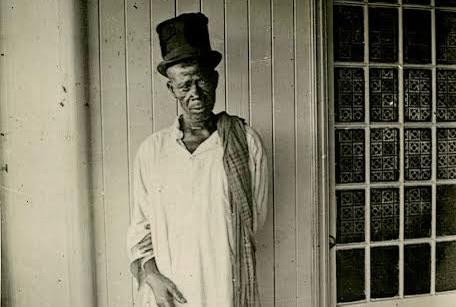
In 1896, King Ibanichuka of Okrika, the Ado VI, was demanded by Britain’s Niger Coast Protectorate Commissioner Ralph Moor to be surrendered into custody. Ralph Moor, the ambitious Commissioner and Consul-General of Britain’s Niger Coast Protectorate, had delivered an ultimatum. Their king, King Ibanichuka of Okrika, the Ado VI, must be surrendered into British custody.
Moor also demanded the destruction of Fenibeso, an important shrine that was a pillar of Okrika’s spiritual and political order.
For twenty years, King Ibanichuka had navigated the treacherous currents of trade, religion, and colonial ambition sweeping the Niger Delta. Now, the tide had turned against him. After tense negotiations, his chiefs made a painful choice.
The coronation of King Ibanichuka of Okrika
They agreed to surrender their king, but only on the condition he be confined nearby in Degema, where they could still visit him. The moment Ibanichuka was taken into custody, his effective reign was over, and the political landscape of Okrika was altered forever.
When Ibanichuka was crowned Ado VI in 1876, he inherited more than just a title. He became the Amanyanabo of a powerful city-state in the complex world of the eastern Niger Delta. Okrika, like its neighbours, was a kingdom built on the control of waterways. Its leaders acted as powerful intermediaries in the lucrative palm oil trade that had come to dominate nineteenth-century European commerce.
Ibanichuka’s path to the throne followed tradition. After the reign of Ado V, King Fibika, the Ado royal house was tasked with selecting a successor. An elderly and respected chief, Abam Dikisikiboka, put forward the name of his younger cousin, Ibanichuka. The kingmakers consented, and a new monarch was crowned.
But he was ascending at a time when the ground was shifting beneath the feet of all Delta rulers. Leaders like King William Dappa Pepple of Bonny had already contended with the growing force of British influence.
The Amanyanabo was no ceremonial figure. He stood at the apex of a commercial system where African rulers and their trading houses managed the flow of produce from the hinterland to the coast. This control was the source of their wealth and political authority.
But European merchants were growing impatient with the arrangement, seeking to bypass the coastal middlemen and trade directly with inland producers. Ibanichuka’s reign would be defined by this escalating tension.
The arrival of the cross in 1881
One of the most significant developments during Ibanichuka’s rule was the formal establishment of Christianity. The faith was not entirely new; historical records from St Peter’s Cathedral in Okrika note that a local chief, Atorudibo, had introduced Christian practices in 1878 upon his return from Bonny.
He was soon joined by other influential figures like Chiefs Inyanaboitamuno George and Ilalamaoku Ogan, who nurtured the small but growing community of worshippers.
As their numbers grew, another chief named Fiberesima demonstrated his support by donating a piece of land for a church. The movement gained significant momentum in May 1881 with the arrival of a pivotal figure: Bishop Samuel Ajayi Crowther. Accompanied by his son, Dandeson Coates Crowther, the bishop’s visit occurred under the official sanction of King Ibanichuka.
Crowther inspected the donated land and formally established the mission that would become St Peter’s. The event showed the king’s diplomatic skill. He could welcome European missionaries and the new faith they brought, engaging with a powerful external institution while simultaneously attempting to resist the political and commercial demands of other foreigners.
This careful balancing act—embracing one form of European influence while opposing another—would become increasingly difficult to maintain.
An 1888 treaty tightens the colonial grip
The next major milestone arrived on May 17, 1888. On that day, a formal treaty was signed between the rulers of Okrika and Great Britain. The agreement was one of many similar “treaties of protection” that Britain was using to formalise its expanding influence across West Africa during the period of intense European imperial competition.
The treaty’s text contained clauses that would have deep and lasting consequences. One provision reserved legal jurisdiction over British subjects and their property within Okrika’s domain, effectively carving out a space where the Amanyanabo’s authority did not apply.
Another part of the treaty sought to define the territorial boundaries of Okrika, a detail that would later become a point of contention in disputes with neighbouring communities like the Kalabari.
For the moment, the treaty did not dismantle Okrika’s political structures. King Ibanichuka remained on his throne for another eight years. But the document was a clear sign of the changing power dynamic.
These treaties increasingly served as the legal pretext for deeper colonial intervention, transforming a relationship of commerce and diplomacy into one of outright political control. The tension between Okrika’s sovereignty and Britain’s imperial ambition was building toward a breaking point.
The final showdown over trade and authority
The conflict that ended Ibanichuka’s reign was fundamentally about economics and power. British officials, backed by commercial interests, were determined to break the coastal states’ control over trade routes to the hinterland’s palm oil markets. Okrika’s entire economic structure was based on maintaining that very control. The confrontation was, in retrospect, inevitable.
The agent of this final push was Ralph Moor, a man determined to convert Britain’s “protectorate” into a directly administered colony. As Commissioner and Consul-General, Moor was relentless in his efforts to consolidate British power. By 1896, his attention was fixed on Okrika. He viewed Ibanichuka not as a partner but as an obstacle to British commercial and political goals.
Moor’s demands were calculated to shatter Okrika’s independence. He insisted Ibanichuka be handed over for confinement and demanded the destruction of the Fenibeso shrine, a powerful symbol of traditional authority. Faced with the threat of overwhelming military force, the Okrika chiefs entered into fraught negotiations.
Their final act of defiance was not to fight a hopeless war, but to bargain for the dignity of their king, ensuring he remained close to his people in Degema. With that, Ibanichuka’s two-decade reign came to a sudden, dramatic end.
A new order and a vacant throne
The removal of King Ibanichuka was immediately followed by a radical restructuring of Okrika’s government. British authorities established a Native Court, a key instrument of colonial rule. This new institution bypassed the traditional monarchy, with colonial officials issuing warrants to local chiefs they deemed cooperative, incorporating them into the new administrative system.
This method of governance, where the Mobee institution and similar traditional structures were co-opted or replaced, was happening across southern Nigeria. In the power vacuum left by Ibanichuka, a new figure rose to prominence: Chief Daniel Oju Kalio. As a literate, English-speaking Christian, Kalio was precisely the kind of leader the British could work with.
He became a vital intermediary, navigating both Okrika’s internal affairs and its relationship with the colonial administration until his death in 1928.
The year 1896 marked more than the fall of a monarch; it was a watershed moment in the transition to colonial rule. The king’s confinement was followed by a long interregnum. For over six decades, the Ado monarchy remained vacant.
It was not until 1959, on the eve of Nigeria’s independence, that the kingship was finally restored with the installation of Zedekiah Fibika as Ado VII.
The portrait that preserved a king’s legacy
After his confinement in 1896, King Ibanichuka faded from Okrika’s political life. His ultimate fate is shrouded in uncertainty. A 1933 colonial intelligence report by District Officer J. C. Porter noted conflicting local traditions: one held that he remained in British custody, while another claimed he escaped from Degema only to drown while trying to make his way back home.
Though his rule ended in defeat, his image survives, thanks to the pioneering work of Jonathan Adagogo Green. The son of a Bonny palm oil merchant, Green became one of the first professional Nigerian photographers, creating an invaluable visual record of the Niger Delta’s rulers, merchants, and communities at this critical juncture in history.
His work provides a rare window into a world undergoing profound transformation.
A portrait, held today by the National Museums Liverpool and dated to around 1897, shows King Ibanichuka. It is a powerful and haunting image, the face of a monarch who ruled at the precise moment when an old political order gave way to the force of a new empire.
More than a century later, it remains a compelling record of a leader who negotiated with missionaries, signed treaties with empires, and ultimately defended the sovereignty of his people until he could defend it no more.
