




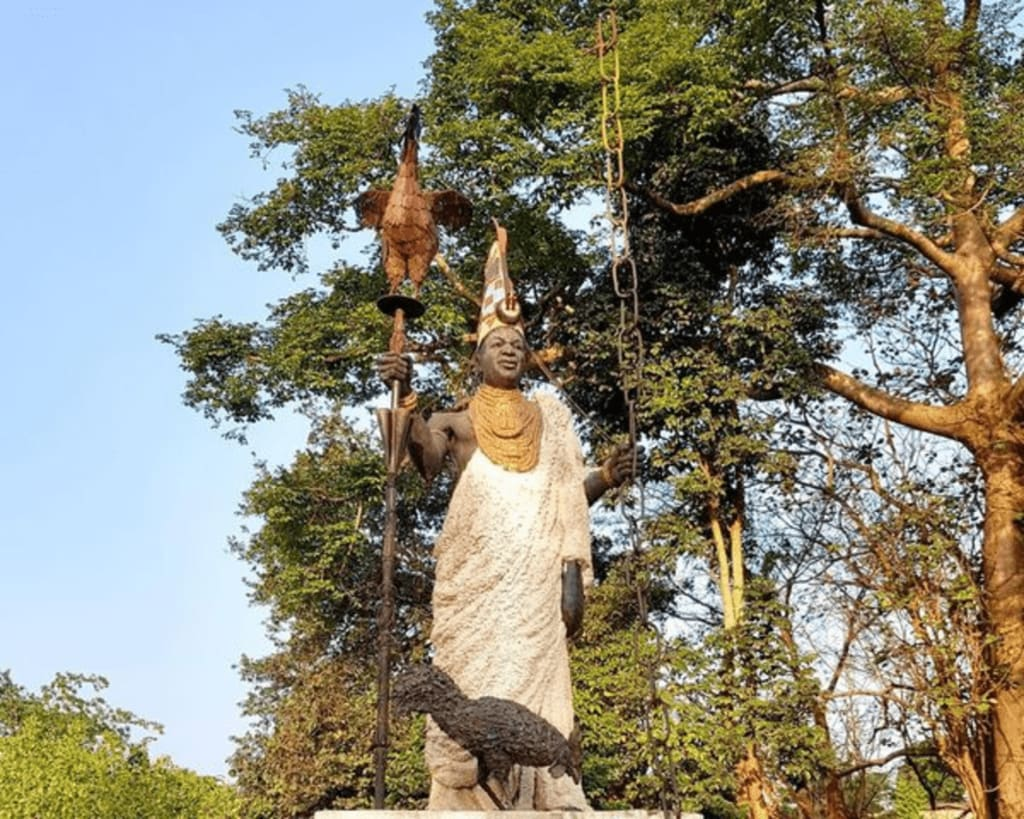
In the primordial realm, where sky met a vast watery expanse, a singular act of creation unfolded. Olodumare, the supreme deity, set a momentous task: to bring solid ground into being. This was the dramatic stage for Oduduwa, the revered progenitor of the Yoruba people, whose descent would fundamentally alter the world and lay the bedrock for all Yoruba kingship, originating from Ile-Ife.
He arrived not with a thunderclap, but with the quiet purpose of a divine emissary. Suspended by a chain, Oduduwa carried a handful of earth and a sacred cockerel to Ile-Ife, a place then covered by endless water. With these tools, he scattered the earth, and the cockerel scratched it, expanding the land until Ile-Ife emerged as the world’s first solid ground.
A descent from the heavens: Creation at Ile-Ife
This foundational event made Ile-Ife the legendary birthplace of humankind. It became the sacred spot where the Yoruba believe creation unfolded, a holy city in present-day Osun State, Nigeria. Oduduwa’s role transcended mere myth; it defined a spiritual geography for an entire civilization.
His actions were not merely geological; they were theological, intertwining the very land with divine will. This initial act of creation at Ile-Ife established it as a sacred center, a spiritual heartland from which all subsequent Yoruba identity would flow. It also paved the way for figures central to Yoruba cosmology, shaping a spiritual complex role in beliefs.
From this singular moment, Oduduwa transformed from a divine agent into the symbolic first ruler. His descent and subsequent land-shaping marked the inception of an organized authority. This established the foundational principle that leadership in Yorubaland was divinely sanctioned and intricately linked to Ile-Ife’s sacred origins.
An earthly journey: Oduduwa’s arrival and reign
While the celestial descent remains the dominant narrative, other Yoruba traditions offer different accounts of Oduduwa’s origins. Some narratives describe him as arriving from a community called Oke-Ora or migrating to Ile-Ife from somewhere to the east. Others suggest Ile-Ife was already inhabited when he appeared.
Regardless of his exact point of origin, Oduduwa emerged as a figure of immense political significance. Historians and archaeologists estimate his kingly existence to the Late Formative Period of Ife, roughly between 800 and 1000 CE. J. ‘Sina Ojuade specifically dates the start of this dynasty to 1000 AD.
He became the first Olofin of Ile-Ife, holding the title Olofin Adimula and Olofin Ayé, establishing a new political order. He ruled briefly, but his influence was profound, setting the precedent for subsequent sacred kingship. His reign solidified Ile-Ife’s position as a political and spiritual capital.
Oduduwa died peacefully in Ile-Ife, but his story didn’t end there. He was deified after his death, becoming a revered ancestor worshipped by the Ife people to this day. This deification reinforced the sacred nature of the kingship he initiated, imbuing it with enduring spiritual authority.
Ile-Ife’s flourishing: A medieval urban powerhouse
The history of the wider Yoruba region stretches back far beyond Oduduwa’s era. Archaeological research shows ancient human occupation across southwestern Nigeria for thousands of years. Sites like Iwo Eleru preserve evidence of communities thriving long before Ile-Ife’s golden age.
But Ile-Ife truly ascended between approximately 1000 and 1400 AD. Archaeologist Akinwumi Ogundiran terms this the era of Classic Ile-Ife, recognizing its pivotal role in the broader development of early Yoruba urbanism. The city quickly became a beacon of culture and power.
During this period, Ile-Ife became renowned for its specialized craftsmanship and sophisticated artistic production. Its artists created naturalistic terracotta sculptures and exceptional copper-alloy works. These pieces, including the famous metal heads, remain among the most celebrated achievements of African art.
Dating to the fourteenth and early fifteenth centuries, these works demonstrate advanced lost-wax casting techniques and extraordinary artistic skill. Ile-Ife supported a complex society of specialized craftsmen, religious authorities, and royal institutions. This artistic prowess underscored the city’s economic and political strength.
The physical evidence of Ile-Ife’s might included extensive settlements, organized compounds, and a vibrant urban life. Its artistic materials, like those used in metalworking and glass production, indicate far-reaching commercial connections. Ile-Ife was deeply integrated into regional and long-distance trade networks, fueling its prosperity.
Spreading the legacy: The expansion of Yoruba royalty
Oduduwa’s most enduring legacy lies in his role as the progenitor of numerous Yoruba royal houses. Founders of important kingdoms across Yorubaland are identified as his children, grandchildren, or direct descendants. This genealogical web connected rulers to Ile-Ife and solidified the city’s exceptional position.
Traditional accounts speak of Oduduwa’s sixteen sons who left Ile-Ife to establish their own kingdoms, spreading the Yoruba people across the region. This included powerful lineages such as those of the Alaafin of Oyo, the Awujale of Ijebuland, the Oba of Benin, and the Olu of Warri. Each new city-state looked to Ile-Ife as its ancestral source.
Historian R. C. C. Law extensively explored the political significance of these genealogies. If rulers shared an ancestral family originating from Ile-Ife, questions of seniority and authority became intrinsically linked to their descent. This common heritage fostered both unity and complex rivalries among the expanding Yoruba states.
Even as other Yoruba states like the Oyo Empire grew in political and military power during the seventeenth and eighteenth centuries, Ile-Ife retained its profound ancestral and sacred prestige. Its spiritual authority remained paramount, even when its direct political influence waned. This duality shaped the political geography of Yorubaland, where different forms of power coexisted.
Scholars continue to unearth history and refine our understanding of these complex dynastic relationships. Yet, the foundational link to Oduduwa persisted as a core element of royal legitimacy, a thread woven through centuries of political evolution.
The living throne: Oduduwa’s legacy in modern Ile-Ife
The association between Oduduwa and Ile-Ife continues vibrantly today through the institution of the Ooni. The Ooni of Ile-Ife, the distinctive royal title for its ruler, is believed to be a direct descendant of Oduduwa. This makes the Ooni the spiritual leader of the Yoruba people, a custodian of a heritage dating back over a millennium.
The present monarch, Oba Adeyeye Enitan Ogunwusi Ojaja II, embodies this living legacy. Born in 1974, he became the 51st Ooni of Ife in 2015, following the passing of Oba Okunade Sijuwade Olubuse II. He holds the esteemed title Arole Oduduwa, meaning heir or successor to Oduduwa, a powerful expression of continuity.
His public coronation ceremony took place in Ile-Ife on December 7, 2015, making him the formal bearer of Oduduwa’s sacred lineage. The Ile Oodua Palace in modern Ile-Ife remains an active royal court. It meticulously maintains the traditions of Oduduwa through continuous ceremonies and cultural practices, keeping the past alive.
Today, Ile-Ife is a city of approximately 500,000 people, blending ancient heritage with modern dynamism. It’s home to Obafemi Awolowo University, established in 1962, a leading academic institution and a center for Yoruba studies. The Ife Museum, founded in 1954, houses an exceptional collection of pre-colonial African art, preserving the city’s artistic achievements.
The Ooni’s role extends beyond ritual. He is a prominent figure in cultural diplomacy and the preservation of Yoruba heritage, ensuring Oduduwa’s influence remains relevant. This makes Ile-Ife a dynamic center where history, spirituality, and modern life intertwine, a testament to the enduring power of its founding narratives.
The significance of Oduduwa’s legacy is deeply embedded in the cultural fabric, guiding traditions and shaping contemporary identity.
Oduduwa’s legacy is not a static historical artifact but a dynamic cultural force. It continues to shape Yoruba identity, providing a shared language for ancestry, royal legitimacy, and sacred geography. More than a millennium after the rise of medieval Ile-Ife, the foundational events initiated by Oduduwa remain central to how Yoruba royal history and ancestral identity are remembered and lived.
