



In September 1901, the Lagos port shimmered under the tropical sun as three unusual articulated steam locomotives arrived from Leeds, England. Among them was Lagos Government Railway No. 101, built by the Hunslet Engine Company. This machine wasn’t just another engine; it was a cornerstone of an ambitious transport system designed to knit together a rapidly expanding colonial capital.
This locomotive and its two siblings, Nos. 102 and 103, were destined for the Lagos Steam Tramway. This narrow gauge urban railway aimed to solve a critical geographical puzzle in early 20th-century Lagos. It would connect Lagos Island, the commercial heart, with the mainland railway terminus at Iddo.
The Lagos Steam Tramway’s birth
The story of Lagos Government Railway No. 101 is inseparable from the larger narrative of Nigeria’s burgeoning railway network, which aimed to unlock the agricultural wealth of the interior.
This new mainline transformed the movement of goods and people between Lagos, Abeokuta, and Ibadan. Produce could travel to the coast more efficiently, while imported goods made their way inland. But a significant hurdle remained. The main railway’s terminus sat at Iddo, separated from Lagos Island, where commerce, government, and much of the population resided.
Passengers and freight reaching Iddo still needed a reliable connection into the bustling island. Colonial authorities soon envisioned a light tramway to bridge this vital gap, running between Lagos Island and Iddo. This new system would crucially cross Carter Bridge.
It was a clear effort to expand colonial transport into the very heart of the capital. For a deeper dive into pre-independence railway operations, explore how these early links shaped the nation.
A narrow gauge for Lagos’ unique demands
The solution wasn’t to simply extend the mainline railway. The Lagos Steam Tramway was built to a much narrower gauge of 2 ft 6 in, or 762 mm.
This specific design choice reflected the challenging topography of Lagos Island itself. The tramway had to operate through an urban environment with extremely sharp curves, and faced restrictions on Carter Bridge.
These physical demands meant a standard locomotive wouldn’t suffice. The answer was an articulated design. This allowed a small and flexible machine to navigate the tight urban alignment, unlike the heavier engines of the main lines.
Hunslet’s engineering for challenging terrain
The initial motive power for this specialised tramway came from the Hunslet Engine Company of Leeds. This British manufacturer had already established a strong reputation. They were known for producing robust industrial and narrow gauge locomotives suitable for demanding conditions.
The locomotives themselves were a product of collaboration. The Crown Agents for the Colonies had designed these engines specifically for the challenging conditions of the Lagos route. Their arrival in Lagos in September 1901, well before the tramway’s public opening, marked a key stage in the system’s development.
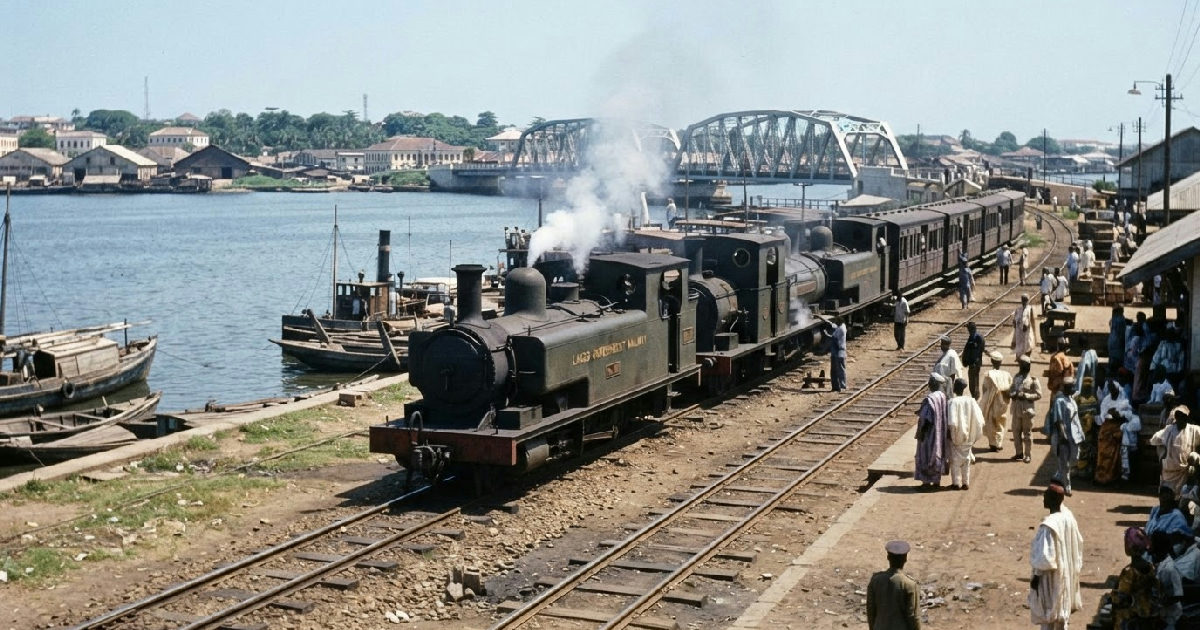
Photographs of Lagos Government Railway No. 101 reveal a machine quite unlike a standard railway tank engine. It featured a powered locomotive section connected to a trailing four-wheel portion, which included an enclosed, van-like compartment. Together, they formed an articulated vehicle designed for maximum flexibility.
This articulated construction was key to negotiating the tight urban alignment and distributing the locomotive’s weight effectively. Published specifications record outside cylinders measuring 6¼ inches by 8 inches. Its driving wheels were about 1 foot 6½ inches in diameter. These dimensions highlight how small these engines were compared with main line locomotives.
The compartment’s function
The enclosed compartment, a van-like section forming an integral part of its articulated rear, was used for transferring mail and parcels from Customs Wharf and the General Post Office to Iddo.
The compartment also served in the transfer of mail and parcels, aligning with the tramway’s connections to railway and postal facilities. It served its purpose within the larger story of large-scale urban planning in Nigeria’s history.
“Kokomaiko” in colonial Lagos
The Lagos Steam Tramway formally entered public service towards the end of May 1902. Railway histories pinpoint May 23, 1902, as the official opening date. The new service connected Lagos Island with the railway terminus at Iddo, facilitating the movement of both people and merchandise. It increasingly became part of the city’s transport network, incorporating seven passing loops and sidings.
The original line ran north-west along the waterfront from near Government House and the European residential area around the Racecourse, to Customs Wharf, then turned north-east towards Ereko Market and Idumota, and over Carter Bridge to Iddo.
Its route mileage was 2 miles 58 chains, with a running time of 21 minutes, achieving an average speed of 7 ¾ mph. Service frequency improved from an initial 45 minutes to 30 minutes headway.
The tramway offered fares such as 3 pence “all the way,” 2 pence from Public Works Department (PWD) to Iddo, and 1 pence from Ereko Market to Iddo. The first tram departed at 6:30 AM to connect with the 7:00 AM mainline train from Iddo to Ibadan.
There was no running after dark; the last tram was around 7:00 PM. Known affectionately as “The Kokomaiko,” the tramway’s nickname phonetically illustrated the sound made by the locomotives as they chugged through the streets.
Beyond passengers: the Sanitary Tramway
The public steam tramway had a relatively short operational life, carrying passengers and goods until the close of 1913. Passenger operations officially ended on January 1, 1914, marking the end of an era for public transport.
But tramway activity did not immediately disappear from Lagos. A separate Lagos Sanitary Tramway, established in 1906 for municipal operations, continued working. This sanitary tramway was specifically used for the removal and transportation of refuse. It remained in operation until 1933, nearly two decades after the public passenger service had ceased.
The two systems, therefore, occupied overlapping but distinct places in Lagos transport history. The Lagos Steam Tramway provided commercial and passenger transport. The sanitary tramway continued serving crucial municipal purposes long after its public counterpart vanished, even employing two 0-4-0 saddle tank locomotives from WG Bagnall of Stafford for the heavy work. One of these was notably named “Kokomaiko.”
An enduring legacy of urban connectivity
The original three articulated engines were not the end of this unique design. In 1910, two additional locomotives were supplied for the Lagos system, becoming Lagos Government Railway Nos. 104 and 105. These later engines were identical in general concept but incorporated modifications, including larger 45-gallon water tanks instead of the original 30-gallon ones. They cost £718 each, free on board Liverpool.
Their arrival demonstrated that the articulated locomotive arrangement remained useful enough for the railway administration to order additional examples. By this time, the Lagos Steam Tramway had been operating for almost a decade. It had become an established and vital part of the city’s transport infrastructure. Its influence stretched across the growing city, creating a lasting blueprint for urban connections.
Surviving photographs and railway documentation are especially valuable. These records preserve the appearance of an unusual class of locomotive, created for a very specific urban environment as a testament to colonial-era engineering solutions.
The story of Lagos Government Railway No. 101 also reveals how railway development in colonial Nigeria extended beyond the great main line routes. Lagos required something different. The railway terminated at Iddo, while commerce, government activity, and much of the urban population concentrated across the water on Lagos Island.
Connecting those spaces required a smaller railway capable of operating across Carter Bridge and through Lagos streets, anticipating future challenges in Nigeria’s national railway system.
The answer was the Lagos Steam Tramway and specialised locomotives such as No. 101. This system belonged to a period when railway construction was fundamentally reshaping movement between Lagos and the Nigerian interior. The tramway extended that transformation into the urban heart of the colonial capital.
A section of its track, found buried under a roadway during public works excavations, is now on display at a museum in Ebute Metta, a tangible link to this crucial era. This demonstrates how Lagos was already confronting the challenge of connecting island and mainland transport networks more than 120 years ago.
