




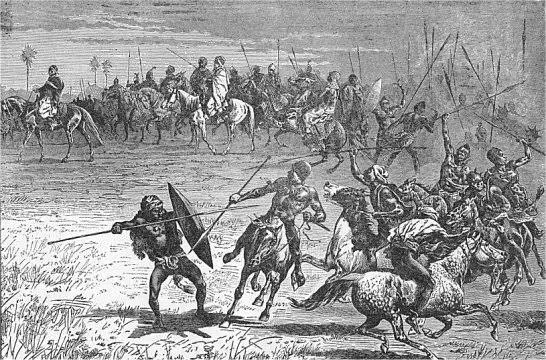
In the tense twilight of nineteenth-century Yorubaland, military encounters decided the fate of entire towns. The Midnight Assault at Osogbo was one such pivotal event.
The conflict was part of the larger Yoruba Revolutionary Wars and Fula jihads. Combined forces from Ibadan and Osogbo achieved a significant victory through a strategic night attack, demonstrating tactical brilliance against an army with a formidable cavalry tradition. Ibadan’s commanders recognized the danger of fighting mounted forces in open terrain, choosing instead to wait for darkness.
From Oyo’s crisis to Ilorin’s emergence
The Battle of Osogbo did not occur in isolation. It was a direct consequence of the dramatic collapse of the old Oyo Empire, which had dominated a vast political and commercial system throughout the eighteenth century. By the close of that century, internal political struggles and military pressures significantly weakened Oyo’s once-unrivalled authority.
A central figure in this crisis was a powerful military commander based at Ilorin. During a political confrontation that ended the reign of Oyo’s ruler, this commander marched against Oyo. Historical scholarship places this decisive confrontation around the late 18th century, when the ruler was reportedly forced to commit suicide.
Ilorin’s growing independence
The political instability deepened in the following decades. Ilorin steadily asserted its independence from the remnants of the old Oyo order. The commander drew upon Muslim fighting groups and developed an association with an influential Muslim cleric of Fulani background. After the commander’s death, political control in Ilorin shifted further towards this cleric’s descendants and their allies.
Ilorin later emerged as an emirate, forging strong political and religious ties with the Sokoto Caliphate. Yet, the ensuing conflict should not be simplified as a straightforward struggle between Yoruba and Fulani peoples. Ilorin itself developed within an earlier Yoruba political setting, and its society and military included Yoruba, Hausa, and Fulani elements. Commanders from Yoruba communities also fought on the Ilorin side.
Osogbo under pressure: Ibadan’s response
As the old Oyo Empire disintegrated, widespread warfare drove large populations southwards. This movement led to the creation of new settlements and military centres. Osogbo was one of the towns transformed by these demographic shifts, its population and strategic importance growing with refugees from troubled parts of the old Oyo country and neighbouring areas.
This upheaval also contributed to the rise of other powerful successor centres, notably Ibadan.
By the 1830s, Ibadan had established itself as an increasingly formidable military state. Its political system elevated successful war chiefs, and its armies became deeply involved in conflicts across Yorubaland. Meanwhile, Ilorin had become one of the most dangerous military powers confronting the remnants and successor communities of Oyo. It was against this backdrop that Ilorin again moved against Osogbo.
The tactical challenge facing Ibadan’s forces
The confrontation was described as an Ilorin siege of Osogbo. The attacking army, led by an experienced commander, pressed the defenders heavily and gained ground in repeated fighting. The ruler of Osogbo appealed to Ibadan for help. Ibadan initially dispatched auxiliary forces, but these reinforcements proved insufficient to reverse the situation. Further assistance was sent, but the defenders remained under pressure.
The seriousness of the siege eventually prompted Ibadan to commit a much stronger force. A leading Ibadan commander marched towards Osogbo with other senior war chiefs. This commander’s office was important, representing a position of commander-in-chief within Ibadan’s military establishment. The army reached Osogbo only to face a major tactical problem.
Ilorin’s cavalry dictates a shift in strategy
Ilorin’s mounted forces were particularly dangerous in open country. Records indicate that the Ibadan troops were reluctant to expose themselves outside the defensive thickets surrounding Osogbo, fearing the Ilorin cavalry. For a period after their arrival, they did not venture into a major open confrontation, instead remaining cautious.
This delay highlights an important aspect of nineteenth-century warfare in the region. Military commanders carefully considered terrain, mobility, visibility, and the strengths of opposing forces before committing to battle. Osogbo’s terrain meant cavalry could pose a serious threat if fighting moved into sufficiently open ground. The Ibadan commanders therefore sought a way to diminish Ilorin’s advantage.
The calculated decision for a night assault
Their initial plan was an afternoon attack, with the hope that continued fighting into dusk would hinder mounted troops. Darkness could also provide cover for an Ibadan retreat if the attack failed. However, the commanders reconsidered this approach.
They eventually decided to delay their advance until nightfall and conceal their movements for as long as possible. This was a calculated attempt to fundamentally alter the conditions of the battle, leveraging surprise.
As the sun set, the allied force began moving towards the Ilorin positions. About a mile from the enemy camp, the army organized itself for the assault. The Osogbo forces and earlier auxiliaries occupied the centre. Other chiefs commanded the right, while a leading Ibadan commander and other war chiefs formed the left.
At about midnight, the attack began. The attackers reportedly used a specific challenge, referring to the fare paid at the river crossing, to identify friendly troops in the darkness, a detail locally meaningful due to the River Osun.
The midnight assault: a chaotic turning point
The surprise was devastating. One section of the Ilorin encampment was attacked and set on fire. Soldiers, awakened suddenly in darkness, struggled to organize an effective defence. The conditions that had previously favoured Ilorin’s mounted troops were now transformed, limiting their effectiveness. Confusion reportedly spread among horsemen forced to react blindly.
Whatever the precise sequence inside the camp, the assault plunged the Ilorin army into disorder, causing their position to collapse.
The Ilorin commander managed to gather part of his cavalry and break through the attacking forces. The siege of Osogbo had been broken, with Ibadan and Osogbo achieving a significant victory. This decisive confrontation, known as the Battle of Osogbo, became a pivotal moment in the struggle for regional dominance.
Why Osogbo’s victory mattered
The consequences of the Battle of Osogbo extended far beyond the survival of one town. Ilorin had grown into a formidable military force following the destruction of the old Oyo order, with its armies significantly reshaping northern Yorubaland. Osogbo demonstrated that its advance could be stopped. This victory was regarded as a turning point in the history of the region.
The subsequent growth of Ibadan further illustrates how important the battle became in the changing political balance. Ibadan emerged from the confrontation with increased prestige. Its armies would subsequently intervene repeatedly across Yorubaland, sometimes protecting allied communities and sometimes expanding Ibadan’s own political authority. In the decades that followed, Ibadan developed into an influential power in its own right.
Enduring rivalries and regional power shifts
The victory at Osogbo was therefore not merely defensive. It formed part of the larger process through which Ibadan became one of the principal successor powers to emerge from the collapse of Oyo. However, the Battle of Osogbo did not permanently remove Ilorin from regional political or military affairs.
Ilorin remained powerful, continuing to fight, intervene, and form alliances with forces opposed to Ibadan in later conflicts. Competition between these two powers persisted for decades, intertwined with wider struggles involving other communities.
Osogbo should not be viewed as the final military defeat of Ilorin, nor as the moment that inevitably determined the political future of every town in the region. The area remained divided among several competing powers, each with its own interests, alliances, and military strength.
The importance of Osogbo rests on what actually followed: Ilorin’s advance was checked, Osogbo survived the siege, and Ibadan emerged with greater military authority, fundamentally altering the balance of power.
A complex conflict: beyond simple divisions
Popular historical retellings sometimes simplify the complex nineteenth-century wars, reducing them to a straightforward conflict between different ethnic groups. However, the historical reality was far more nuanced. Ilorin itself had deep roots within the earlier Oyo political environment. The initial figure who asserted Ilorin’s independence was a Yoruba military commander.
While Ilorin’s subsequent leadership aligned with the Sokoto Caliphate, its population and military institutions were a diverse mix, incorporating people of Yoruba, Hausa, and Fulani backgrounds. A commander for Ilorin at Osogbo was identified as Hausa, and notably, Yoruba commanders also served with Ilorin forces. This internal complexity shows these were not simply ethnic wars.
Throughout the nineteenth century, communities in the region frequently engaged in warfare against other communities.
This indicates that while religion and ethnicity played roles, they existed alongside more fundamental conflicts over sovereignty, trade routes, tribute collection, territorial control, and regional supremacy. Understanding this intricate historical reality makes the Battle of Osogbo even more significant.
It places the engagement where it truly belongs: within the violent, multi-faceted struggle to forge a new political order in the aftermath of the old Oyo Empire’s collapse. It was a time when allegiances were fluid, and the identity of the region was being shaped in the crucible of conflict.
The Battle of Osogbo, fought circa 1840, was a pivotal military engagement that decisively halted the southward expansion of the Ilorin Emirate and the Sokoto Caliphate into the Yoruba heartland.
This conflict, part of the larger Yoruba Revolutionary Wars and Fula jihads, saw the combined forces of Ibadan and Osogbo achieve a significant victory through a strategic night attack. This decisive check on expansion had lasting ramifications for the cultural and political development of Yorubaland.
