




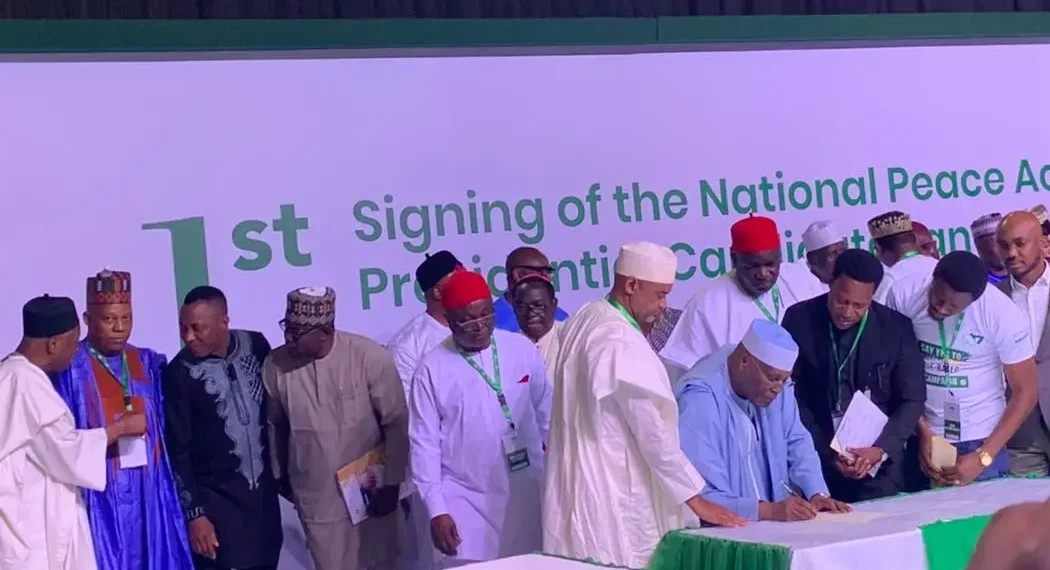
The 2027 Electoral Peace Accord, signed by political candidates on August 18, 2026, at the Bola Ahmed Tinubu International Conference Centre in Abuja, is a system designed to foster electoral peace.
Adewole Adebayo, the 2027 presidential candidate for the Social Democratic Party (SDP), did not just sign the document; he used the moment to deliver a stark message: there can be no genuine peace without justice in Nigeria’s electoral process, casting a shadow over the accord’s efficacy.
The electoral peace accord system in Nigeria
Adebayo’s intervention went straight to the heart of a recurring national debate, intensified by President Bola Ahmed Tinubu’s conspicuous absence from the ceremony. For many, the president’s decision to send a representative, George Akume, the Secretary to the Government of the Federation, signaled a lack of commitment. It raised questions about the moral weight of an agreement designed to foster peace and transparency.
The practice of electoral peace accords isn’t new to Nigeria. Over recent election cycles, notably in 2019 and 2023, similar agreements have been brokered by the National Peace Committee, in partnership with entities like the Kukah Centre. These accords aim to secure commitments from political actors to conduct issue-based campaigns, shun violence, avoid hate speech, and uphold the integrity of the electoral process.
But for critics like Adebayo, these agreements have become more of a symbolic gesture than a substantive safeguard. He argues that the recurring violations of past accords, often without meaningful consequences, have undermined their credibility. This system, he contends, has learned to perform the ritual without truly internalizing its spirit, revealing a complex institutional challenge.
This raises a fundamental question about the evolution of conflict resolution mechanisms within Nigeria’s political landscape. What began as a sincere attempt to de-escalate tensions and foster good conduct has, in some views, ossified into a predictable pre-election event, whose outcomes are less about transformed behaviour and more about optics.
Adebayo’s challenge to the electoral system
Adewole Adebayo’s critique extends beyond the specific signing ceremony to the broader architecture of Nigeria’s electoral system. He insists that true peace isn’t something found by searching for it, but rather an automatic byproduct of justice. “Electoral justice will bring peace automatically,” he stated, outlining a vision where every participant follows the law without exception.
He envisions a system where the government of the day doesn’t interfere, where the Independent National Electoral Commission (INEC) operates with genuine independence, and where voters can cast their ballots freely, unburdened by inducement or harassment.
For Adebayo, the sanctity of the vote—its mathematical and arithmetical exactitude—is the bedrock upon which lasting peace must be built. His party, the SDP, consistently campaigns on issues, avoiding personal attacks, hate speech, or the divisive politics of identity.
The cost of presidential commitment
Central to Adebayo’s argument is President Bola Tinubu’s absence from the peace accord signing. He didn’t just call it a missed opportunity; he said, “This is an insult to the process,” calling it a “wrong signal” to political actors. This challenges the perceived moral authority and commitment of the nation’s highest office.
Adebayo drew a parallel to contractual law, suggesting that a delegation to sign such a significant commitment might render it invalid. He believes that the President, as a moral leader, has a constitutional mandate to uphold the principles of free, fair, and credible elections. His non-attendance, therefore, speaks volumes about the executive’s perceived commitment to electoral integrity, and potentially, to the system of accountability itself.
Echoes of past agreements: when accords fall short
The skepticism surrounding the 2027 Peace Accord isn’t isolated. It stems from a history where similar agreements have been signed with fanfare, only to see their tenets violated in the heat of campaigns and during the electoral process itself. The 2019 and 2023 elections, for instance, were preceded by accords intended to prevent violence and ensure civility.
Yet, incidents of intimidation, vote-buying, and even violence continued to mar various polls, according to Adebayo. He argues these realities underscore a profound disconnect between the high-minded declarations of peace accords and the grim realities on the ground. He also queried, “How do you expect justice to be done by those who violate the rules?”
This historical pattern reveals a flaw not just in the execution of specific agreements, but in the underlying electoral system. If signed agreements can be disregarded with impunity, then the agreements themselves become performative rather than transformative. The question then becomes: what purpose do they truly serve beyond offering a temporary veneer of order?
Beyond the signature: reforming electoral integrity
For many, the problem isn’t the idea of a peace accord, but rather the failure of the broader institutional framework to enforce its principles. Adebayo advocates for significant systemic changes, starting with strengthening INEC. He insists that the electoral body must be truly independent, both operationally and financially.
Adebayo suggested President Tinubu’s government had put INEC in a position where it cannot plan properly, claiming they are “holding its money. They are holding it to ransom.” An independent INEC, free from executive influence, is crucial for ensuring a level playing field and building public trust. It’s a long-standing call that echoes through Nigeria’s democratic journey, often linked to broader societal stability.
Beyond INEC, Adebayo also demands that law enforcement agencies—the police, Department of State Services (DSS), civil defense, and military—remain strictly neutral during elections. He argues that their presence should not be a tool for political intimidation or manipulation, but rather a guarantee of security for all participants. Such neutrality, he believes, would remove a significant source of electoral conflict and intimidation.
The President’s shadow: delegated commitment and moral leadership
President Tinubu’s decision to delegate his attendance to the Secretary to the Government of the Federation, George Akume, stirred considerable debate. While some might argue that the SGF represents the presidency, Adebayo views it as a slight, suggesting that certain commitments, particularly those touching on the moral fabric of the nation, require the principal’s personal presence.
Adebayo views this delegation as a slight, suggesting that certain commitments, particularly those touching on the moral fabric of the nation, require the principal’s personal presence. For him, it isn’t simply a matter of state protocols; it’s about the perception of leadership and setting the right example for the entire political class and the citizenry.
In his view, President Tinubu has been “missing in action” in public engagements, suggesting a deeper issue than mere scheduling conflicts. This absence, particularly from an event designed to foster electoral peace, signals a potential disconnect between the executive and the commitment required to ensure a truly fair democratic process. It challenges the very notion of presidential moral leadership in upholding democratic tenets.
Calls for systemic reform and accountability
Adewole Adebayo isn’t just identifying problems; he’s advocating for specific systemic reforms. He pledged that if he were to become president, he would actively work to change existing laws that grant the president undue control over INEC’s finances. His vision is for a truly independent electoral commission, unshackled from executive influence.
This commitment to legislative change reflects a belief that the current “system” inherently creates vulnerabilities that undermine electoral integrity. The focus isn’t on individual malfeasance alone, but on the structural incentives and disincentives that allow such problems to persist. Changing the law, he argues, is a prerequisite for a truly free and fair election.
He also emphasized the need for law enforcement agencies to be “totally agnostic to politics,” meaning they should not take political instructions or influence electoral outcomes. Such neutrality, he believes, would remove a significant source of electoral conflict and intimidation.
Without these fundamental changes, peace accords will remain what he sees as mere paperwork, devoid of transformative power, much like political campaigns are judged by their practical impact.
The future of Nigeria’s electoral system: justice as a cornerstone
The conversation ignited by Adewole Adebayo after the 2027 Electoral Peace Accord signing pushes beyond the superficiality of symbolic gestures. It forces a national introspection into whether Nigeria’s current electoral system is genuinely designed to deliver justice, and by extension, lasting peace.
His arguments suggest that without fundamental structural adjustments, particularly regarding the independence of key institutions like INEC and the neutrality of security forces, these accords will continue to fall short.
The challenge for Nigeria, as it looks towards 2027 and beyond, is to move from merely signing agreements to actively building a system where democratic principles are non-negotiable. It requires addressing the root causes of electoral disputes and violence, rather than simply papering over the cracks with periodic peace pacts.
The question remains whether the political will exists to undertake these deeper, more enduring reforms that truly embed justice at the heart of the electoral system.
