




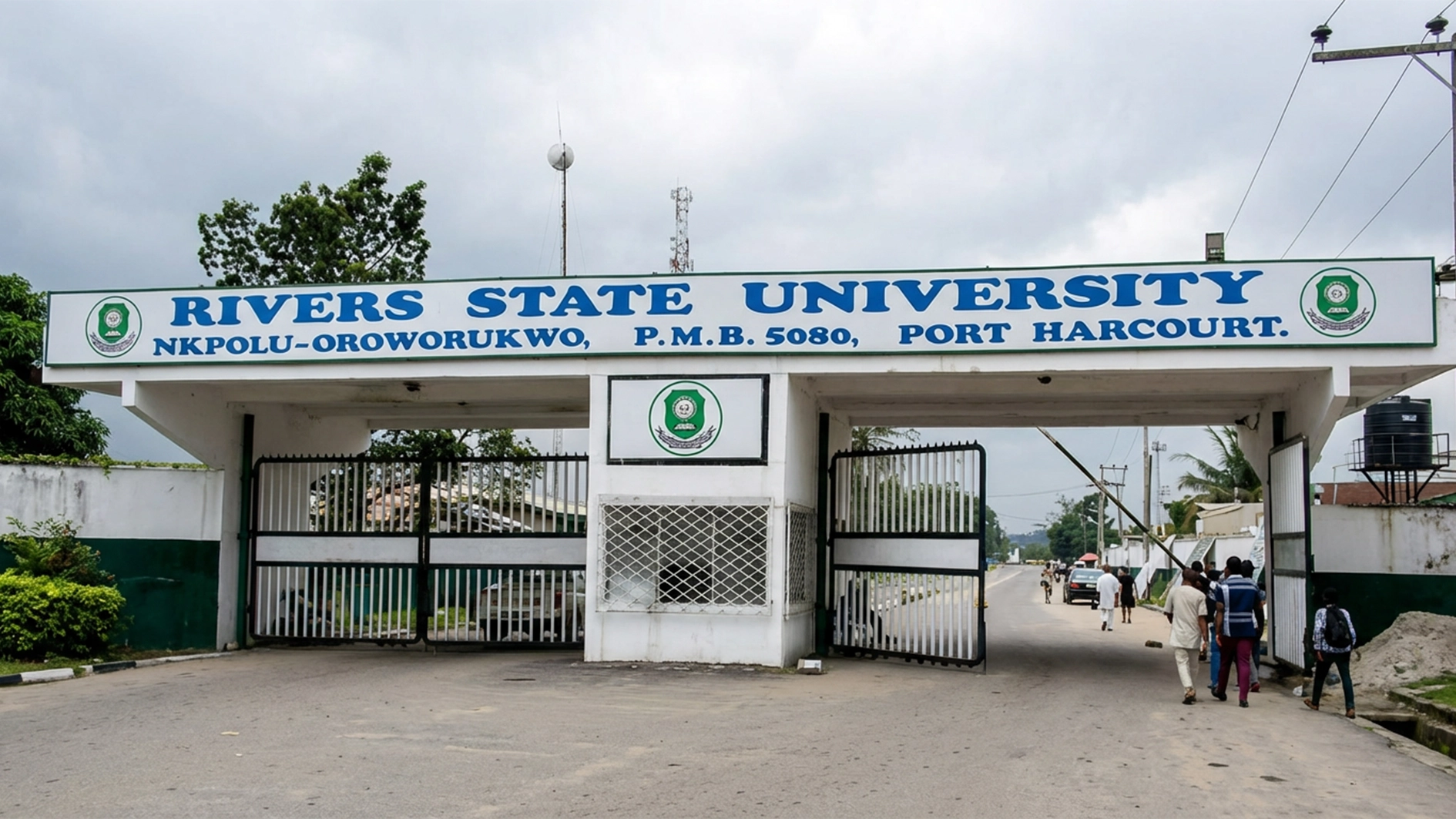
Today, the Rivers State government talks about its Internally Generated Revenue (IGR) in tens of billions of naira per month. Institutions like the Rivers State University (RSU) now measure their earnings in billions annually.
But this dramatic overhaul of the Rivers State revenue system was forged not in a state treasury or a boardroom, but from a student dormitory in Port Harcourt over two decades ago.
The leaky pipes of the old Rivers State revenue system
The system that plugs revenue leakages across the state—from taxes to university fees and court filings—traces its origins back to the year 2000. It started with a group of engineering students who had a simple, ambitious idea: to use technology to solve the problem of exam malpractice they saw all around them.
Before digital transformation, collecting public revenue in Rivers State, like in many parts of Nigeria, was a notoriously inefficient process. For decades, the state relied on manual systems that were slow, cumbersome, and riddled with opportunities for corruption. Cash transactions, paper receipts, and manual reconciliations meant a significant portion of potential government revenue never made it into official coffers.
This wasn’t just a problem for the state’s tax agency. Public institutions felt the strain acutely. At the then University of Science and Technology (UST), annual revenue hovered between N360 million and N400 million. Students endured long queues for registration and often waited until their final year to see an official statement of their academic results. The system was broken.
By 2017, the state government had already run two separate, failed biometric exercises in an attempt to sanitise its payroll and eliminate ghost workers. These efforts had collapsed, unable to overcome the deep-seated “human factor” and resistance to change.
It was clear that technology alone wasn’t the answer; a different kind of system was needed, one built on a foundation that could withstand the pressures of the old ways.
An idea born during an ASUU strike
That new system began with Asawo Ibifuro and his friends on campus. While mooting the idea in 2000, it was an Academic Staff Union of Universities (ASUU) strike in 2002 that gave them the time to turn their concept into a real product.
They developed a piece of software they called “BrainFriend,” an e-learning tool with past questions, electronic textbooks, and video lessons designed to help students prepare so thoroughly for exams that cheating would become unnecessary. They officially founded their company, CINFORES Limited, on September 8, 2004.
But the journey was far from easy. Ibifuro, an engineer by training, admits they had a product but no idea how to run a business. “We went to banks, banks didn’t answer; we looked for investors,” he recalls. The market wasn’t ready for their digital solution, and they had no money to market it.
They bootstrapped, scraping together personal resources to keep the vision alive, a challenge not unlike Nigeria’s virtual asset challenge in establishing new financial frameworks.
From a small grant to a turning point
Their first break came from a Science and Tech Fair organised by Total, where they won a grant of N924,000. It was just enough to package their software on CDs and produce some T-shirts for an exhibition. There, they met Dr. BB Fakae, then the Rector of Bori Polytechnic. He was intrigued.
A later trip to an exhibition in Abuja earned them a promise of N10 million from the government, but the money never materialised.
Disappointed but not defeated, they returned to Port Harcourt for another fair. They ran into Dr. Fakae again. Shocked they never received the promised funds, he threw them a lifeline. “He asked if we could develop a software to manage the Bori Polytechnic,” Ibifuro says. Their answer was an immediate “Why not?”
That single project became their major turning point, landing them a N27 million contract. It was the moment CINFORES pivoted from a single educational product to a builder of institutional systems.
A late-night test at the university
An even bigger test came from their own alma mater. With just three days until the post-UTME exams, the University of Science and Technology had no system in place. CINFORES was called in.
They delivered the project, making their first N3 million and learning a hard lesson about government contracts when payment was delayed for over a year. But they had proven their system worked under immense pressure, conducting the exams and generating results in record time.
Their success became the talk of the town. Soon after, Dr. Fakae was appointed Vice Chancellor of UST. He remembered the “young boys” and brought them in. “He said he was going to give us his head to cut,” Ibifuro remembers the VC telling them.
“If we cut it well, people would see it and praise us… If we failed to cut it well, people would also see and not come to us.” That challenge became their guiding principle.
Plugging the leaks: digital transformation in action
The impact at the university, now renamed Rivers State University (RSU), was immediate and seismic. In the first year of CINFORES deploying their comprehensive campus management system—covering everything from admissions and fee collection to result computation—the university’s annual revenue tripled. It jumped from around N400 million to N1.2 billion.
People, according to Ibifuro, wondered “where did these boys bring out all of this money from.” The money had always been there; the old system had simply failed to collect it.
The successful turnaround at his alma mater became their calling card. In 2017, then-governor Nyesom Wike, hearing of their work after the state’s two failed biometrics projects, called them in. CINFORES succeeded where others had failed, cleaning up the state’s payroll. This opened the door to tackling the biggest system of all: statewide revenue collection.
The same principles that increased a university’s income were applied to the Rivers State Internal Revenue Service (RIRS). Asawo Ibifuro stated that this led to the state’s IGR moving from N6.2 billion to N40 billion.
However, Governor Siminalayi Fubara reported in April 2024 that the state’s monthly IGR had increased from N12 billion to N27 billion under his administration. By 2025, Fubara disclosed a consistent monthly range of N25 billion to N28 billion, aligning with BudgIT data that placed Rivers State’s 2024 average at N25 billion monthly.
The system of digital collection and administration has fundamentally altered the state’s financial capacity. This success has been replicated elsewhere. At the Rivers State University Teaching Hospital (RSUTH), monthly revenue climbed from N31 million to over N400 million after their “MediTracks” health-tech solution was deployed.
The impact of such revenue improvements is critical, especially when considering funding for private schools and other public services.
A system built on integrity and homegrown solutions
What explains this pattern of success where so many other IT projects in Nigeria have faltered? Ibifuro insists it’s not just about the technology. He points to the company’s “deep Christian culture” and an unwavering focus on integrity. From the beginning, they decided their technology would be for development, not for exploitation.
“We have chosen our own value for technology,” he explains. “To develop our country.”
This philosophy meant refusing to engage in practices like altering student results or siphoning off a percentage of school fees. Their mission, he says, is to improve client efficiency. This created a level of trust that was essential for overhauling sensitive systems like payroll and tax collection.
It demonstrates how efficient state systems can be a powerful engine for development, an area where Rwanda’s real estate market has shown the benefits of streamlined processes.
The company culture reflects its origins. Growing up in Diobu and old Port Harcourt township, the founders had no godfathers. Every Friday, the office still shuts down for worship and fellowship. This, Ibifuro believes, is the core of their resilience and the invisible infrastructure that makes their digital systems work. They built a system of values first, and the technological systems followed.
The next frontier for Nigeria’s digital future
From its roots in Port Harcourt, CINFORES’ solutions are now spreading across the country. Their court management system, which introduced e-affidavits and e-filing in Rivers, is now being deployed in Lagos, Oyo, Ogun, and the FCT. Their original product, BrainFriend, is now in schools in every state in Nigeria.
CINFORES has provided thousands of licenses for the Universal Basic Education Commission (UBEC), with an additional 10,500 licenses for tablets recently approved. As part of their 22nd anniversary, CINFORES is also offering 22 million free licenses for three months, an initiative worth over N16.5 billion, to support students preparing for WAEC and JAMB.
Ibifuro sees this as just the beginning. For RSU, he envisions a fully paperless, hybrid university within five years, capable of enrolling hundreds of thousands of students globally and tripling its current revenue. He even believes a national e-voting system is “not a big deal” if the political will exists, noting CINFORES has already executed it for organisations like the Ijaw National Congress.
The story of CINFORES is more than a tech success story. It is a story about how systems change. It suggests that the solutions to some of Nigeria’s most persistent institutional problems—from revenue leakage to electoral integrity—might not come from expensive foreign consultants or top-down government decrees.
They may come, as this one did, from a few determined people who saw a problem in their own backyard and decided to build a system to fix it.
