




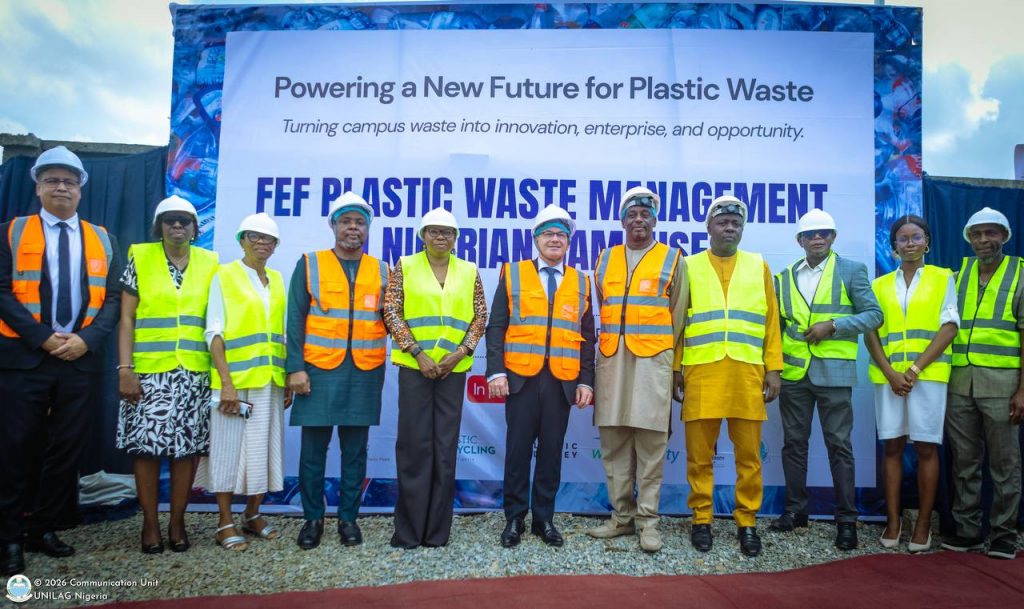
A quiet revolution in waste management just completed its three-year run across Nigeria, spearheaded by the French Embassy in Nigeria and a consortium of 13 local universities. This ambitious Plastic Waste Processing Project has not only transformed tons of discarded plastics into valuable products but has also demonstrated an annual green economy opportunity valued at nearly ₦950 million.
The initiative, generously funded by the French Government’s Fonds Équipe France (FEF 209) to the tune of €753,000 (roughly ₦1.3 billion), wrapped up its operations around July 2026, with closeout ceremonies held across Abuja.
A blueprint for a circular economy
French Ambassador to Nigeria Marc Fonbaustier, Deputy Head of Cooperation Pierre Andriamampianina, and project initiator Sebastian Bede heralded the program as a significant stride towards environmental sustainability and economic diversification for the West African nation.
This project wasn’t just about cleaning up; it was about building new value chains. The core idea centered on equipping universities with the infrastructure and knowledge to turn plastic waste into marketable goods, fostering a circular economy model. Think crushers, extruders, and injection presses – all installed on campuses to process discarded materials.
The results speak for themselves. Collectively, the participating institutions developed the capacity to recycle 3.17 metric tonnes of plastic waste daily. This means 145.2 metric tonnes of plastic have been diverted from Nigeria’s overflowing landfills and waterways, preventing further environmental damage.
But the impact stretches further than just diversion. The universities successfully converted 79.3 metric tonnes of this waste into a surprising array of products. They’re now churning out eco-bricks, paving stones, and construction materials, alongside plastic flakes, consumer goods, and even 3D-printing filament.
These tangible outputs are the bedrock of the estimated ₦949.3 million annual economic opportunity if the participating institutions operate at full capacity. Ambassador Marc Fonbaustier put it plainly: “Environmental ambition and economic opportunity are not in opposition. They are, in fact, two sides of the same coin.”
He sees Nigeria’s youthful population and growing technological capacity as perfectly positioned to leverage these opportunities in plastic recycling for broader economic growth.
Equipping the next generation of innovators
Beyond the impressive numbers, the project focused heavily on human capital development. More than 1,500 students received specialized training in recycling technologies, digital fabrication, and circular economy innovation. This isn’t just academic learning; it’s hands-on experience that could ignite a new wave of green entrepreneurs.
The initiative also had a profound social impact, integrating 275 informal waste pickers into organized recycling value chains. This formalisation offers not only better working conditions but also a pathway to economic stability for individuals often on the fringes of society. It’s a model that recognizes and empowers those already at the front lines of waste management.
Universities like the University of Lagos (UNILAG) have become beacons of this transformation. Professor Anthony Eneji, Deputy Vice-Chancellor for Research, Linkages and Collaborations at UNILAG, noted that their recycling facility alone diverts approximately five tonnes of plastic waste monthly. They’re even using recycled plastics to produce furniture, showcasing the versatility of the processed materials.
Sebastian Bede, the project’s initiator, had a clear vision for its longevity. He designed the intervention “not only to reduce plastic waste but to equip universities with the knowledge, technology and partnerships needed to sustain innovation long after completion.” This foresight means the project’s benefits will ripple through generations of students and communities.
Nigeria’s persistent battle against plastic pollution
The urgency behind this project is starkly clear when considering Nigeria’s environmental challenges. The nation ranks ninth globally in plastic pollution, a grim statistic that underlines the scale of the problem. Lagos, a mega-city of over 20 million people, contributed around 870,000 tons to the world’s 57 million tons of plastic waste in 2024 alone.
Annually, Nigeria generates an estimated 2.5 million metric tons of plastic waste, with a dismal recycling rate of less than 10%. This means the vast majority ends up in landfills, clogging drainage systems, polluting waterways, and exacerbating health and environmental crises. The environmental and economic costs are staggering.
Recognizing this, the Nigerian government introduced the National Policy on Plastic Waste Management in 2021. This policy aims to shift Nigeria from a linear “take-make-dispose” model to a circular plastic economy. It sets ambitious targets, including a 50% reduction in plastic waste generation from the 2020 baseline by 2025 and a ban on certain single-use plastics by January 2025.
Nigeria also joined the World Economic Forum’s Global Plastic Action Partnership (GPAP) in 2021, further solidifying its commitment to tackling plastic pollution. The Nigeria National Plastic Action Partnership (NPAP) launched in 2023, subsequently releasing a National Action Roadmap in 2024. These policies provide a framework, but practical interventions like the French Embassy project are crucial to their success.
Beyond the numbers: institutional challenges and opportunities
While the project’s successes are undeniable, the path to widespread adoption isn’t without hurdles. Priscilla Ibadin, Executive Director of BluerAfrica-Africa Blue and Coastal Community Development Initiative, an independent evaluator, praised the program for proving Nigerian universities’ technical capacity for environmental solutions. But she also offered a crucial caution: stronger institutional systems are needed for sustainability.
This observation touches on a deeper historical pattern in Nigeria – the struggle to translate successful pilot projects into sustained national programs. Without robust institutional support, proper funding mechanisms, and clear policy enforcement, even the most promising initiatives can falter.
The opportunity for universities to become self-sustaining economic hubs through recycling is immense; the University of Calabar has already projected recycling could become a major revenue source if expanded nationwide.
The French model, with its nearly 35-year history of Extended Producer Responsibility (EPR), offers a compelling comparison. France’s EPR program makes companies responsible for packaging waste, fostering high recycling rates and funding solutions to plastic pollution. This structured approach ensures a continuous financial and logistical commitment that Nigeria could adapt and learn from to scale its own efforts.
Pierre Andriamampianina emphasized the project’s broader impact, stating it was “an outstanding success whose impact extended far beyond its financial value, creating employment opportunities and demonstrating that plastic waste can become valuable economic resources.” This sentiment captures the essence of the initiative: proving that waste can be wealth, creating jobs, and driving green innovation.
The path ahead for Nigeria’s green economy
The successful completion of the Plastic Waste Processing Project by the French Embassy and Nigerian universities offers more than just a case study; it presents a vivid blueprint for Nigeria’s future.
It proves that with targeted investment, technological transfer, and a commitment to human capital development, the nation can transform its environmental liabilities into economic assets. The journey from a linear “take-make-dispose” model to a vibrant circular economy is complex, but this project shows it’s achievable.
This moment feels like a turning point, echoing past attempts at industrial transformation in Nigeria that sometimes stumbled under the weight of political and systemic challenges. But here, the focus on universities as incubators for practical, localized solutions could be the difference. Empowering academic institutions means empowering a generation of Nigerians who understand that a cleaner environment and a stronger economy are not mutually exclusive.
The message is clear: the green economy isn’t some distant aspiration; it’s a present-day reality offering concrete financial returns and social benefits. Nigeria has the intellect, the population, and now, a proven model to tackle its plastic waste crisis head-on, creating wealth and jobs in the process.
The question now isn’t if it can be done, but how quickly the nation can replicate this success across its vast and dynamic landscape. Embracing such initiatives could unlock further economic parity for many who’ve been marginalized.
